The Newest, Cutest Baby Animals from the World's Zoos & Aquariums

Category: Anteater

  • ,

    1 anteater

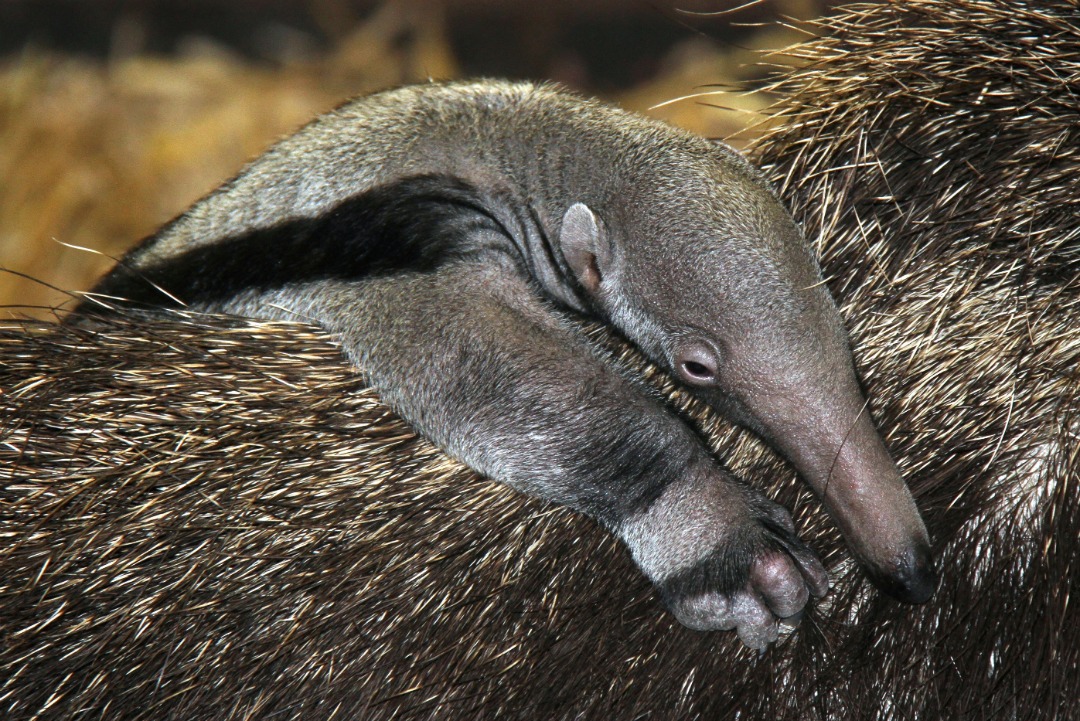
    Cleveland Metroparks Zoo is celebrating the birth of their first-ever Giant Anteater! The baby, whose sex is still undetermined, was born on exhibit on November 25 to mom, Pica, and dad, Kutter. The baby seems to be healthy and thriving. For now, animal care and veterinary staff are keeping their distance and giving mom and baby time to bond, as Pica is very protective of her newborn. (We're told it was even tricky to snap a few photos!) Now weighing about two pounds, the little Anteater will cling to mom's back for several weeks as it develops.

    The successful birth of this tricky-to-care-for species was the result of careful collaboration between the zoo's conservation and science staff. To predict the optimal time to pair Pica with Kutter, staff sampled the hormones in Pica's urine. Further hormone monitoring allowed the zoo to confirm Pica’s pregnancy and make a reasonable prediction of when the birth might take place.

    2 anteater

    3 anteaterPhoto credit: Cleveland Metropark Zoo

    The baby Anteater is a welcome addition not just to the zoo, but to the managed nationwide population of Giant Anteaters as well. The zoo participates in the Association of Zoos & Aquariums Species Survival Plan (SSP) for Giant Anteaters, which are classified as Vulnerable in the wild. SSPs are cooperative breeding and management groups for endangered or threatened species such as Black Rhinos, African Elephants, Lowland Gorillas and Amur Tigers. 

    Giant Anteaters are native to Central and South America and can eat tens of thousands of ants and termites in a single day with their long, sticky tongues. Full-grown males can measure up to 7 feet (2.13 m) long and weigh more than 100 pounds (45.36 kg). 

  • ,

    Anteater Pup - Heather Robertson

    Gabana the baby Giant Anteater is part of an exciting baby boom at the Nashville Zoo:  He is the fifth Giant Anteater to be born at the zoo in the last 13 months.

    IMG_0882 - Heather Robertson

    IMG_0922 - Heather Robertson

    IMG_0906 - Heather Robertson
    Photo Credit: Margarita WocCoburn

    Nashville Zoo has been involved in Giant Anteater conservation for 15 years and has the largest collection of Anteaters in the country.  Gabana, who was born on November 16, is the first birth for mother Dolce, who was born at Nashville Zoo in 2011. Both mother and baby are doing well and living together in the off-exhibit Giant Anteater barn.

    Giant Anteaters are solitary animals from the tropical forests of Central and South America. The International Union for Conservation of Nature lists Giant Anteaters as Vulnerable, although they are Extirpated (locally Extinct) in parts of Belize, Costa Rica, Guatemala and Uruguay.  


    Related articles

    Keepers Step In To Raise Maryland Zoo's First-ever Lion Cubs
    Anteater Pup Holds On Tight at Marwell Wildlife
    Margay Kitten Blends in with Mom at Bioparque M'Bopicuá
  • ,

    1 anteater

    Marwell Wildlife in the UK is celebrating its first successful Giant Anteater birth and you can help name the pup! The youngster was born to first-time mom Chiquita early November and weighs just three pounds. Check in here with the zoo's FaceBook page over the next few days for an opportunity to vote on your favorite name, and maybe win a family ticket to the zoo. 

    Giant Anteaters are native to South America and are listed as Vulnerable on the International Union for Conservation of Nature's Red List of Threatened Species. Females normally give birth to one baby after a gestation period of 190 days. Anteater pups cling to their mother's back or legs while they are young, and sometimes continue to do so for up to a year. The pup, still nursing for now, will begin to start eating solids at around three months old.

    2 anteater

    3 anteater

    4 anteaterPhoto credits: Marwell Wildlife

    Mother and baby are currently spending a lot of their time indoors and are enjoying the heaters in their den during the cold weather. They are difficult for visitors to see at the moment. However, animal teams are keeping an eye on the pair, and the two will move to a more visible position in a couple of weeks. 

    Shelly Parkes, collection manager at Marwell Zoo said, “We are so proud to see Chiquita carrying the baby as it hitches a ride across her back and demonstrating maternal instincts, as it’s her first pup. She seems content and we can hear the pup feeding and occasionally whistling as it talks to mum.”

    Chiquita, who is two years old, arrived at the zoo nine months ago from Warsaw. When she met the zoo's resident male Ernesto, the pair clicked. 

    Ernesto, who is nine years old, had previously been unlucky in love. Ernesto’s first mate was described to Marwell as a female but when the new mate arrived the pair didn’t mix well. On closer inspection Marwell Zoo staff realized they had been sent a male Anteater instead of a female! This is an easy mistake to make as an Anteater’s gender is notoriously difficult to determine.

    The new baby will be given a health check once Chiquita is settled and the sex of the pup will be determined when it is older.

  • ,

    Anteater Pup - Amiee Stubbs

    Nashville
    Zoo
    is happy to announce the birth of a male Giant Anteater on July 17. For the
    Zoo, the newest addition is the fourth pup born in the past 10 months. Both
    mother and baby are doing well and living together in the off-exhibit Giant
    Anteater barn.

    “We now have 15 Giant Anteaters at
    Nashville Zoo which is the largest collection in North America,” says Rick
    Schwartz, Zoo President. “While they are not currently on public display, we do
    hope to change than in the future. In the meantime, we will continue to learn
    more about this little known and threatened species both in captivity and in
    the wild.”

    Anteater Pup w Mother - Amiee Stubbs

    Edit_ASP_8676
    Photo credits: Amiee Stubbs

    Giant
    Anteaters are solitary animals from the tropical forests of Central and South
    America. The International Union for Conservation of Nature (IUCN) lists the
    Giant Anteater as vulnerable due to habitat loss and hunting. Giant Anteaters
    are considered extinct in areas of Belize, Costa Rica, Guatemala and
    Uruguay.

  • ,

    Baby giant anteater at Howletts 1 c Dave Rolfe

    Riding on mom’s back, a baby Giant
    Anteater is the latest arrival at the United Kingdom’s Howletts Wild Animal Park.

    Baby giant anteater at Howletts Wild Animal Park 2 c Dave Rolfe

    Baby giant anteater at Howletts Wild Animal Park c Dave Rolfe
    Photo Credit:  Dave Rolfe


    Joel Bunce, head of the zoo’s
    hoofstock section, said: “We were delighted with this latest arrival. It’s been
    a long time since we had a Giant Anteater birth and this little one is getting
    on really well.”

    The baby was born to female Fidgi
    and male Zet. According to zoo keepers,
    both are providing excellent care to their newborn.

    Giant Anteaters are native to South
    America and females normally give birth to one baby at a time, after a
    gestation period of 190 days. Young are carried on their mother’s back and
    they may stay with their mothers for up to two years. Giant Anteaters are listed as Vulnerable by
    the International Union for Conservation of Nature. Though their range extends from Honduras to
    Argentina, they are extirpated (regionally extinct) in some countries due to
    overhunting and habitat loss. 

    Related articles

    Giant Anteater Born at Zoo Berlin
    Two Coati Pups Surprise Zoo Budapest
    Tiny Southern Pudu Fawn Born at Detroit Zoo
  • ,

    10236_10151645225282557_1451534259_n

    Zoo Berlin welcomed a baby Giant Anteater on May 26. The baby, named Evita by her keepers, is a female. The name was chosen because "E" is the fifth letter in the alphabet, and this is mom Griseline's fifth surviving baby. Before Evita there were Adolpho, Benita, Carlos, and Danita, all born at Berlin Zoo. Evita is being hand-fed by keepers and receives three additional bottle meals per day.

    1270_10151647269732557_588242013_n

    1043928_10151654704402557_117359357_n

    Evita was just 1,570 grams, or 3.5 pounds, when she was born, but has now increased her weight to 2.5 kg, or 5.5 pounds. She's strong enough to ride on her mother's back — a behavior that is common in Giant Anteaters. Keepers, however, must keep a close eye on Evita since her coloration makes it difficult to distinguish her from her mother's fur.

    5c90d1082a

    Giant Anteaters are insectivores native to South America. As the name implies, their diets consist of ants as well as other small insects. They use their strong claws to tear open termite mounds and anthills. Since Giant Anteaters have no teeth, their two-foot-long tongues and sticky saliva help them to extract the insects.

    924dbc3f53


    02d2390141

    Photo Credit Zoo Berlin

    Related articles

    White Canadian Wolf Parents Have a Play Day with Their Five Pups
    Rare Southern Tamandua Born at Buffalo Zoo
    Tiny Southern Pudu Fawn Born at Detroit Zoo
  • ,

    IMG_5474

    A group of Southern Tamanduas was
    imported to the United States last August as part of an effort to bolster the
    population in US zoos.  A pair named
    Olive and Brutus were placed at the Buffalo Zoo.

    Not much is known about the
    reproductive behaviors of this species, but Olive and Brutus had their first
    pup on April 7.  The male baby, named Otis, is strong,
    alert and very vocal.  

    IMG_5482 (2)

    IMG_5474
    Photo Credit:  Kelly Brown

    Zoo keepers report that Olive is
    a very attentive mother and though she is protective of her baby, she is calm
    around her keepers.  Every morning, the baby can be seen
    clinging onto his mom’s back as she makes her way down to the feeding pans for
    her breakfast. He has no problem letting mom know when she is not by his side!

    Southern
    Tamanduas are native to much of South America, but they are becoming rare.  These ant- and termite-eating mammals are
    expert diggers, and are able to extract insects with their long tongues.


    Related articles

    Nashville Zoo Welcomes Eurasian Lynx
    UPDATE: Baby Tiger Gets Her Bottle at Point Defiance Zoo
    Sea Lion Pup Thriving at Prague Zoo
    Woodland Park Zoo's Trio of Jaguar Cubs Full of Personality
  • ,

    774097_522202421153050_2107681755_o

    Poland’s Warsaw Zoo is celebrating
    the birth of a baby Giant Anteater.  The
    male baby was born on January 18, and is the fourth baby for the zoo’s breeding
    pair. 

    775624_522202684486357_1037488630_o

    775103_522202381153054_1808198959_o

    774903_522202517819707_2065757504_o
    Photo credits:  Warsaw Zoo

    Female Giant Anteaters normally give
    birth to a single pup, which is born with its eyes closed.   A pup rides on its mother’s back for several
    months.  This offers not only free transportation
    for the pup, but excellent camouflage as well: 
    the pup’s black and tan color bands line up perfectly with those of the
    mother, making the pup nearly invisible against mom's shaggy coat.  By
    the time the pup is about ten months old, it is completely independent.

    Native to much of South America, Giant
    Anteaters exploit a variety of habitats, from grasslands to rain forests.  They are listed as Vulnerable by the
    International Union for Conservation of nature (IUCN), but they have been
    extirpated from parts of Uruguay, Belize, Costa Rica, and Guatemala.  In the last decade, the population of wild Giant
    Anteaters has declined by about 30%.

  • ,

    Ant 1

    A rare baby Giant Anteater was born at Chester Zoo on
    December 23. The tiny baby, whose gender is not yet known, is only the second
    of the species to ever be born at the zoo. The baby will cling to its mother’s
    back for approximately six months until it is ready to walk, explore and find
    food on its own. Parents Pedro and Bliss, both aged three, arrived in 2010 as
    part of an international breeding program.

    Team Manager David White said, “Bliss is a very good mum and
    is so far doing an excellent job of looking after her new arrival. She’s
    obviously very proud of her newborn and has, every now and again, been parading
    around and showing off to our visitors. Seeing the youngster clinging tightly to her tail is quite the sight!”

    Giant Anteaters are classed as Vulnerable to extinction by
    conservationists, so the birth is good news for the unusual looking species.
    Native to Central and South America, the animals do not have teeth but have
    tongues which can measure up to almost 24 inches (over half a meter) long!

    Ant 2

    Ant 3
    Photo Credit: Chester Zoo

    Find Giant Anteater facts just after the fold:

    (more…)

  • ,

    486933_10151320700959309_250027799_n

    Early in the morning on September 27, female Giant Anteater
    Zoe delivered a healthy baby at the Reid Park Zoo.  After allowing the first-time mom and her new
    baby to spend some quiet time together, the two are now delighting crowds while
    they are on exhibit every afternoon.

    A naming contest among zoo fans resulted in the winning name
    of Zola for the female baby. Her father’s name is Xander.

    Anteater1

    Anteater3

    Baby Giant Anteaters, called pups, are carried on
    their mothers’ backs for the first several months of life.  They become independent at around 10 months.

    Giant Anteaters are native to South America, where they live
    in a variety of habitats from grasslands to rain forests.  After breaking open ant and termite mounds
    with their huge, curved claws, they collect the insects with their long, sticky
    tongues. 

    In parts of their South American range, Giant Anteaters are
    abundant, while in other areas they have been completely eradicated.  Because of these regional extirpations, Giant
    Anteaters are listed as Vulnerable by the IUCN. 

    Photo Credit:  Reid Park Zoo