The Newest, Cutest Baby Animals from the World's Zoos & Aquariums

Category: Bronx Zoo

  • , ,

    5 Julie Larsen Maher 4881 Female Kihansi Spray Toad with Toadlet 01 27 10

    The Wildlife Conservation Society’s Bronx Zoo, the Toledo
    Zoo
    , Tanzanian government, World Bank and other partners reintroduced
    2,000 Kihansi spray toads into the Kihansi Gorge in Tanzania in October. This
    is the first example of an amphibian species that had been declared extinct in
    the wild being reintroduced into its native habitat.

    The repatriation effort marks a major milestone for a
    species declared extinct in the wild in 2009. It is the result of a 12-year
    partnership to breed the toads in captivity while its habitat was
    restored. 

    6 Julie Larsen Maher 5448 Kihansi Spray Toad BZ 12 04 12

    2. Alyssa Borek 0339 Kihansi Spray Toads in Tanzania 10 00 12


     “The WCS Bronx Zoo has been working with our partners
    for more than a decade to save the Kihansi spray toad with the ultimate goal
    of  reintroducing it back into the wild,” said Jim Breheny, Executive Vice
    President and General Director of WCS Zoos & Aquarium and Director of the
    Bronx Zoo. “The curators in the Bronx Zoo and in the Toledo Zoo – whose
    expertise allowed them to develop a successful husbandry and propagation
    program for these unique little toads – have helped to ensure the
    reintroduction of an important living component back into the Tanzanian
    ecosystem.”

    (more…)

  • ,

    Tiger1

    The Wildlife Conservation Society’s Bronx Zoo roared with
    new activity last week as three Amur Tiger cubs born in April made their public
    debut.   The cubs, one male and two
    females, are vitally important to the future of wild Tigers:  in the last 100 years, the global wild Tiger
    population has plummeted 97 percent. 
    Only about 3,200 Tigers remain in the wild, with only 1,000 breeding
    females.  Amur Tigers, also known as
    Siberian Tigers, are among the rarest big cats on Earth.

    Tiger3

    Tiger2
    Photo Credit:  Julie Larsen
    Maher

    (more…)

  • , ,

    _Julie Larsen Maher 6551 Coquerel's Sifaka and Baby MAD BZ 04 25 12

    The Wildlife Conservation Society's Bronx Zoo recently welcomed two baby lemurs, a Conquerel's Sifaka and a Collared Lemur. 

    Both babies will spend their next few weeks clinging firmly to mom's back. Coquerel’s Sifakas spend most of their time in trees and leap effortlessly, launching themselves vertically with their strong legs. Like most species of lemurs, the females are dominant, claiming the choicest food and the best sleeping and sunning spots.

    Collared lemurs use their long tails to balance when leaping through the forest canopy. Collared Lemurs live in groups of males and females but are not matriarchal like the Sifaka and many other lemurs.

    _Julie Larsen Maher 6830 Collared Lemur and Baby MAD BA 04 27 12

    Photo Credits: Julie Larsen Maher © WCS

    Video Credits: Luke Groskin © WCS

  • , ,

    Nuzzle
    The Giraffe calf born in March at the Wildlife Conservation Society’s Bronx Zoo has made her debut on the African Plains, and she's one busy girl. See her nuzzle with mom, romp around her exhibit, and interact with a surprise visitor—an interloping butterfly. You can see earlier pictures of this tall baby from our ZooBorns article on March 23.

    The calf has not yet been named. The Bronx Zoo names all of its giraffes in memory of Mr. and Mrs. James Carter, benefactors for the Carter Giraffe Building.

    Raff front

    CU
    Photo credits: Julie Larsen Maher © WCS

  • ,

    _Julie Larsen Maher 1754- Reticulated Giraffe and Calf CGB BZ 03 20 12

    A female Baringo Giraffe calf was born this month at the Wildlife Conservation Society’s Bronx Zoo. The calf was approximately 6 feet tall and over 100 pounds at birth. As an adult, she could eventually grow to 16 feet and weigh 2,600 pounds.

    Giraffes are native to grasslands, savannas, and open woodlands in central, east, and southern Africa. The Baringo, or Rothschild’s, Giraffe is found in western Kenya and eastern Uganda. While Giraffe populations are robust in many places, overall the population is decreasing. The Wildlife Conservation Society works across the globe and within the giraffe’s African range to save wildlife and wild places. WCS is working to protect giraffes in key African landscapes like Zakouma, Chad, Murchison Falls, Uganda, and in the Sahel of South Sudan.

    _Julie Larsen Maher 1790 Reticulated Giraffe and Calf CGB BZ 03 20 12

    _Julie Larsen Maher 1797 Reticulated Giraffe and Calf CGB BZ 03 20 12

    _Julie Larsen Maher 1748- Reticulated Giraffe and Calf CGB BZ 03 20 12
    Photo credits: Julie Larsen Maher © WCS

    The calf has not been named as of now. The Bronx Zoo names all of its giraffes in memory of Mr. and Mrs. James Carter, benefactors for the Carter Giraffe Building.

  • ,

    Solo

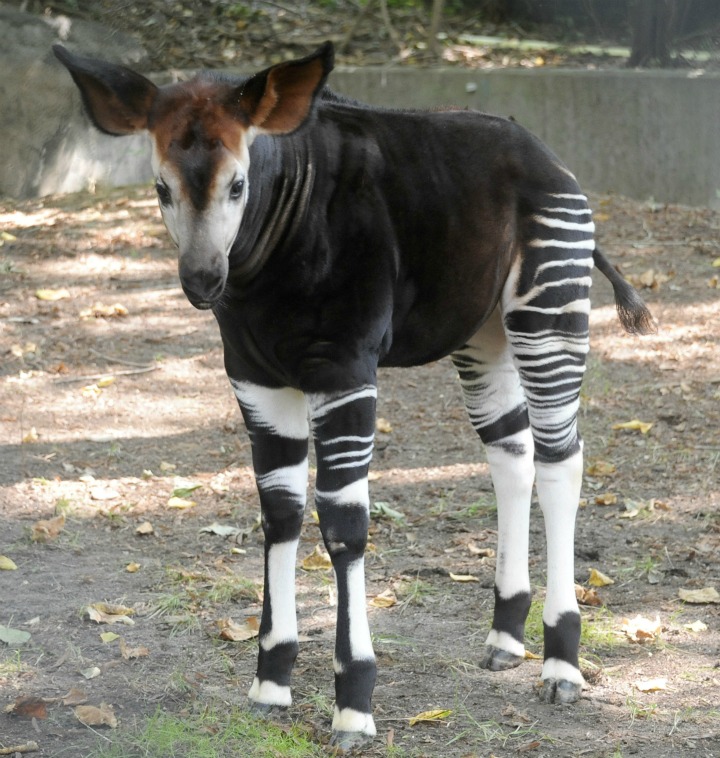
    A baby okapi was born this summer, at the Wildlife Conservation Society’s Bronx Zoo following more than a year of careful animal husbandry science by the zoo’s mammal curators. The calf, named M’bura, just made her public debut in the habitat. She'll be on exhibit intermittently as she adjusts to her sourroundings.

    Upon birth, the mother and the calf are allowed time to bond. Unlike what would be normal practice for other ungulate species, a neonatal exam is not performed and the calf is not weighed because the species is very susceptible to stress.

    Curators give the mother and calf plenty of room to encourage natural behaviors. In the wild, okapi females will leave their calves for long periods of time to feed and return only for short periods to nurse them. The female and calf spend relatively little time together.  For the first two months of its life the calf will spend about 80 percent of its time in its “nest” area. Okapi calves start sampling solid foods by three weeks of age and are usually weaned by the time they are six months old. At the Bronx Zoo, this new calf will slowly transition to a diet of leaves, alfalfa hay, specially formulated pelleted grain, and produce.

    Baby and mom

    Okapi
    Photo Credit: Julie Larsen Maher


    (more…)

  • ,

    _Julie-Larsen-Maher-5195-Reticulated-Giraffe-and-Calf-BZ-10-03-11

    Earlier this month, a Baringo giraffe calf made its public debut at the Bronx Zoo’s African Plains. Born on September 14, 2011, James Marjani is the first giraffe calf born at the Bronx Zoo since February 2009. He was approximately six feet tall at birth and estimated to weigh more than 100 pounds. As an adult, he could eventually grow to more than 17 feet and weigh close to 4,000 pounds. The baby was born to mother, Margaret Sukari, and father, James Michael. The Bronx Zoo names all of its giraffes in memory of Mr. and Mrs. James Carter, benefactors for whom the Carter Giraffe Building is named. His birth brings the total number of giraffes in the herd to eight.

    _Julie-Larsen-Maher-5229-Reticulated-Giraffe-and-Calf-BZ-10-03-11

    304125_10150336766208314_19978643313_8280298_108123263_n

    305233_10150336766608314_19978643313_8280301_1179466390_n

    293649_10150336766493314_19978643313_8280300_732780738_n
    Photo credits: Julie Larsen-Maher (c) WCS's Bronx Zoo

    (more…)

  • , ,

    Baby-titi-monkey
    A Gray Titi Monkey was born at the Bronx Zoo in April and has just now gone made it's debut on exhibit with mom. In fact, you can hear them sing together early in the morning.

    Gestation for the Bolivian gray titi monkey is about 132 days, a little over 4 months. A single baby is usually born; very rarely, twins are born.  Gray titi monkeys live in family groups, which usually consists of a breeding couple and several offspring. The father will help wtih the baby, carrying it on it's back in the first few days after birth. Older brothers or sisters may also help in this same way.

    The Wildlife Conservation Society, which owns the zoo, works in Bolivia where gray titi monkeys live in the wild. This species is endangered largely due to habitat destruction.

    Titi
    Photo by Julie Larsen Maher/WCS

  • ,

    View2

    Officials from the Wildlife Conservation Society’s Bronx Zoo announced yesterday that after a thorough seven-day search in the zoo’s Reptile House, the missing Egyptian cobra has been found inside the building. Officials made the announcement at a news conference, where they showed a photograph of the adolescent snake resting comfortably in a secure enclosure. This morning kicked off a whirlwind media tour with the yet to be named female Cobra joining the ladies of The View for a special live broadcast.

    View3

    Cobra-blog480
    Photo credit: Julie Larsen Maher / Wildlife Conservation Society

    HAPPY APRIL FOOL’S DAY!

  • ,

    _Julie-Larsen-Maher-7086-Mertens'-Water-Monitor-Hatchling-WOR-BZ-03-03-11

    A Mertens’ Water Monitor hatched from its egg last week in the World of Reptiles nursery at the Wildlife Conservation Society’s Bronx Zoo.  The hatchling measured more than eight inches from nose to tail once it freed itself from the egg, which is approximately the same size as a chicken egg. The hatchling is one of 9 siblings at the Zoo.  Mertens’ Water Monitors are a protected species native to Australia and are threatened by collection for the pet trade. WCS works around the globe to protect wildlife and wild places and stop the illegal collection of wild animals.

    _Julie-Larsen-Maher-7025-Mertens'-Water-Monitor-Hatchling-WOR-BZ-03-03-11

    _Julie-Larsen-Maher-7032-Mertens'-Water-Monitor-Hatchling-WOR-BZ-03-03-11

    _Julie-Larsen-Maher-7044-Mertens'-Water-Monitor-Hatchling-WOR-BZ-03-03-11

    _Julie-Larsen-Maher-7050-Mertens'-Water-Monitor-Hatchling-WOR-BZ-03-03-11

    _Julie-Larsen-Maher-7067-Mertens'-Water-Monitor-Hatchling-WOR-BZ-03-03-11

    _Julie-Larsen-Maher-7080-Mertens'-Water-Monitor-Hatchling-WOR-BZ-03-03-11
    Photo credits: Julie Larsen Maher © Wildlife Conservation Society