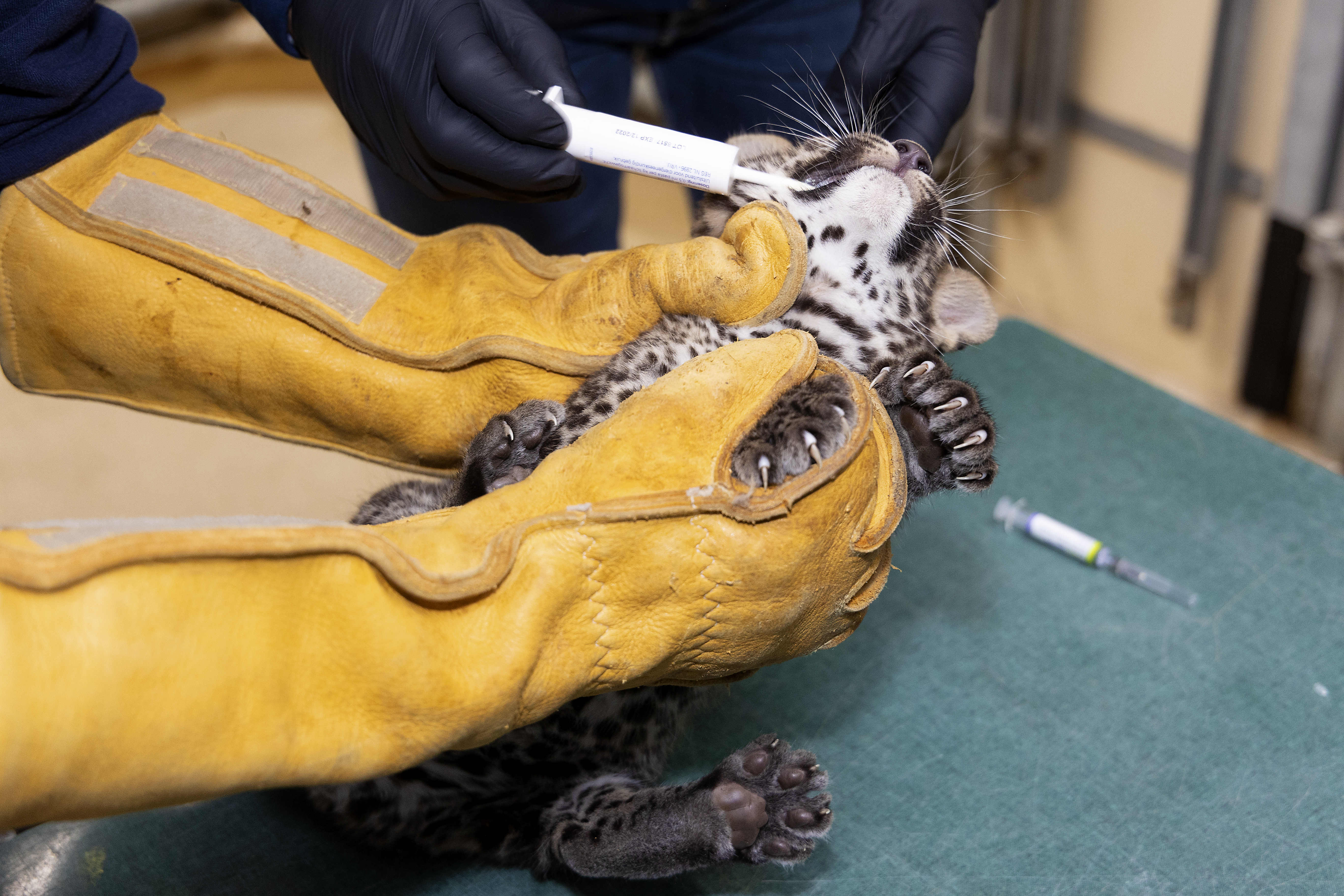
Monday morning 18 October 2021, Burgers’ Zoo veterinarian Henk Luten vaccinated a six-week-old Sri Lankan leopard against feline panleukopenia and cat flu, dewormed it and microchipped it. The leopard is a female. There are 77 Sri Lankan leopards living in zoos worldwide, 38 males and 39 females. It is estimated that between 200 and 400 leopards still exist in the wild in Sri Lanka.
The six-week-old Sri Lankan leopard was touched by human hands for the first time on Monday, 18 October. The cub will receive a second vaccination at the age of about nine weeks, after which it will be immune to feline panleukopenia and cat flu. Not long after the second vaccination, the cub will be introduced to the enclosure for the first time under the watchful eye of its mother.
A 2-week-old male cheetah cub from the Smithsonian Conservation Biology Institute in Front Royal, Virginia, was transferred to a new cheetah foster mother at Wildlife Safari in Winston, Oregon, Sunday, Oct. 3. SCBI staff were hand-raising the cub, born Sept. 16, who had been abandoned by his mother. It is important for cheetah cubs to learn species-appropriate behaviors and skills from their mothers and siblings. The SCBI cub was successfully introduced to Wildlife Safari’s cheetah foster mother, Jezebel, and integrated into her litter of four cubs.
SCBI is part of the Cheetah Breeding Center Coalition—a group of 10 cheetah breeding centers across the United States that aim to create and maintain a sustainable North American cheetah population under human care. Wildlife Safari was the next institution in the Cheetah Breeding Center Coalition to have cubs. The male cub will remain at Wildlife Safari with his new family until he is at least 2 years old.
TULSA, Okla. – A female Malayan tiger cub is doing well after being born at the Tulsa Zoo earlier this month. The announcement comes on International Tiger Day.
The cub was born on July 11, 2021, to mother, Ava, and father, Tahan, through Tulsa Zoo’s ongoing participation in the Association of Zoos & Aquariums (AZA) Malayan Tiger Species Survival Plan (SSP). This program works to ensure a sustainable population of these animals in our care. Malayan Tigers are native to the Malay Peninsula, and are the national animal of Malaysia, but there are fewer than 250 in the wild due to threats such as habitat loss and poaching.
Staff at the wildlife conservation charity say the one-week-old cubs, born on Tuesday 18 May, are doing well so far but they remain cautious at this early stage.
While the tiny triplets are being nursed by mum Dominika away from public view, visitors to the park can still spot dad Botzman who will be gradually introduced to the cubs as they grow older.
Vickie Larkin, carnivore team leader at Highland Wildlife Park said, “We are really excited about our new arrivals but the first few weeks of a cub’s life are crucial, so we are keeping public viewing closed for now to give Dominika and the youngsters lots of peace and quiet.
“The cubs’ eyes will start to open any day now and in the coming weeks they will be weighed and sexed during their first health check and named shortly after. Amur tigers grow quite quickly, increasing almost four times in size within the first month of their life, but they will remain dependent on their mum for at least 15 months. We hope visitors will start to see them out and about towards the end of July.
“Dominika is a very attentive mother and it is beautiful to see her given the chance to display these natural behaviours again.”
As well as being part of the endangered species breeding programme for Amur tigers, with Dominika giving birth to a previous litter in 2013, the charity has supported tiger conservation in Nepal by developing methods to evaluate tiger diets within the RZSS WildGenes laboratory based at Edinburgh Zoo.
Vickie continued, “There are just 500 Amur tigers remaining in the wild, so our adorable cubs represent an important contribution to the future of this endangered species which is at risk of extinction due to extensive habitat loss and poaching.”
Once the cubs are old enough for visitors, one lucky winner and their loved ones could have the chance to feed the tiger family by entering an RZSS prize draw to help raise funds for Scotland’s Wildlife Discovery Centre, a new visitor experience at the park. Entry is just £5 and closes on 31 May, with the prize valid until March 2022 – find out more at crowdfunder.co.uk/NightAtHighlandWildlifePark
Cleveland Metroparks Zoo today announced the birth of two Amur tiger cubs, the first tigers born in Cleveland in 20 years.
The cubs, a male and female, were born overnight between December 24 and December 25, and are being hand-reared by a special team of Animal Care experts behind-the-scenes at the Zoo’s Sarah Allison Steffee Center for Zoological Medicine.
Over the past few weeks, the cubs have been bottle-fed five times a day and have been gaining weight as well as reaching developmental milestones including opening their eyes and beginning to walk. Once they are a few months old, having gained adequate strength and fitness, they will make their home at the Zoo’s Rosebrough Tiger Passage.
Pippa, a female cheetah at Cango Wildlife Ranch gave birth to 5 purrrrfect cheetah cubs at the end of 2020.
Since the worldwide epidemic has threatened to close Cango Wildlife Ranch, a 35-year-old business, they were honored to receive an early Christmas present after a challenging year.
Cango says the cubs need your support; by sponsoring one of them, you are contributing towards saving an endangered species. Your funds will be used for their feed, vaccinations & maintenance of their enclosure.
On November 5, the Santa Barbara Zoo ’s African lion, Felicia, gave birth to her first cub, a female named Pauline. Pauline is a meaningful family name selected by her Premier Foster Feeder sponsors, the Mozilo family. The Mozilos also sponsor the cub’s parents, Felicia and Ralph.
On November 19, the cub became critically ill as she was not getting enough milk from her mother (and became hypothermic and hypoglycemic), so the Zoo’s animal care team made the decision to move her to the veterinary hospital for intensive care, where she has been in the incubator, receiving fluid therapy, and has been learning to nurse formula from a bottle.
“The first month of a lion cub’s life is precarious in terms of survival, particularly when born to a first-time mother,” shared Dr. Julie Barnes, the Zoo’s Vice President of Animal Care & Health. “Felicia is a young first-time mother and this situation that has occurred with her cub is not uncommon with inexperienced mothers. We are very happy to report that the cub has been responding well to treatment and is now successfully nursing from a bottle. The cub will remain in the hospital for a little longer and then she will move back to the lion holding area so that she can be in close proximity to her parents, Felicia and Ralph, but will continue to be bottle-fed until she is weaned.”
“We’re happy and relieved to know the cub has recovered and is doing well,” shared Rich Block,
President & CEO of the Santa Barbara Zoo. “I’d like to acknowledge our incredible animal care team who expertly handled the birth and the cub’s critical care needs, and continue to provide around-the-clock care for the cub. This is just the kind of warm and fuzzy news we think everybody can appreciate right now, and we look forward to introducing the new cub to everyone soon!”
The Zoo’s animal care staff were strongly suspicious Felicia was pregnant based on her physical
changes and fecal hormone analysis. Lion pregnancies are only approximately 110 days and although pregnancy can be determined by measuring hormone levels in the female's feces, this is not done until 60 days after mating due to the possibility of a pseudo-pregnancy. If the hormone levels are still elevated 60-70 days after mating, then the female is confirmed pregnant.
“We were encouraged from the very beginning to see how quickly and easily Felicia and Ralph bonded, and observed them breeding frequently as soon as they were introduced,” said Barnes. “As lion populations have been steadily declining in the wild, we’re proud to be a part of the conservation efforts of these majestic animals and to know that these lions are a successful breeding pair.”
This is the first cub for both Felicia (two years old) and Ralph (five years old), who arrived at the Zoo this past May. The Association of Zoos and Aquariums (AZA) recommended the pairing of Felicia and Ralph as part of its Species Survival Plan to maintain a sustainable population of lions in North America. As part of the AZA’s cooperative breeding program, the Zoo started the planning process to bring in new lions even before the passing of longtime beloved lion, Chadwick, in December of 2019.
Felicia and the cub will remain behind the scenes for approximately eight weeks before making their official public debut. The Zoo will share viewing information as soon as it becomes available, but in the meantime, the public is encouraged to tune in to the Zoo’s social media channels ( Facebook , Instagram , and Twitter ) for updates.
Support the pride! The public is invited to help welcome the new lion cub by becoming a Foster Feeder sponsor of the African lion. New Foster Feeders at all levels will receive a personalized digital Foster Feeder certificate (includes honoree’s name and lion photo), and recognition on the Foster Feeder board at the Zoo. Various donation levels are available on the website with different, wild benefits! For more information or to become a Foster Feeder, click here: https://sbzoo.pivvit.com/african-lion
About African Lions
African lions are the second largest big cat after tigers and are the only truly social cats. In the wild, they live in groups called prides, which consist of six to seven lions on average. All females in a pride are typically related, and outsiders of either gender are not tolerated. Listed as “vulnerable” by the International Union for Conservation of Nature , their population is steadily decreasing in the wild. In just two decades, populations decreased by 43 percent, and it’s estimated that as few as 23,000 remain today. Threats to lions include habitat loss, poaching, and retaliation killings by farmers attempting to protect their livestock. One of the main causes is the alarming rate at which they are losing their habitats due to expanding human populations and the resulting growth of agriculture, settlements, and roads.
About The Santa Barbara Zoo
The Santa Barbara Zoo is open with limited capacity. Online ticket reservations are required for all guests, including Zoo Members, available at http://www.sbzoo.org . Known as one of the world’s most beautiful zoos, the Santa Barbara Zoo is located on 30 acres of botanic gardens and is home to more than 500 individual animals in open, naturalistic habitats. The Santa Barbara Zoo is accredited by the Association of Zoos & Aquariums (AZA), representing the highest level of animal care, and participates in AZA endangered species programs for Masai giraffe, California condor, island fox, and Western lowland gorilla, among others. As a private 501(c)(3) nonprofit corporation, the Santa Barbara Zoo depends on community support, not tax dollars, for operations and improvements. Visit sbzoo.org .
On Thursday, 26 November 2020, at around 19:30, a lioness at Royal Burgers' Zoo gave birth to triplets.
The first days of life are often critical for large predators, which is why Burgers' Zoo initially provided the animals with as much peace, quiet and space as possible to ensure minimal disturbance.
Arnhem's pride has one adult male and two adult females. One of the lionesses gave birth to twins on 27 July 2020: a male and a female. With the birth of the triplets on 26 November 2020, there will soon be five lion cubs on display at Burgers' Zoo. However, the three newcomers will spend the next few weeks behind the scenes in a separate enclosure with their mother.
Even an iconic predator such as the lion, with few natural enemies other than humans, is becoming less and less common on the African savannahs. Loss of habitat, illegal hunting for trophies or traditional medicine, and human-animal conflict are taking their toll: the number of lions in the wild is drastically decreasing.
Rescued mountain lion UPDATE: Oakland Zoo vet staff treated "Captain Cal" and removed the dead skin from his wounded feet, then wrapped each foot in bandages to heal. This little guy is drinking formula, and getting lots of fluids and TLC. Dr. Herman and the entire veterinary staff are hopeful that he will continue to improve. We will continue to give you updates and let you know how Captain Cal is doing!