The Dallas Zoo is celebrating the birth of three adorable African lion cubs – one male and two females – born on August 17 to Bahati and Kijani. This is the first time since 1974 that the Zoo has welcomed a litter of multiple lion cubs.
The Zoo’s carnivore zoologists researched names for each cub that perfectly match their personalities and unique circumstances. The first cub, a male, will be called Izwi (IS-we), which means “vocal” in the Shona language of Zimbabwe. Izwi came into this world with a strong personality and a lot to say! The second cub, a female, has been named Ilola (ee-LOH-la), meaning “to become strong” in the Sesotho language of South Africa. Ilola has overcome significant challenges to become strong, including weeks of physical therapy to correct developmental issues in her legs. Bahati’s third cub, also female, will be called Tadala (ta-DAH-la), which means “we have been blessed” in the southeast-African Chewa language. During Bahati’s initial ultrasounds, it was clear that two cubs were developing. During the birth, the Zoo was thrilled to find three cubs instead.
“We are overjoyed to see Bahati, who was our first lion cub in 43 years, become a mother and play a crucial role in protecting her species from extinction,” said Gregg Hudson, the Dallas Zoo’s President & CEO. “These three cubs are the embodiment of resiliency, strength, and hope, which we hope can be a bright spot in our community right now.”
The Zoo’s three-year-old female lion, Bahati, delivered the three cubs via Caesarian section. Bahati was closely monitored as she went into labor, and the Zoo’s veterinary staff made the critical decision to intervene after natural labor failed to progress in a timely manner and created an unsafe situation for the cubs.
“The cubs were not positioned correctly in Bahati’s birth canal, meaning that a natural birth would likely have had a negative impact on her health as well as the cubs’,” said Harrison Edell, the Zoo’s Executive Vice President of Animal Care and Conservation. “Thanks to our veterinarians’ thorough preparation and decisive decision-making from our animal management team, all three cubs arrived without incident and are able to thrive under the close watch of our team and, of course, mom Bahati.”
Bahati remains behind the scenes with her cubs as she recovers from the C-section surgery. She exhibited curiosity early on, and even while she was resting in a different area than the cubs, she positioned herself so she could see them. The Zoo’s veterinary staff monitored and hand fed all three cubs until Bahati was ready for a reintroduction to her little ones. Bahati’s aunt, Jasiri, joined mother and cubs, modeling appropriate behaviors for Bahati and taking an active social role, just as lions would in a wild pride.
Even still, the challenges were far from over for Ilola, one of the female cubs who was born weighing less than her siblings and who had some developmental challenges.
“Developmentally, this cub found it difficult to walk, and she also had trouble maintaining her glucose level, which is vital to support healthy growth,” said Edell. “Our expert veterinary staff kept a watchful eye on her and immediately devised a plan, beginning physical therapy to help her walk correctly.”
Ilola responded well to the initial physical therapy and has made amazing strides to correct her gait. At this point, all three cubs are eating well, gaining weight, and spending time with mom.
Bahati and her cubs will remain behind the scenes in their den for another 4-6 weeks before making their official public debut. The cubs will be gradually introduced to the rest of the pride, including their grandmother Lina, as well as their father Kijani. The Zoo will share updates and the date of the cubs’ debut on its social media channels.
Three-year-old Kijani came to the Dallas Zoo in March of 2020 to breed with Bahati on a recommendation from the Association of Zoos and Aquariums’ Lion Species Survival Plan (SSP). The SSP aims to maintain a sustainable and healthy lion population, ensuring genetic diversity of animals in AZA institutions. The pair bonded quickly and soon began exhibiting breeding behaviors. Zoo staff suspected the pregnancy in April, which was later confirmed by ultrasound in June.
African lions are native to Sub-Saharan Africa, where they roam the savanna and open grasslands. Their numbers have dwindled by 50% in the last 25 years, and the species faces ongoing threats from poaching, habitat loss, and human-wildlife conflict. The Dallas Zoo is proud to support a healthy African lion population in human care through our work with the AZA’s Lion Species Survival Plan as a safeguard against extinction. These animals serve as critical ambassadors for their wild counterparts.
Dallas Zoo is thrilled to share that they have welcomed a second blue duiker calf! This male calf was born on August 15 to mom Daisy and dad Viazi. He is 0.88 pounds of pure cuteness. 💚
With only about 35 individuals living in US zoos accredited by The Association of Zoos and Aquariums, each blue duiker birth is a major win for the species! Dallas Zoo currently working hard behind the scenes to create an extensive blue duiker breeding program to bolster the genetic diversity of this population and ensure their long-term survival.
For the first time in Dallas Zoo’s 129-year history, they are proud to announce the birth of two extremely rare Somali Wild Ass foals. Born ten days apart, the little girls and their moms are doing great and have been bonding beautifully behind-the-scenes.
The first foal, named Kalila (“dearly loved” in Arabic), was born on July 9 to 13-year-old mom Liberty. This is dad, Abai, and Liberty’s third foal together; the pair previously welcomed two offspring at their former home, the St. Louis Zoo.
The second foal, named Naima (“calm” in Arabic), was born July 19 to the same dad, Abai, and first-time mom, five-year-old Hani. Just like her older half-sister, little Naima was standing, walking and nursing within minutes after birth.
“This is a big moment for our hoof stock team. Somali Wild Asses are critically endangered, with less than 600 left in the wild,” mammal curator John Fried said. “Only nine institutions in the U.S. care for this rare species, and to be able to welcome two babies is truly one of the highlights of my career.”
Photo Credits: Dallas Zoo
The Somali Wild Ass (Equus africanus somaliensis) is a subspecies of the African Wild Ass. Native to the arid regions of the Horn of Africa (Ethiopia, Somalia and Eritrea), there are many reasons the Somali Wild Asses’ numbers have dropped drastically in the wild. Locals hunt this species for food and traditional medicine. Some believe their fat treats tuberculosis. Somali Wild Asses also directly compete with livestock for limited land and water sources. Additionally, wild assess are crossbreeding with domestic asses, hurting the genetics of this species.
The Dallas Zoo is thrilled to announce the birth of the first African Lion in more than 40 years.
The female cub, named Bahati Moja, was born on March 17. Bahati Moja means “lucky one” in Swahili, a fitting name for a cub born on St. Patrick’s Day and who has overcome considerable odds to enter the world.
Photo Credit: Dallas Zoo
Bahati Moja’s mother, Lina, had previously delivered stillborn cubs. The zoo’s veterinary team assisted Lina to ensure a successful outcome, and Bahati Moja is now called a “miracle baby” by the zoo staff.
As a result of the professionalism and dedication of the keepers and veterinary staff, Bahati Moja is developing right on schedule as she bonds with Lina in the den. Keepers report that the little cub is nursing, gaining weight, and getting feisty. Mom and cub will remain behind the scenes for a few months before venturing into the Lion habitat.
African Lions (and their counterparts, Asiatic Lions) once dwelled across most of Africa, the Middle East, and the Indian subcontinent. Today, Asiatic Lions have nearly vanished from the wild, and African Lions’, once numbering in the hundreds of thousands, have dwindled to as few as 20,000 individuals. African Lions are listed as Vulnerable by the International Union for Conservation of Nature.
The Dallas Zoo welcomed a big new arrival on May 14: a male African Elephant born to Mlilo, an Elephant rescued from drought-stricken Swaziland this spring.
The calf stands about three feet tall, and his tiny trunk is just over a foot long. His ears are light pink, contrasting with his darker gray body. He weighs 175 pounds, which is on the low end of the 150- to 300-pound range for newborn African Elephants. A low birth weight isn’t surprising, given the difficult conditions his mother encountered in Swaziland during his 22-month gestation.
Photo Credit: Dallas Zoo
The calf, who isn’t yet named, is active and exploring the barn, although he doesn’t get too far from mom. He’s nursing and vocalizing as expected.
“This birth validates the critical importance of our rescue efforts and why we worked so hard to get these animals to safety as quickly as possible,” said Gregg Hudson, president and CEO of the Dallas Zoo.
The Dallas Zoo collaborated with conservation officials in Swaziland, Africa, and two other accredited U.S. facilities to provide a safe haven for 17 African Elephants. The Elephants had destroyed trees and other vegetation in the managed parks where they lived, making the land uninhabitable for more critically endangered Rhinos. Swaziland managers planned to cull the Elephants in order to focus on Rhino conservation. The zoos’ collaboration to relocate the Elephants was conceived not only to save them, but to support Swaziland’s Rhino conservation efforts.
In a complex process that lasted nearly two years, the Dallas Zoo, Omaha’s Henry Doorly Zoo and Wichita’s Sedgwick County Zoo applied for permission from the U.S. government to accept the animals. The permit was granted in January after extensive review, and a detailed move was planned for nearly two months. The Elephants were flown to the U.S. aboard a chartered 747 jet, arriving March 11, 2016.
Mlilo (pronounced “ma-LEE-lo”) arrived in Dallas showing signs of a possible pregnancy, but all tests conducted were inconclusive. Regardless, the Dallas Zoo staff was careful with the day-to-day care of Mlilo, creating positive conditions for her to have a successful birth.
“This calf will be an excellent ambassador for his species, helping us teach guests about the grave crisis facing Elephants in Africa, and inspiring them to help protect this majestic species from extinction,” Hudson said.
This is the first birth of an African Elephant calf in the United States in nearly two years.
African Elephants face many threats, ranging from human encroachment on their habitat to extreme poaching, which claims the life of nearly 100 Elephants every day.
Since 2010, three Brazilian Ocelot kittens (females “Milagre,” “Ayla,” and “Revy”) have been produced using artificial insemination (AI) techniques developed and performed by scientists from the Cincinnati Zoo’s Center for Conservation & Research of Endangered Wildlife (CREW).
All three of these genetically valuable Ocelots have gone on to produce offspring of their own as a result of natural breeding. The most recent kitten was Neto who was born to Revy at the Santa Ana Zoo in December. Revy is the last of the three AI offspring to reproduce.
Image 1: Revy as a kitten by Bill Swanson ; Images 2,3,4,8: Revy and Neto by Ethan Fisher ; Images 5,6,7: Revy and Neto by Lauren Bergh ; Images 9,10,11,12: Milagre and kitten Matteo by Shannon Calvert ; Images 13 & 14: Ayla and kitten courtesy Dallas Zoo
“Without the AI option, Milagre, Ayla and Revy – and all of their subsequent offspring – would have never existed and the long-term genetic viability of our Brazilian Ocelot population would have been further diminished as a consequence,” said Dr. Bill Swanson, CREW’s Director of Animal Research and one of the world’s authorities on breeding endangered small cats. “Only 30 Brazilian Ocelots exist in North American Zoos, and seven, or nearly one quarter of the population, were born as a direct or indirect result of AI. That’s strong evidence that biotechnology can play a major role in species conservation.”
In October of 2014, on a recommendation from the Ocelot Species Survival Plan (SSP), which makes breeding pairings based on each individual’s genetic importance to the population as a whole, Revy moved from the Cincinnati Zoo, where she was born, to the Santa Ana Zoo to breed with “Diego,” a male from Oklahoma City Zoo. Because Diego’s parents were imported from Brazil to the United States in 2006 (a process that took six years to plan & execute), Diego’s genetic lineage was considered critically important to establishing a sustainable, genetically viable population.
“Revy and Diego are both extremely valuable to the Ocelot SSP due to the multiple founder lines they represent. The fact that they are compatible and have produced a kitten through natural breeding is a significant step toward conserving this species,” said Swanson. “Our objective is to use AI when necessary to produce offspring that then can breed on their own.”
The SSP’s goal is to increase the Brazilian ocelot population in North American zoos from 30 to 125 individuals. In some cases, however, the SSP’s carefully selected breeding pairs fail to reproduce naturally, sometimes due to behavioral incompatibilities (as with Revy’s parents) or, occasionally, physical impairments (as with Milagre’s and Ayla’s mother).
CREW scientists perform many of the AI procedures with wild cats in the U.S. They focus primarily on five priority small cat species: Ocelots, Pallas’ Cats, Black-footed Cats, Sand Cats, and Fishing Cats.
Dr. Swanson has also aided in AI procedures on tigers, lions, and leopards, in the past few years. “We have become the go-to source for AI in cats, as well as rhinos and polar bears, because of CREW’s expertise and past success. All cat SSPs have pairs that are not reproducing on their own for various reasons, so we try to help out with other cat species as much as possible,” said Swanson.
In cats, AI has been used to produce offspring in 12 species (tiger, snow leopard, cheetah, clouded leopard, leopard cat, ocelot, tigrina, fishing cat, Pallas’ cat, golden cat, leopard, puma), but half of those AI births consist of only a single pregnancy. Historically, cheetahs have been most successful, with about 13 AI pregnancies produced since 1991 (but none since 2003) followed by the ocelot (with 5 pregnancies).
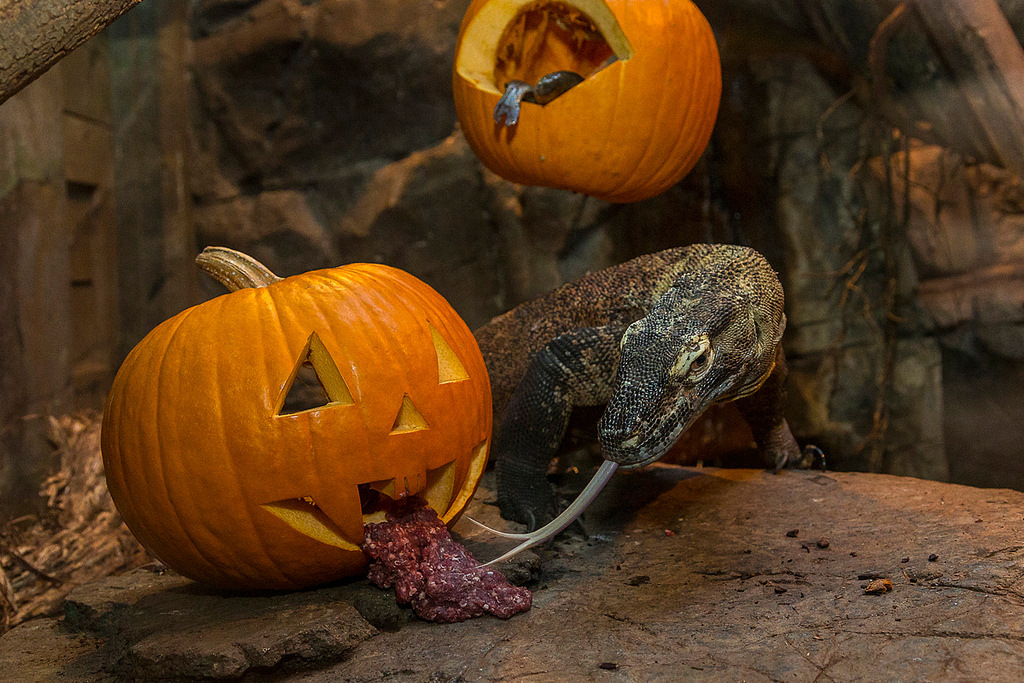
It's Halloween, and that means zoo animals around the world are enjoying encounters with pumpkins and gourds of all shapes and sizes. Animals' reactions to pumpkins vary, but critters may sniff, munch on, or completely destroy their pumpkin treats.
The pumpkins are more than a seasonal celebration – they serve as enrichment for zoo residents. Enrichment provides physical, mental, or sensory stimulation and encourages natural behaviors in animals. Happy Halloween from ZooBorns!
Photo Credits (top to bottom) Ring-tailed Lemur: Fort Wayne Children's Zoo Galapagos Tortoise: San Diego Zoo Komodo Dragon: San Diego Zoo North American River Otter: San Diego Zoo Gorilla: Paignton Zoo Asian Elephant: Oregon Zoo/Shervin Hess Sumatran Tiger: Fort Wayne Children's Zoo African Lion: Columbus Zoo & Aquarium/Grahm S. Jones Red Panda: Fort Wayne Children's Zoo Spider Monkey: Paignton Zoo Satanic Leaf-tailed Gecko: Dallas Zoo
Dallas Zoo recently welcomed their first ever clutch of Texas Horned Lizard hatchlings – 39 babies in all! Also known as “horny toads”, Texas Horned Lizards, were once quite common, but are now disappearing.
This threatened species has vanished in East and Central Texas, and is now decreasing in North Texas, too. While these babies may be only the size of a penny now, they’re helping ensure the survival of this Texas icon.
Photo Credits: Dallas Zoo
The Dallas Zoo has taken an active role in the protection of this threatened reptile. The Dallas Zoo's Texas Horned Lizard Conservation page (http://dzmconservation.wix.com/texashornedlizards#!) provides great information and resources.
Horned Lizards, also known as "horny toads", represent a unique group of lizards that inhabit the southern United States and northern Mexico. The Texas Horned Lizard, Phrynosoma cornutum, is perhaps the most recognizable species of Horned Lizard. It is the largest North American native species of Horned Lizard (Family: Phrynosomatidae) and has the widest distribution of any other Horned Lizard species in the United States.
Once extremely common, they are now in decline throughout much of their range. The Texas Horned Lizard is perhaps the most threatened member of this group, with estimated population declines of greater than 30% across its range (Texas, Oklahoma, Kansas, New Mexico, and northern Mexico) and even higher in Texas. Populations have disappeared in East and Central Texas, and are decreasing in North Texas as well.
Staff of the Dallas Zoo is studying the life history of Texas Horned Lizards at the Rolling Plains Quail Research Ranch. The Rolling Plains Quail Research Ranch is 4,700 acre preserve located in Fisher County, Texas. By collecting lizard life history data (including but not limited to population densities, habitat preferences, diet, sex ratios, activity patterns, etc.) they hope to shed valuable light on the ecology of this threatened native Texan.
A blue-eyed Ocelot kitten born a the Dallas Zoo won’t stay that way for long. As the kitten matures, its eyes will naturally turn brown. But that won’t make it any less adorable.
Born in the middle of the night on March 20, the kitten is learning its first lessons in hunting – but instead of capturing rodents, this little kitten uses its mother’s tail as its prey. Its mother, Milagre, takes it all in stride.
This is the second kitten for six-year-old Milagre. Keepers continue to give Milagre and her baby privacy, and will conduct a well-baby checkup within the next few days. The baby’s weight and gender will be determined at that time, and he or she will be given a name.
“Milagre is once again embracing motherhood tremendously,” said Lisa Van Slett, carnivore assistant supervisor. “She manages a lot with her energetic newborn and makes it took effortless.”
Ocelots are found throughout much of South America, Central America, and Mexico, with Texas at the far northern edge of their range. Fewer than 50 wild Ocelots are thought to survive in Texas, and they face severe threats from human encroachment in their native habitat.
“Their territory used to cover all of Texas, and now it’s rare to find one in the wild,” said Van Slett.
Milagre will remain the sole caretaker of her kitten, since Ocelots are solitary by nature. The two are expected to venture out to the Ocelot habitat soon. That’s also when the kitten will meet its neighbors – dad Joaquin and Rufus, a bobcat – for the first time.
Joaquin and Milagre were paired by the Association of Zoos and Aquariums’ Ocelot Species Survival Plan (SSP) in 2011. As a member of the SSP, the Dallas Zoo works with other zoological parks to ensure that the Ocelot gene pool remains healthy and genetically sound.