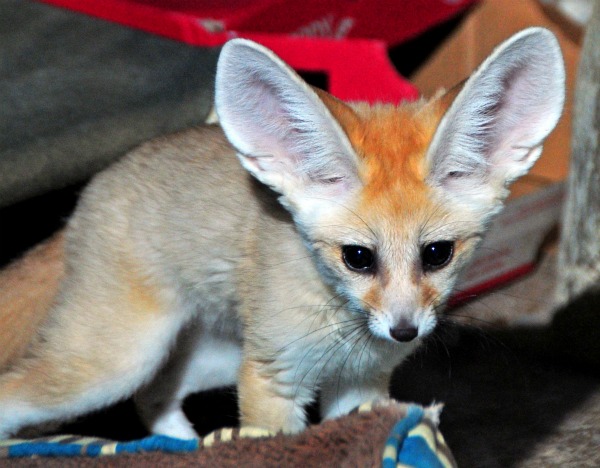
Meet Lulu and Roscoe, the Milwaukee County Zoo's newest Fennec Fox kits. Born January 27th, the cubs recently made their public debut accompanied by mom, Daisy, and father, Duke. Fennec foxes' oversized ears act like natural air conditioners, radiating heat away from their bodies and cooling their blood in the light desert breeze. Their ears also help detect tasty prey at night, including small insects scurrying nearly-silently atop the sand.
Keepers describe the kits as very playful, enjoying their toys and rough-housing with each other.
Photo credits: Secret World Wildlife Rescue Center
An unsuspecting dog walker heard the tiny screams of this newborn Fox cub from within a thorny bramble bush in Weston-super-Mare, England and immediately notified Secret World Wildlife Rescue Center. Center Manager Sara Cowen was able to extract the tiny Fox from the thorn covered fox hole and rush him to an incubator on site. It is suspected that the cub's mother had to make a hasty escape from her den, leaving vulnerable Pedro behind. Cowen said, "He would almost certainly have died if we hadn’t found him so soon." Pedro is the smallest Fox ever to come into Secret World's care.
Five Bat-eared fox kits – 4 males and 1 female – were born on May 4 in their den at the Oklahoma City Zoo. This was the first offspring for both of their parents and the first litter of bat-eared foxes born at the Zoo since 2005. The kits weigh approximately one to two pounds each.
Bat-eared foxes are primarily nocturnal and the kits are still spending the majority of their time inside the den and out of sight. Lucky Zoo visitors might catch them scurrying about their yard in the early morning or late evening hours as they start to get older and more active.
Bat-eared foxes can grow to be about 2 feet long and can weigh anywhere from six to 12 pounds. They are a sandy brown color with darker markings on their ears, nose, feet and tails. Their feet have claws perfectly suited for digging, whether going after a tasty insect or hollowing out a cozy burrow.
Photo Credit: Jaimee Flinchbaugh
In the wild, Bat-eared foxes live in the dry savannas and brush of eastern and southern Africa and are easily recognized by their huge 5-inch ears. These large lobes serve multiple purposes – they are full of blood vessels that help disperse heat and keep the fox cool, and they give them acute hearing for listening for their primary diet of insects. They can even hear the underground movement of a termite or beetle larvae!
The Aquarium of the Pacific has welcomed two male six-week-old Arctic Fox pups that are now on view in the Aquarium’s Molina Animal Care Center. The two brothers are part of the Aquarium of the Pacific’s new Arctic & Antarctic: Our Polar Regions in Peril exhibition, which gives the public the opportunity to see polar animals up close while learning about what can be done to protect their habitats.
Photo credits: Aquarium of the Pacific
Arctic fox babies are called either pups or kits. A litter usually has about seven kits but may contain up to fifteen. The Arctic fox is an incredibly resilient animal that can live in temperatures as low as -59° F and as warm as temperatures we experience in Southern California. They are found in the Arctic and alpine tundra regions, from coastal Alaska and Greenland to Scandinavia and Russia.
Photographer Sean Gordon took some outstanding photographs of Edmonton Valley Zoo’s young Arctic fox pups last Tuesday. In the wild, Arctic fox litters typically comprise five to eight babies, although reports of as many as 25 kits in a single litter have been recorded. That would make for one massive puppy pile-on!
Last Friday, lensmen A.J. Haverkamp shot some great images of Zoo Duisburg's baby Arctic foxes. These canids are specially adapted for life in the frigid arctic with thick fur, a compact form, and a special circulation system in their paws. They also have keen hearing, which allows them to precisely locate prey beneath a layer of snow pack. They hunt by diving down beneath the snow and often emerge victorious!
The Everland Zoo in Seoul, Korea is always full of surprises. This time, it's a pair of Bat-eared Fox pups photographed just days ago by In Cherl Kim. Bat-eared Foxes are mostly nocturnal animals that live in small groups
consisting of mated pairs and their young. The pairs live in dens and
typically raise two to five pups together. Mated pairs are very social
and are monogamous, although it is
unknown if they mate for life.
Red fox cubs apparently beget even more red fox cubs! The British Wildlife Centre in Surrey, England educates people about Britain's native wildlife and promotes conservation. These baby red foxes were born in March at the Centre and the pictures were taken April 5th.
An older cub from 2009 tolerates some attention below:
While ZooBorns typically focuses on zoos and aquariums, we couldn’t help but share the work of a few of the UK’s wild red fox rehabilitation centers. The first one to catch our eye was the Fox Project, which educates the public about foxes and operates a wildlife hospital that takes in around 600 casualty foxes per year including 250 cubs. In March they took in five tiny fox cubs found squealing within a trash bag. The rescuer originally brought them to the RSPCA having mistaken them for dogs.
Cubs are rehabbed back to the wild when they are around five months old after graduating from a “wilding-up” program. Results are successful in most cases.
The organization also runs a fox deterrence consultancy that assists people who have problems – actual and perceived – with foxes. The Fox Project believes that this is their most important and beneficial program as it offers an alternative to unnecessary destruction of foxes where deterrent methods are possible – which is nearly always.
Photos courtesy of The Fox Project
Another organization that got our attention was Wildlife Aid, which operates a 24 emergency line in the UK to facilitate the rescue of a wide variety of wild animals, including little fox cubs. Their most recent arrival, “Bad Attitude” or “B.A.” for short, is shown in the video below.
OK… one more… Milly, Molly and Mandy at 5 days old.
Meet the Calgary Zoo’s four newest little swift fox cubs born to father Beren and mother Foxy Cleopatra (yeah, you read that right) on April 22nd. Swift foxes were hunted to extinction within Canada in the 1930s but have slowly recovered from isolated populations in the United States with the help of reintroduction efforts. Today swift foxes are threatened by habitat destruction and fragmentation from natural resource exploitation in their remote prairie homelands.


 Photo credits: Milwaukee County Zoo