The Newest, Cutest Baby Animals from the World's Zoos & Aquariums

Category: Frogs & Toads

  • ,

    Cinammon frog Nyctixalus pictus (8)

    Rare frogs found in the forests of South East Asia have bred for the first time at Chester Zoo. The 43 Cinnamon Frogs are the only amphibians of their kind to hatch in any zoo in the world in nearly two years. 

    Cinammon frog in metamorph (3)

    Cinammon frog_juvenille (7)

    Cinammon frog_juvenille (9)Photo Credits: Steve Rawlins/Chester Zoo

    Team manager of lower vertebrates and invertebrates for Chester Zoo, Ben Baker, said, “It’s really exciting that we have bred these unusual and very sensitive frogs, especially as we’re the first zoo in Europe to ever do so. 

    “Cinnamon Frogs are a secretive species and live in a very, very specialized environment. Their ideal habitat is incredibly limited and so, as with many frog species around the world, they are extremely fragile. Currently they are listed as near threatened by the International Union for the Conservation of Nature (IUCN), but with population sizes decreasing due to widespread habitat loss; the species is likely to become threatened in the near future. 

    “Relatively little is actually known about the Cinnamon Frog, and so we now hope to learn a lot from our new arrivals. The delicate work the team has put in to getting these beautiful but complex animals to breed and all of the intensive care we’re now giving them will help us to build up our knowledge base. This kind of information can be invaluable for the long-term protection of the species.”

    (more…)

  • ,

    1 frog

    Check out this young Blue Dart Frog morphing from a tadpole to a froglet at Smithsonian's National Zoo! It takes about 80 days to go from fertilized egg, to tadpole, to fully-formed tiny frog.

    Poison Dart Frogs are native to Central and South America. In the wild, the blue frog secretes poison from its skin due to chemicals from its diet. But at the zoo, without rainforest ants to eat, this bright blue frog is harmless. Visitors can see froglet and its family on exhibit at the zoo.

    Frog 1

    2 frog

    3 frog

    4 frog

    Photo credit: Justin Graves / Smithsonian's National Zoo 

    Blue Dart Frogs are found in a few isolated 'islands' of forest in the savanna of southern Suriname. Because their habitat is so difficult to reach, there is little data to tell us whether their population is in decline. Some species of Dart Frogs are Threatened or Endangered, and Blue Dart Frogs are certainly at risk as a result of their small ranges.

    Did you know that worldwide, over 32% of amphibians are listed as globally endangered, and almost half of all known amphibian species are declining? 

  • ,

    Milky Tree Frog_Froglet Stage1

    On March 12, an amazing transformation took place at Omaha’s Henry
    Doorly Zoo
    :  a Milky Tree Frog tadpole
    became a froglet, one more important stage on its journey to becoming an adult Frog.  The metamorphosis from tadpole to
    juvenile took about three weeks to complete.

    Milky Tree Frog_Froglet Stage2

    Milky Tree Frog_Adult Stage1

    Milky Tree Frog_Adult Stage2
    Photo Credit:  Omaha’s Henry
    Doorly Zoo.

    Milky Tree Frogs are also known as Amazon Milk Frogs, Mission Golden-Eyed Tree Frogs or Blue Milk Frogs.  They inhabit tropical rain forests in the
    Amazon basin, and dwell entirely in the forest canopy.  This is not all that unusual, except most
    Tree Frogs are rather small.  The Milky
    Tree Frog, however, grows up to four inches (10 cm) long – big enough to dine on pinky mice at the zoo.

    The “milk” in this Frog’s name comes from the poisonous, milk-colored
    fluid they secrete when stressed. The photos above show the froglet (top two photos) and adult (bottom two photos).

    Related articles

    Otter Pup Trio Makes a Splash at Oakland Zoo
    Phoenix Zoo Receives Unexpected Fuzzball
  • ,

    Frog coin 2

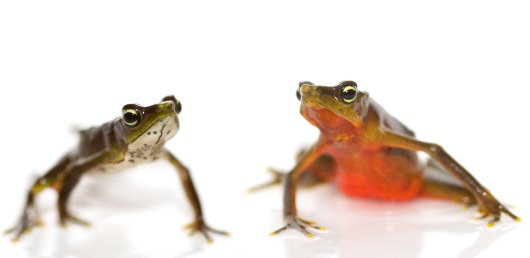
    The Limosa Harlequin Frog (Atelopus limosus), an endangered species native to Panama, now has a new lease on life. The Panama Amphibian Rescue and Conservation Project is successfully breeding the chevron-patterned form of the species in captivity for the first time. The rescue project is raising nine healthy frogs from one mating pair and hundreds of tadpoles from another pair.

    “These frogs represent the last hope for their species,” said Brian Gratwicke, international coordinator for the project and a research biologist at the Smithsonian Conservation Biology Institute, one of six project partners. “This new generation is hugely inspiring to us as we work to conserve and care for this species and others.”
    Nearly one-third of the world’s amphibian species are at risk of extinction. The rescue project aims to save priority species of frogs in Panama, one of the world’s last strongholds for amphibian biodiversity. While the global amphibian crisis is the result of habitat loss, climate change and pollution, a fungal disease, chytridiomycosis, is likely responsible for as many as 94 of 120 frog species disappearing since 1980.

    Frog duo
    Frog piggyback

    Frog on leaf
    Photo Credit: Brian Gratwicke, Smithsonian Conservation Biology Institute

    See more pictures and read much more about these frogs, and the great efforts to preserve their species, after the fold:

    (more…)

  • ,

    Frog hero

    For the first time ever, Archey's Frogs have been successfully bred in captivity. Aukland Zoo is the only facility in the world to keep this critically endangered New Zealand species. 

    Laid in October, the eggs hatched in early December. Twice before, other facilities had attempted to breed Archey's Frogs from wild-caught individuals, but the young did not survive to adulthood. Aukland Zoo now has seven healthy young frogs, bred from their own long-term captive population. 

    Frog 2

    Frog 3
    Photo credit: Aukland Zoo

    Watch Archey's Frogs wiggle their way through different developmental stages:
      

    What makes Archey's Frogs unique? Read more after the fold.

    (more…)

  • , ,

    5 Julie Larsen Maher 4881 Female Kihansi Spray Toad with Toadlet 01 27 10

    The Wildlife Conservation Society’s Bronx Zoo, the Toledo
    Zoo
    , Tanzanian government, World Bank and other partners reintroduced
    2,000 Kihansi spray toads into the Kihansi Gorge in Tanzania in October. This
    is the first example of an amphibian species that had been declared extinct in
    the wild being reintroduced into its native habitat.

    The repatriation effort marks a major milestone for a
    species declared extinct in the wild in 2009. It is the result of a 12-year
    partnership to breed the toads in captivity while its habitat was
    restored. 

    6 Julie Larsen Maher 5448 Kihansi Spray Toad BZ 12 04 12

    2. Alyssa Borek 0339 Kihansi Spray Toads in Tanzania 10 00 12


     “The WCS Bronx Zoo has been working with our partners
    for more than a decade to save the Kihansi spray toad with the ultimate goal
    of  reintroducing it back into the wild,” said Jim Breheny, Executive Vice
    President and General Director of WCS Zoos & Aquarium and Director of the
    Bronx Zoo. “The curators in the Bronx Zoo and in the Toledo Zoo – whose
    expertise allowed them to develop a successful husbandry and propagation
    program for these unique little toads – have helped to ensure the
    reintroduction of an important living component back into the Tanzanian
    ecosystem.”
    (more…)

  • ,

    Tadpoles

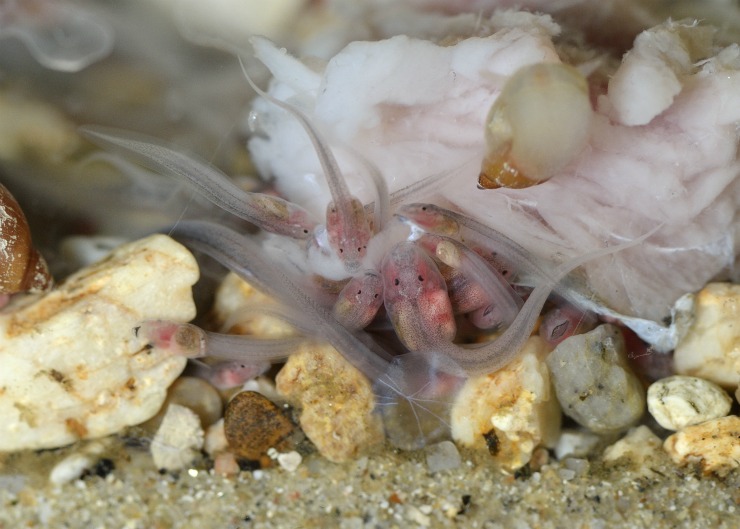
    These tiny tadpoles are a huge sensation at Schönbrunn Zoo, the first zoo to have succeeded in the breeding these food flagging frogs native to Borneo. Congratulations come from Professor Walter Hödl of the University of Vienna, one of the most renowned international amphibian specialists, saying: “This is the first breeding program world-wide!”
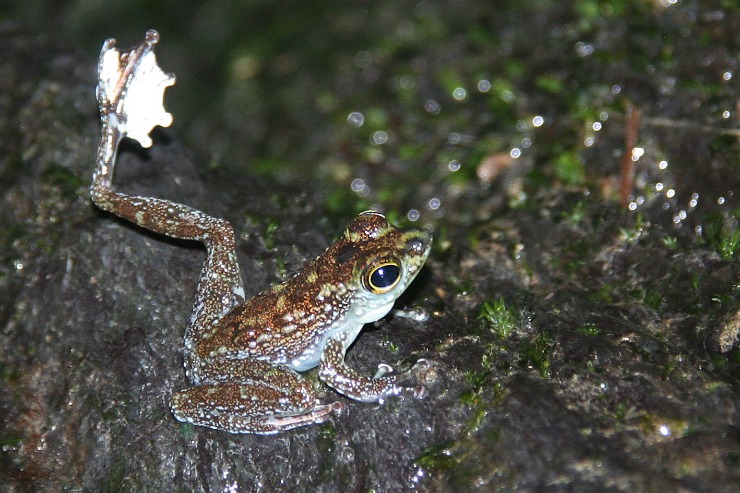
    Food flagging frogs owe their name to the fact that they communicate by waving to each other. This habit comes from their adapting to their natural surroundings, as they live by roaring streams and waterfalls. In order to attract their fellows’ attention, they not only call but they also wave their hind legs. By doing this, they spread the coloured webs between their toes to emphasise their signals.

    Wave

    3 tads

    Photo Credit: Photo 1 and 3 Schönbrunn Zoo/Norbert Potensky, Photo 2: Doris Preininger

    (more…)

  • ,

    Frog face

    Northwest Trek Wildlife Park in Washington just helped release over 1,200 endangered Oregon spotted frogs into the wild! They reared some of the endangered frogs from tiny tadpoles to full-fledged frogs, giving them a head start on survival. 

    The native amphibian has lost ground to habitat loss from draining and development, disease and the introduction of invasive species such as the American bullfrog, and have been decimated by 80-90%. 

    Oregon spotted frogs are highly aquatic.They are found in or near permanent still water such as lakes, ponds, springs, marshes and the grassy margins of slow-moving streams.

    Before the frogs were released into the wild on October 7, each was weighed and measured at Northwest Trek. The frogs were released in the Dailman Lake area at Fort Lewis. The protected site contains one of the largest relatively intact wetlands remaining in the Puget Lowlands. State biologists will be able to track the Oregon spotted frogs using their ID tags. Their life expectancy in the wild is approximately 5-8 years.

    Frog babies

    Measuring

    A frog in hand...

    Release 2
    Photo Credit: Northwest Trek Wildlife Park


  • A. limosus (lowland) 3

    Amphibian populations worldwide are in crisis. A mysterious but far-reaching fungal disease has spread globally and threatens to kill off entire species. Thankfully, organizations like the Smithsonian Institution are doing their part to help. These endangered Limosa Harlequin Frogs, which are technically toads, were bred as part of the Panama Amphibian Rescue and Conservation Project. The project aims to build an ark to house priority rescue species and find a cure so that one day our assurance populations can be put back in the wild.

    The Panama Amphibian Rescue and Conservation Project is a joint project between the Smithsonian Institution, Defenders of Wildlife, Zoo New England, Cheyenne Mountain Zoo, Houston Zoo, El Valle Amphibian Conservation Center, Africam Safari, ANAM and the Summit Zoo (in Panama). Learn more and find out how you can help on their website http://amphibianrescue.org or show your support on their Facebook page today!

    Atelopus limosus lowland juvenile 1

    Atelopus limosus baby 2Photo credits: Brian Gratwicke, Smithsonian Conservation Biology Institute

  • , ,

    The Bronx Zoo has just unveiled what is sure to be a major-miniature attraction and an essential piece of conservation to boot – Kihansi Spray Toads! When Tanzania built a massive hydroelectric dam in the Kihansi Gorge, this tiny toad lost 90% of its habitat. True to their name, Kihansi Spray Toads required the mist generated by water crashing through the gorge to keep their skin moist. When the heavy water was reduced to a trickle, the spray dried up. 

    Baby kihansi spray toad 1a rs 

    Luckily, researchers from the Wildlife Conservation Society's Bronx Zoo were on hand to collect an "assurance colony" of 499 toads. Over the last nine years these researchers have figured out how to keep the little toads comfortable and, more importantly, how to encourage them to produce baby toads! The eensy-teensy-tiny results can be enjoyed below!

    Baby kihansi spray toad 3 rs 

    Baby kihansi spray toad 1 rs 

    Baby kihansi spray toad 4 rs Photo credits: Julie Larsen Maher / WCS

    If you live anywhere near New York or were looking for an excuse to make the trip, the Kihasa Spray Toad exhibit is reason enough. Learn more by clicking "continue reading" below.

    (more…)