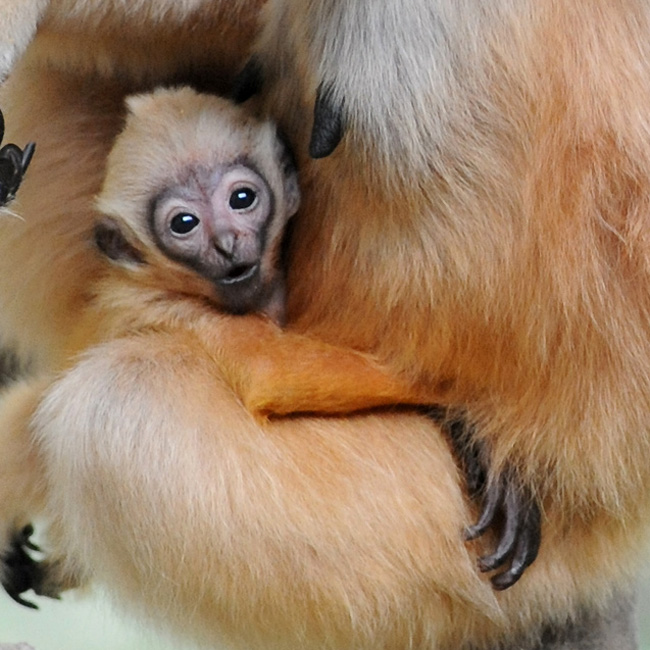
The Newest, Cutest Baby Animals from the World's Zoos & Aquariums

Category: Gibbon

  • ,

    PerthZooOwaGibbon69daysAug282014_8

    A rare Javan Gibbon has survived the first few months of life, all thanks to the round-the-clock care and attention provided by the staff at Perth Zoo, Western Australia.

    PerthZooOwaGibbon69daysAug282014_7

    PerthZooOwaGibbon41daysJul242014_1

    PerthZooOwaGibbon62daysAug212014_6Photo Credits: Perth Zoo

    The little male Javan Gibbon, named ‘Owa’ (Indonesian for ‘gibbon’), was born on June 20th, and has had to be reared by Perth Zoo keepers. Six days after his birth, it became evident that his mother, ‘Hecla’, wasn’t producing enough milk to sustain her infant.

    Primate Supervisor, Holly Thompson, said, “It is difficult to rear a primate and introduce it back to its family, so it’s not something we took on lightly. However, Perth Zoo has an exceptionally good track record in this area.  We’ve successfully hand-reared four White-Cheeked Gibbons, but Owa is our first Javan Gibbon!”

    According to Holly, life in her department has become a blur of nappies, milk formula and sleepless nights. Their department now features a portacot, and has been essentially turned into a temporary nursery. However, Thompson emphasizes, “It’s certainly a labor of love!”

    Currently weighing in at a healthy 860g (1.9 lbs), Owa receives six bottle feeds a day and has just started enjoying mashed fruit and vegetables.

    The infant Javan Gibbon visits his mother and father, ‘Jury’, and four-year-old sister, ‘Sunda’, at least twice a day. The group is very interested and protective of him, and it’s anticipated that he will return to his family once he is old enough to be weaned off his milk feeds.

    Owa is Hecla’s tenth offspring. Hecla and her mate, Jury, are the world’s most successful breeding pair of Javan Gibbons. Perth Zoo is responsible for the coordination of the Studbook for this unique species, which involves updating the international studbook for Javan Gibbons and advising on suitable breeding and genetics for this species throughout Australasia.

    See more great pics and learn more, below the fold!

    (more…)

  • ,

    1 gibbon

    A warm welcome to the newest White-handed Gibbon born at Mississippi's Jackson Zoo! The baby is a little female named Jari, an Indonesian word meaning 'fingers'. She was born on November 22 to  mom Mia and father Cookie-Man, and weighed 1.3 pounds (.6 kg) at birth.

    The infant is being hand-raised by veterinary staff due to complications and an unreliable parenting history. Animal care staff feel this is the best way to ensure that the little baby will grow up healthy and safely. The newborn is now under the constant care of veterinary technician Donna Todd.  She is being fed half an ounce of formula every 2 to 3 hours, 24 hours a day.  Visitors can see the new White-handed Gibbon weekdays at the 11:00 a.m. feeding at the Vet Hospital nursery window.

    2 gibbon

    3 gibbon

    4 gibbon Photo credit: Jackson Zoo / Chris Todd

    The Jackson Zoo houses a breeding pair of White-handed Gibbons as part of the Species Survival Plan (SSP). An SSP is a cooperative breeding program between zoos accredited by the Association of Zoos and Aquariums. The programs help to coordinate breeding between zoos to keep the captive population healthy and genetically diverse. This management is especially vital for the conservation of species that are threatened in the wild. 

    White-handed Gibbons are listed as Endangered by the International Union for Conservation of Nature. Living in the evergreen forests of Indonesia and Malaysia, the White-handed Gibbon eats mainly fruits and leaves. Because they consume both the fruit and the seeds, these small apes are important seed dispersers, with some plant species relying solely on the Gibbon for dispersal. Currently, the main threats to the wild Gibbon population is hunting and habitat loss. 

  • ,

    1 gibbon

    The Gibbon Conservation Center in southern California just shared with us some photos of a newly-arrived Northern White-cheeked Gibbon! The buff colored gibbon holding the baby is the mother and the dark one is the father. Babies are born with light-colored hair, which will darken with maturity if the gibbon is male.

    The center has welcomed six new infants in the last 18 months, a sure sign that the residents are comfortable and well cared-for. The gibbons live in family groups, adults and offspring, giving visitors the opportunity to observe family-oriented behavioral patterns, infant care and development. Though in captivity, these creatures are not tame: they are focused on their families, claiming their territories and on finding the food that is provided for them several times a day. 

    2 gibbon

    3 gibbon

    4 gibbon

    5 gibbonPhoto credits: Gibbon Conservation Center

    The Gibbon Conservation Center focuses on the study and conservation of gibbons – small apes from the forests of South, East, and Southeast Asia. The center participates in the Species Survival Plan for Northern White-cheeked Gibbons, a captive breeding program that coordinates breeding of genetically diverse individuals between zoos. The Northern White-cheeked Gibbon is now extinct in southern Yunnan, China and is nearly extinct in northern Vietnam, and Critically Endangered in Laos. There are more Northern White-cheeked Gibbons in North American and European zoos than in the wild in China and northern Vietnam, where fewer than 500 are left. This gibbon species is the rarest primate in the wild currently in a successful captive breeding program.

    See more photos after the fold!

    (more…)

  • ,

    1045052_10151783854693833_1190249297_n

    A rare Javan Gibbon baby at the Greensboro Science Center
    celebrated his two-month birthday last week, thanks to the dedicated efforts of
    staff and volunteers. 

    1045116_10151783854813833_1239670937_n

    1045066_10151783854958833_901474874_n

    580178_10151783851988833_217774777_n
    Photo Credit:  Greensboro Science Center

    Born on April 29, the infant Gibbon was discovered abandoned
    by his mother, Isabella, as described in an earlier Zooborns
    post
    .  Despite attempts to reunite
    mother and baby, staff and volunteers have been hand-rearing the baby 24 hours a day.

    Because baby Gibbons cling to their mothers day and night,
    zoo keepers wear a special furry vest to allow the male baby, named Duke, to
    cling to them.  Duke receives formula
    from a bottle.  Zoo keepers spend the
    night with Duke so he is never alone.

    Zoo keepers bring Duke to see his mother, and, although they
    are separated by a fence, the two vocalize and touch each other.  The zoo staff plans to reunite the Gibbon
    family within a few months.

    Javan Gibbons are endangered on the island of Java in
    Indonesia, their only wild home.  Only
    about 4,000 of these apes, also called Silvery Gibbons, remain in the
    wild.  Their forest habitat is under
    intense pressure from the island’s burgeoning human population. 

    See more pictures of Duke below the fold.

    (more…)

  • ,

    8730706784_ac99e20d3c_o

    On April 29, Isabella, the Greensboro Science Center’s (GSC)
    rare and endangered Javan Gibbon, gave birth to a baby boy. In both the wild and
    in zoos, it’s not unusual for first-time mother Gibbons to abandon their first
    child, and that’s exactly what happened to the fragile newborn, who was discovered
    alone in the Gibbon habitat. Thanks to the expert care of zoo keepers,
    veterinarians, and the staff of a local hospital, the baby, named Duke, was
    revived and stabilized. To give Duke the
    best chance of survival, zoo staffers decided to hand-rear the baby for the
    next six months until he is self-sustaining, then try to reintroduce him to his
    parents, Isabella and Leon, in the exhibit.

    The compelling story of Duke’s first few hours of life and
    the days immediately following his discovery are detailed below.

    8730700996_c63014fd74_o

    8730703900_78de5822a8_o

    8729586127_6758d5aa28_o
    Photo Credit:  Greensboro Science Center


    In the early morning of April 29, a zoo keeper discovered a
    tiny, full-term baby Javan Gibbon lying without its mother inside the Gibbons’
    indoor habitat. She immediately wrapped the seemingly lifeless and cold infant
    into her jacket and ran back to the animal hospital. Slowly, the baby started
    to warm up and began moving and vocalizing. Keepers held the baby in their arms
    and up against the body for contact and continuous warmth the first critical
    hours. Room temperatures were increased to 85 degrees. Once warmed and clinging
    firmly to a toy Gibbon, Duke was given tiny drops of fluid to rehydrate, then
    he began taking diluted formula.  Duke
    gained strength and opened his eyes forcing a crucial decision: Should the
    staff try to introduce him back to Isabella or not? Knowing that parent
    rearing is always the best option (though filled with risk given the initial
    abandonment), the decision was made to introduce Duke back to his parents
    approximately 30 hours after being found. After some initial nervousness,
    Isabella grabbed him up in her arms and mother and son were reunited.

    Unfortunately, after just 24 hours, it was clear that Duke
    was weakening and likely not nursing. After much discussion, the decision was
    made to hand-rear Duke knowing that staff would now need to do everything
    possible to keep him in visual, vocal and olfactory contact with his parents.

    Duke’s condition is stable, and the GSC staff are committed
    to providing care 24 hours a day for the next six months.  “Nothing in nature is about fairness. It is
    about survival,” said GSC director Glenn Dobrogosz. “Duke, and hopefully his
    species, will have a fighting chance thanks to keepers, curators and wildlife
    biologists who dedicate their lives to preserving and protecting our world’s
    wild things and wild places.” 

    In 2012, GSC was selected by the Association of Zoos &
    Aquariums to be the second accredited zoo in the U.S. to exhibit and breed
    Javan Gibbons – one of the rarest Gibbon species on the planet found only on
    the island of Java in Indonesia. Duke is one of only eight born in zoos across
    the world and one of three born in North America in the past 12 months.

  • ,

    3Silbergibbon-Baby mit Mutter Pangrango_Hellabrunn_2012

    Clinging
    to its mother as she swings from branch to branch at Munich’s Hellabrunn Zoo, a
    tiny Javan Gibbon represents hope for this critically endangered primate.

    Born
    August 19, the infant is one of only handful of Javan Gibbons born worldwide
    each year in zoos, making it an important part of the international captive breeding and conservation effort for this species.

    1Silbergibbon-Baby mit Mutter Pangrango_Hellabrunn_2012 (1)

    2Silbergibbon-Baby mit Mutter Pangrango_Hellabrunn_2012 (2)

    The baby,
    whose gender is not yet known, is the fourth baby born to female Pangrango and
    is a constant source of entertainment for older brother Flip, age 7, and
    sisters Isabell, 4, and Kim, 2. 

    “Munich’s
    Javan Gibbons are really very special; this endangered species of primate is
    only found in one German zoo, here at Hellabrunn. The birth of a fourth
    baby increases the family to six members. We play an important role in
    breeding and we are making a significant contribution to the conservation of
    Javan Gibbons. We are very proud of this,” said zoo director, Dr. Andreas
    Knieriem.

    Javan Gibbons
    are found only on the Indonesian island of Java and are one of the world’s most
    endangered primates.  They share the island,
    which is about the size of North Carolina, with 135 million people and are
    confined to a few small forest reserves. 
    Javan Gibbons are also known as Silvery Gibbons. Like all gibbon
    species, they use their long arms to brachiate among tree branches.  Family groups sing loudly to advertise their
    territory to other gibbons. 

    Photo Credit:  Hellabrunn Zoo


  • ,

    1

    Gibbons have a reputation as the trapeze artists of the animal kingdom. They are
    able to glide up to almost 40 feet (12 meters) through the air using their elongated arms to move
    from branch to branch in an effortless motion. Born in December 2011 at Drusillas Park in the UK, this young Lar Gibbon named Sholo is just a quarter of the size of the adults, but that doesn’t stop him from asserting his independence. Over the last few weeks he has started branching out alone and getting into the swing of life at the zoo. Following in the arm-steps of
    many Gibbons before him, Sholo is developing his skills, moving between the trees and ropes in his habitat — although mom Tali never lets him get too far away.

    Throughout the early years, Gibbon babies remain dependent on their mothers for
    both warmth and food. Sholo will be nursed for up to two years and will not reach
    full maturity until the age of eight. But since May, Sholo has been feeding himself little amounts of food; grapes seem to be a particular favorite. Lar Gibbons mostly eat fruit, leaves, flowers and seeds, but they will also eat small animals in the wild. 

    Lar Gibbons are found throughout the forests
    of Southeast Asia, where populations are threatened mainly due to hunting and
    loss of habitat. They live in family groups and are monogamous, mating for
    life. 

    2
    Photo Credits: Ian Standivan

  • , ,

    Lar Gibbon Paradise Wildlife Park3

    Paradise Wildlife Park in Broxbourne, U.K. is proud to announce the arrival of a baby Lar Gibbon born to mother Mugwai and father Gremlin on Thursday 5th January 2012. Mother and Baby are doing very well. Section Leader of Primates, Steve Goodwin says, “This is the first baby for Mugwai, but she is proving to be a really good mum. We haven't been able to get close enough to sex the baby yet, and we're excited to find out if it is a boy or a girl.”

    Also known as a White-headed Gibbon, this endangered species is threatened in the wild by habitat destruction, the illegal pet trade, and poaching.

    Lar Gibbon Paradise Wildlife Park2

    Lar Gibbon Paradise Wildlife Park6

    Lar Gibbon Paradise Wildlife Park

    Lar Gibbon Paradise Wildlife Park5

    Lar Gibbon Paradise Wildlife Park7
    Photo credit: Paradise Wildlife Park

  • , , ,

    Brookfield-Zoo---White-Cheeked-Gibbon4

    The Chicago Zoological Society, which manages Brookfield Zoo, is happy to announce the birth of a male White-Cheeked Gibbon on November 15. The 1-month-old infant—along with his mom, Indah; dad, Benny; and 2-year-old brother, Thani—can be seen on exhibit in the zoo’s Tropic World: Asia exhibit daily between 10:00 a.m. and 2:00 p.m.

    Since his birth, the infant has been keeping a close grip on his mom. He will stay in contact and be carried by Indah for a few more months. As he gets older, he will begin to explore the habitat on his own, become more independent, and play with his brother and dad. 

    All White-cheeked Gibbons are born with a blond coat matching their mother’s coat, a form of camouflage. The new male Gibbon will retain this light coloring until it begins to turn dusky when he is half a year old. By the time he reaches his first birthday, the young Gibbon will be sporting a black coat with light cheek patches, like his dad and brother. He will retain this coloration for life. Females turn black and then back to blond again, with a small patch of black on their crown, when they reach sexual maturity at around 6 to 8 years of age.

    Brookfield-Zoo---White-Cheeked-Gibbon5

    Brookfield-Zoo---White-Cheeked-Gibbon3

    Brookfield-Zoo---White-Cheeked-Gibbon

    Brookfield-Zoo---White-Cheeked-Gibbon2

    Brookfield-Zoo---White-Cheeked-Gibbon6

    Indah, 23, and Benny, 26, have been together at Brookfield Zoo since August 1995. Indah was born at Minnesota Zoological Garden, and Benny was born in Leipzig, Germany. They are managed as a breeding pair based on a recommendation by the Gibbon Species Survival Plan (SSP) of the Association of Zoos and Aquariums (AZA). An SSP is a cooperative conservation program for the long-term management of an endangered species’ breeding, health, and welfare in North American zoos. Jay Petersen, curator of mammals for the Chicago Zoological Society, is the Gibbon SSP coordinator. With the assistance of the Gibbon SSP Management Group, he is responsible for management goals for all gibbons in AZA zoos and for breeding recommendations to ensure the sustainability of a healthy, genetically diverse, and demographically varied North American white-cheeked gibbon population. Currently, 83 white-cheeked gibbons live in accredited North American zoos.

    (more…)

  • , , ,

    Gibbon-PerthZoo17

    A rare baby Gibbon born at Perth Zoo eight weeks ago is thriving thanks to around the clock care by Perth Zoo staff. Weighing just 610 grams (21 oz.) at birth, White-cheeked Gibbon Nakai is being bottle fed and cared for by Zoo staff until he can be reunited with his mother who had difficulties caring for him shortly after the birth. Nakai is being bottle fed baby milk formula nine times a day including night feeds and has almost doubled his birth weight. He now weighs 1050 grams – just over 37 oz.

    Gibbon-PerthZoo8

    Gibbon-PerthZoo14

    Gibbon-PerthZoo16
    Photo and video credits: Perth Zoo

    “The White-cheeked Gibbon is a critically endangered species quite literally on the brink of extinction so Nakai and every single gibbon is precious,” says Holly Thompson, Perth Zoo keeper and one of Nakai’s primary carers. Read below the fold for more pictures.

    Gibbon-PerthZoo7

    Gibbon-PerthZoo1

    Gibbon-PerthZoo3

    Gibbon-PerthZoo15

    “Nakai spent the first few weeks of his life in a humidicrib to maintain his body temperature but now sleeps in a warm room with his teddy bear which is his surrogate mother for now.”

    “We exercise him daily, stretching his arms and swinging him while he hangs on to help strengthen his arms and encourage natural gibbon behaviour. His upper body strength is really developing now and his overall progress has been amazing.

    (more…)