The Newest, Cutest Baby Animals from the World's Zoos & Aquariums

Category: Little Rock Zoo

  • ,

    1G8A1063 Baby Loris 12 days old Karen Caster v2

    LITTLE ROCK, Arkansas (August 20, 2021) – The Little Rock Zoo is proud to announce the names of the boy and girl set of twin pygmy slow lorises born in June.  After a naming contest, the names Nova and Sol were chosen by the public.  The twins were born to dad, Frasier, and mom, Minh Yih, and are the second set of twins produced by the parents.  They are a much welcome addition to the Little Rock Zoo family. 

    2021 0817 Sol-top  Nova- bottom-Pygmy slow loris twins-resized

    To celebrate their birth, the Zoo hosted a naming contest for the public.  Zoo staff selected three (3) sets of names from which to choose. Choices for the sets of names were the following:  1) Nova (for the girl) and Sol (for the boy) [Lorises are nocturnal, so these are names that celebrate elements of space and sky]; 2) Garnet (for the girl) and Topaz (for the boy) [After the gemstones that share colors with lorises]; and Eloise (for the girl) and Elmer (for the boy) [Eloise for the beloved childhood character of books and movies, and Elmer since to goes nicely with Eloise.]

    2021 0808 baby slow loris- veritical- hand out

    Zoo staff are very pleased with the winning names, Nova and Sol. 

    The birth of the slow loris twins comes at a recommendation of the Species Survival Plan ® Program (SSP).The SSP Program, developed in 1981 by the Association of Zoos and Aquariums (AZA), helps to ensure the survival of select species in zoos and aquariums, which are either threatened or endangered in the wild. Native to Southeast Asian countries (Vietnam, Laos, eastern Cambodia, and China), pygmy slow lorises are listed an endangered species on the International Union for the Conservation of Nature’s (IUCN) red list.  This means this species is very likely to become extinct in the near future.  They are primarily threatened by loss of habitat due to commercial and residential development, agricultural threats and other environmental threats.

    Currently, there are only forty-four (44) pygmy slow lorises in the Association of Zoos and Aquariums (AZA’s) population, so the birth of these two at the Little Rock Zoo is significant to the conservation and survival of this species!  The recent births represent an important contribution to the Pygmy Slow Loris SSP (Species Survival Plan). 

    With the Little Rock’s Zoo’s mission to inspire people to value and conserve our natural world, the hope is that by housing these animals at the Zoo the public will learn to appreciate them and want to work toward their conservation and those of other species. The Little Rock Zoo is an active supporter of and donor to conservation funds that protect animals all over the world.   Please join the Zoo’s efforts to secure a future for this species and others by donating to our conservation fund.

  • ,

    21731013_1660917693919556_6148107212969118719_n

    The Little Rock Zoo recently announced the arrival of two Pygmy Slow Loris babies to their family.

    Born in August, the tiny male and female primates are healthy and active in their exhibit. They have been given the names Apollo and Artemis and were born to 3-year-old mom, Mihn Yih, and 7-year-old dad, Frasier.

    The new births are part of a Species Survival Plan by the Association of Zoos and Aquariums. There are currently only 56 Pygmy Slow Lorises in human care in AZA zoos, including the four at the Little Rock Zoo.

    "Our work in the field of conservation is one of the most important roles we have as an AZA-accredited zoo," said Director Susan Altrui. "To have not one but two babies born here is significant not just for us but for the future of this vulnerable species."

    Apollo and Artemis were born three days prior to the calculated due date the Zoo's keepers had determined based on observation. So far, first-time mom, Mihn Yih, has been an attentive mother. As she works to gather food, she is careful that she is never too far from where the two siblings are “parked” on branches. As they get older, she will leave them for longer periods of time, until they are ready to be on their own.

    21730993_1663636830314309_4215330778775319700_nPhoto Credits: Karen Caster

    The Pygmy Slow Loris (Nycticebus pygmaeus) is a species found east of the Mekong River in Vietnam, Laos, eastern Cambodia, and China. It occurs in a variety of forest habitats, including tropical dry forests, semi-evergreen, and evergreen forests.

    The animal is nocturnal and arboreal, crawling along branches using slow movements in search of prey. Unlike other primates, it does not leap. It lives in small groups with one or two offspring. An adult can grow to around 19 to 23 cm (7.5 to 9.1 in) long and has a very short tail, and it reaches a max weight of about 450 g (1.0 lb). Their diet consists of fruits, insects, small fauna, tree sap, and floral nectar.

    The Pygmy Slow Loris is classified as “Vulnerable” by the International Union for the Conservation of Nature. The pet trade, habitat destruction and hunting are the biggest threats to its survival.

    Slow-loris-2

    Related articles

    Rare Four-Eyed Turtles Hatch at Tennessee Aquarium
    New Kid Makes Her Mark at Stone Zoo – ZooBorns
    Meerkat Pups Emerge for Mischief at Nashville Zoo – ZooBorns
    Screaming Hairy Armadillo Pups Are a First For National Zoo – ZooBorns
  • ,

    1_image2Photo Credits: Little Rock Zoo / Video Credit: Maggie Quinn

    Three Maned Wolf pups are the newest additions at the Little Rock Zoo. The trio was born December 21 to parents Gabby and Diego. The two females and their brother currently weigh around two pounds each.

    Zoo visitors to the Laura P. Nichols Cheetah Outpost may have recently noticed “Quiet Please” signs on one of the observation decks. Gabby’s den is beneath the deck, and keepers want to help the new family enjoy their bonding time.

    “We don’t want to stress her out,” said Debbie Thompson, Carnivores Curator at the Zoo. “For example, if there were too much noise on the deck, we wouldn’t want her to bring the pups out in the cold.”

    Thompson said it would likely be six more weeks before Zoo guests can hope to see the pups in the exhibit. However, she notes that a lucky few may catch a glimpse of them before then.

    “Gabby has already moved all three out into one of the huts. She stayed there all day then moved them all back to the den,” Thompson said.

    Those who catch sight of the pups now might think they look like a different species from the parents. At birth they’re covered in black fur with white-tipped tails, while their parents resemble foxes on stilts.

    The Maned Wolf (Chrysocyon brachyurus) is the largest canid of South America. Its markings resemble those of foxes, but it is not a fox, nor is it a wolf, as it is not closely related to other canids. It is the only species in the genus Chrysocyon (meaning "golden dog").

    Adults have the thick red coat, tall erect ears, pointed muzzle and white-tipped tails of foxes, but long slender black legs.  

    Native to South America’s forests, grasslands, savannas, marshes and wetlands, these omnivorous animals eat fruits*, vegetables, small mammals, reptiles and amphibians as well as birds and insects.

    *(According to Little Rock Zoo keepers, Gabby and Diego’s favorite fruit is bananas!)

    Related articles

    Two Maned Wolf Pups Call Little Rock Zoo Home
  • ,

    1558551_929109287100404_8660251377773110290_nTwo Maned Wolf pups were born December 21st at the Little Rock Zoo and are growing strong! 

    1794799_929109290433737_7246952231605762166_n

    1511159_929109293767070_8720081837232425976_nPhoto Credits: Paul Caster

    The pups’ parents are ‘Gabby’ and ‘Diego’. Gabby occasionally takes her pups out into the yard of her exhibit, allowing visitors to catch a glimpse every so often. The pups are expected to fully be out on exhibit in the next two to three months.

    The Maned Wolf is a South American native whose range extends from the Amazon basin rain forest in Brazil to the dry shrub forests of Paraguay and northern Argentina.

    Maned Wolves have chestnut red pelage over rather large bodies, and black pelage on their long, slender legs, feet and muzzle. They have long red fur covering necks, backs, and chests which they can stand on end to give the appearance of a mane.

    The Maned Wolf also differs from true North American wolves in diet and temperament. These gentle and very timid wolves are solitary by nature. Only during the breeding season would you generally see more than one at a time.

    The Maned Wolf is omnivorous, eating a combination of fruits, vegetables and meat. It often preys on small birds, rodents and frogs, and favors fruits such as bananas, apples and avocados.

    The Maned Wolf is misunderstood and widely persecuted. For years it was hunted and killed by farmers who believed that the wolves were killing their poultry and livestock. The Maned Wolf’s small teeth and jaws make it hard for it to kill large prey, but it is often blamed because of its intimidating size.

    The Maned Wolf is listed as near threatened in its native range. This listing is due to loss of habitat by encroaching human populations, the introduction of certain diseases and a belief that certain of its organs have medicinal healing powers.

    The development of a Species Survival Plan (SSP) has enabled the breeding of Maned Wolves in captivity. The SSP program aims to pair up genetically significant individuals to produce offspring with the greatest genetic variation.

  • ,

    Tiger Cubs1

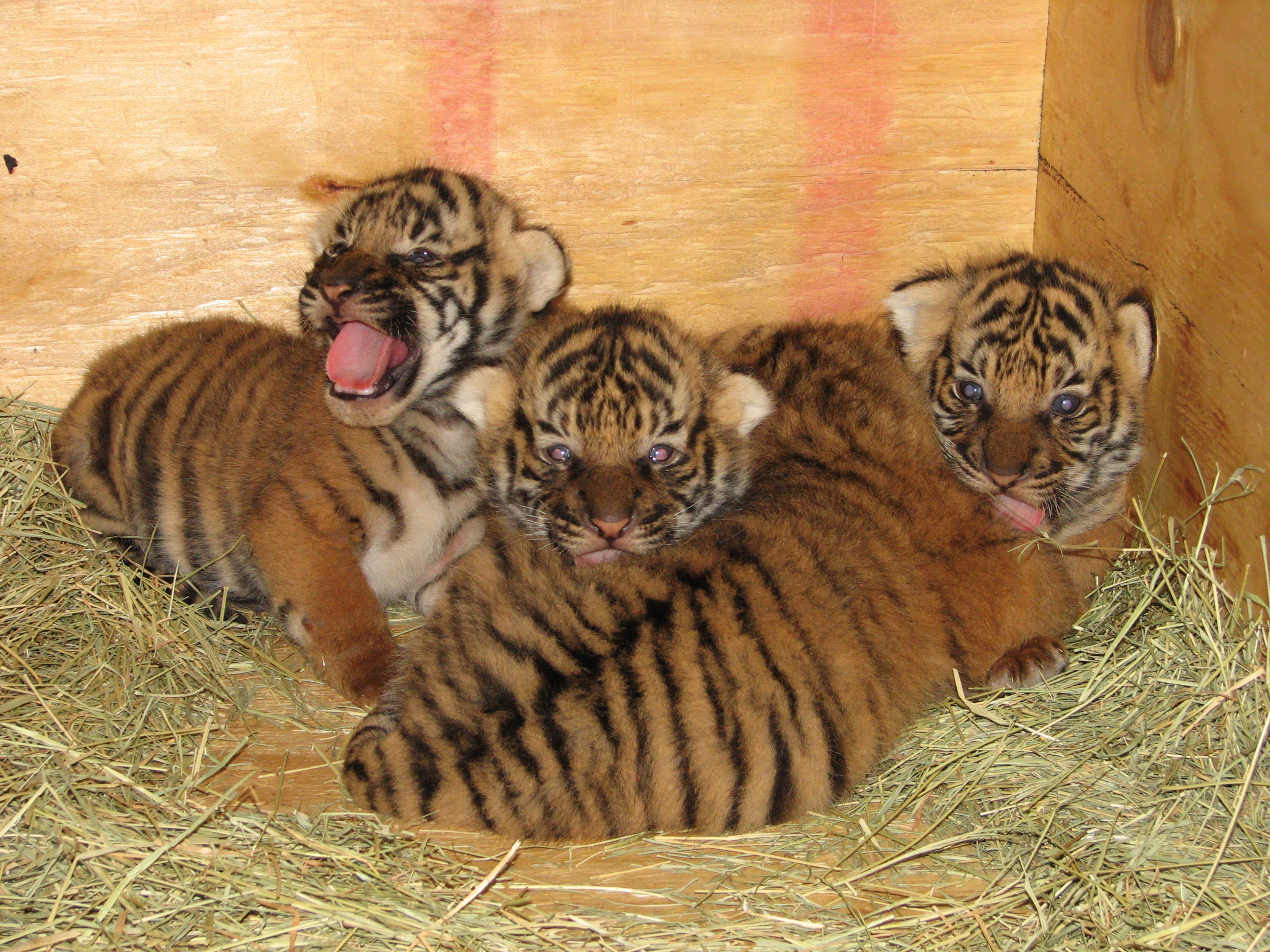
    Early in the morning on November 12, Suhana the Malayan Tiger gave birth to four healthy cubs at the Little Rock Zoo.  The zoo staff monitors the family with remote cameras, where they captured this video of a sneezing cub.

    Tiger Cubs
    Tiger Cubs 2
    Tiger Cubs 3
    Photo Credit:  Little Rock Zoo


    For now, the cubs are with Suhana in their den, where they will remain for several more weeks, and all signs indicate that the cubs are progressing exactly as they should.  Once the cubs are weaned at three to five months, they will move into the zoo’s newly-renovated outdoor Tiger habitat.

    The breeding of Suhana, age five, and her mate, nine-year-old Liku, was recommended by the Species Survival Plan of the Association of Zoos and Aquariums, which seeks to maintain a genetically-diverse zoo population of Malayan Tigers. 

    Malayan Tigers are one of six existing Tiger subspecies.  Three subspecies – Javan, Caspian, and Bali – have gone extinct within the last 80 years.  In the wild, fewer than 500 Malayan Tigers remain in the forests of the Malay Peninsula and the southernmost tip of Thailand. The International Union for Conservation of Nature lists all Tigers as Endangered.

  • ,

    Penguin Chick 2 Days Old Cerdit Hannah Baker 2

    An endangered African Black-Footed Penguin chick at the Little Rock Zoo is on a mission –
    to eat, eat, and eat so he can grow, grow, and grow!  So far, the strategy is working.  This little chick, who weighed just 2 ounces
    (54 grams) at two days old (top photo), now weighs more than a pound (450 grams) at five
    weeks of age (bottom photo).

    Penguin Chick 3 Weeks Credit Stephanie Hollister 2

    Penguin Chick 5 Weeks

    Like many young birds, Penguin chicks eat huge amounts of food
    in relation to their body weight and grow rapidly.  This allows the chicks to become
    self-sufficient at a young age, relieving mom and dad of the burden of constant
    feedings. 

    The zoo’s new arrival is the first chick for parents Skipper and
    Easy.  He does not yet have a name.   The chick’s arrival increases the zoo’s Penguin
    flock to 16 birds.

    African Black-Footed Penguins are native to the rocky coastlines
    of southern Africa and nearby islands.  African
    Penguins once numbered more than 1.5 million, but there are fewer than 200,000
    birds today.  The harvesting of Penguin
    eggs, loss of habitat, and repeated oil spills have taken a toll on the
    population, and the African Penguin is now considered endangered.

    Photo Credits:  Hannah baker
    (top), Stephanie Hollister (center), Little Rock Zoo (bottom)

  • ,

    Baby6

    Adelina,
    a baby Western Lowland Gorilla born on August 19, has her own Facebook page and
    devoted fans who gave her a baby shower when she was just a few weeks old.  Why all the fuss?  Adelina is only the second baby Gorilla ever born
    at the Little Rock Zoo.

    Baby4

    Bby5

    Baby1

    BABY2

    By3

    Sekani,
    Adelina’s 21-year-old mother, is demonstrating excellent care for her baby, according
    to the zoo staff.  The father,
    26-year-old Fossey, was recommended to breed with Sekani by the Species Survival
    Plan (SSP) a breeding and conservation program of the Association of Zoos and Aquariums
    (AZA), which accredits North American zoos.

    Sekani was registered for her baby shower
    at a local retailer.  Soft receiving
    blankets topped her list, along with safe and colorful infant toys.  In the photos, you can see Sekani studying the
    cards she received at the shower.  Like
    most youngsters, Adelina appeared to enjoy the wrapping paper more than the gifts
    themselves. 

    At 11 weeks old, Adelina is growing
    normally and appears strong, alert, and healthy.   Fans
    can watch Adelina' progress via weekly updates posted on her Facebook page.

    Western Lowland Gorillas are critically
    endangered in their native central African home, due to illegal hunting and the
    destruction of their habitat.

    Photo Credits:  Little Rock Zoo

  • , , ,

    Little_Rock_Zoo_Geoffroy's_Marmosets

    These twin Geoffroy's Marmosets were born November 21, 2011 on a very stormy night at the Little Rock Zoo. They were born to parents Becky and Santana.  In these photos they are riding on Santana (dad). Their sex remains unknown. Becky was very protective of them and was slow to let Santana carry them, but finally did.  They have an older brother, Carlos who was born in early 2010. He would like to help carry the babies, but so far has not been allowed.  They share and exhibit with a White Faced Saki family and 7 Green Iguanas.

    Little_Rock_Zoo_Geoffroy's_Marmosets_1

    Little_Rock_Zoo_Geoffroy's_Marmosets_2
    Photo credit: Karen Caster, Primate Keeper at the Little Rock Zoo