The Newest, Cutest Baby Animals from the World's Zoos & Aquariums

Category: Omaha’s Henry Doorly Zoo

  • ,

    Lion younger 5

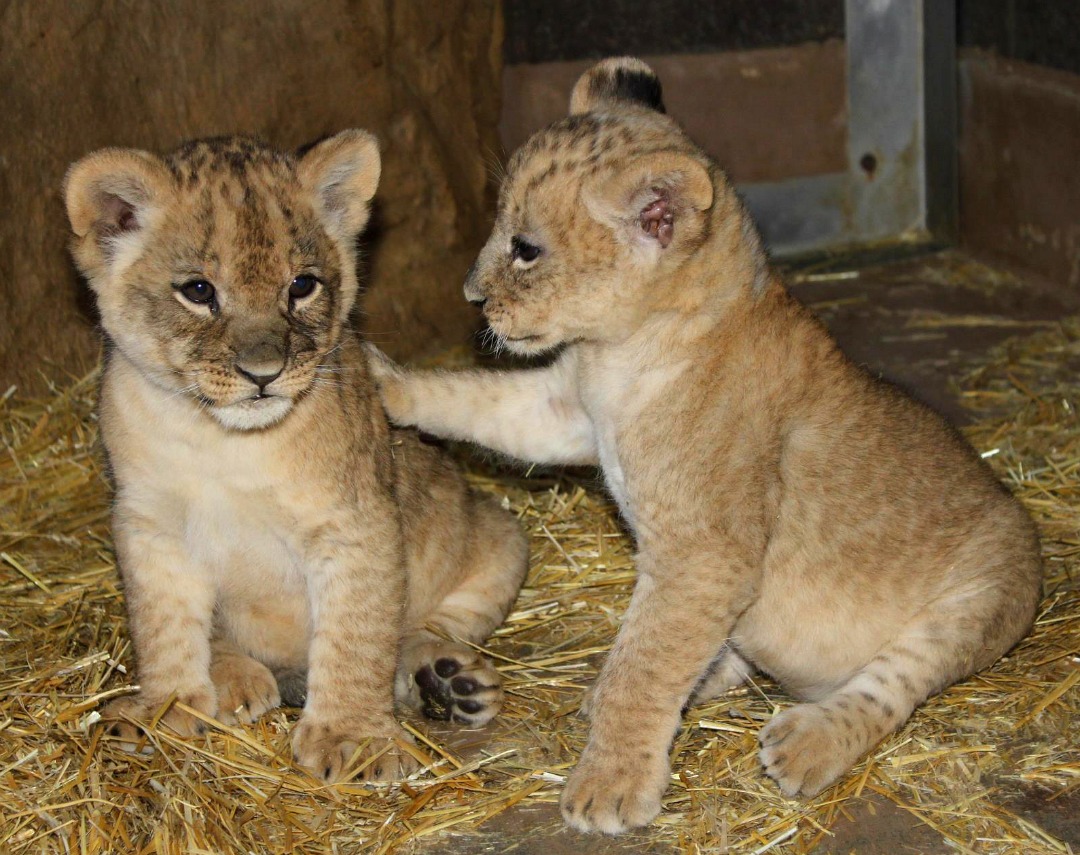
    Getting five Lion cubs to look at the camera at the same time is not easy, but the staff at Omaha's Henry Doorly Zoo and Aquarium enjoy trying. You may have first learned about these two male and three female African Lion cubs, born on December 29, here or here on Zooborns.

    First-time mom Mfisha, six years old, has her paws full but is clearly doing a great job. The cubs are weighed every day and are growing as they should, including one female, who was having trouble nursing early on. After spending eight days in
    the hospital to improve her health, she was put back with her siblings, mom and
    aunt, though she continued to be bottle fed by keepers. 

    African Lions are listed as Vulnerable on the IUCN (International Union for Conservation of Nature and Natural Resources). Over the last 20 years the lion population has estimated to have declined from 30% to 50%. African lions live in sub-Sahara Africa with the majority in east and southern Africa.

    Lion wiegh

    Lion paw bro


    Lion pile
    Photo Credit: Henry Doorly Zoo

    Read more about this beautiful species after the fold:

    (more…)

  • ,

    IMG_3358

    You met the five African Lion cubs born at Omaha’s Henry Doorly
    Zoo
    a few weeks ago on ZooBorns. Take a
    look at these new photos and you’ll see that they’re growing fast!

    Born to first-time mother Mfisha and father Mr. Big on
    December 29, the five cubs are thriving. 
    The litter includes two males and three females.

    IMG_3339

    394895_10151380035720851_1660264366_n

    IMG_3335
    Photo Credit:  Henry
    Doorly Zoo

    This breeding was recommended by the Association of Zoos
    & Aquariums (AZA) Species Survival Plan (SSP) as part of an effort to breed
    Lions of appropriate genetic backgrounds. 
     

    The population of African Lions has fallen dramatically over
    the last few decades.  Some experts
    estimate there are half as many wild African Lions as there were two decades
    ago, and most are confined to national parks and protected areas.  Zoo breeding is one of many efforts
    underway to protect these majestic cats from extinction.


  • ,

    Lion1

    Being a Lion cub is hard work, as these images of the latest additions to Omaha's Henry Doorly Zoo show.  Five Lion cubs, two males and three females, were born on December 29, 2012 to first-time mother Mfisha and father Mr. Big.

    Lion3

    Lion4

    Lion2
    Photo Credit:  Henry Doorly Zoo

    Four of the cubs are on display with their mother and aunt, but one of the female cubs is currently in the zoo's hospital receiving round the clock care. She was smaller than the other cubs and didn’t compete well for food, so at 24 hours old Animal Care Staff gave her fluids to keep her hydrated. At 48 hours old the decision was made to remove the cub to the hospital for hand-rearing. When the cub’s health is stable and she is gaining weight, she will be introduced to her mother and siblings while keepers will provide her with extra feedings throughout the day when the mother is briefly shifted to a nearby enclosure.

    This breeding is part of an SSP (Species Survival Plan) recommendation. The subspecies, krugeri, is the focus of AZA’s (Association of Zoos and Aquariums) Felid Taxon Advisory Group to concentrate zoo efforts nationwide to breed Lions of known lineage. There have been eleven African Lion births in the last twelve months at AZA accredited zoos in North America. The count does not inlcude these cubs. 

    African Lions are listed as Vulnerable on the IUCN (International Union for Conservation of Nature and Natural Resources). Over the last 20 years the lion population has estimated to have declined from 30% to 50%. African Lions live in sub-Sahara Africa with the majority in eastern and southern Africa.  The last Lion birth at the zoo was in 1994.

  • ,

    Aardvark 1

    What weighs 16 pounds, has a long snout, and is wrinkly all
    over?  The new Aardvark calf at Omaha’s
    Henry Doorly Zoo!

    The female calf, which was born on October 8, made her
    public debut on December 27.  Because her
    mother has a history of not caring for her offspring, the calf is being
    hand-reared by zoo staff.   She is displayed next to her parents so she
    can become familiar with their scent and vocalizations.

    Aardvark 2

    Aardvark 3
    Photo Credit:  Henry Doorly Zoo

    Though the effort required to hand-rear an aardvark is
    significant, it is definitely worthwhile:  only
    about 30 Aardvarks currently live in twelve accredited North American zoos.

    Aardvarks live throughout sub-Saharan Africa, exploiting any
    habitat where ants and termites are available. 
    Using their powerful front legs and claws, Aardvarks tear open insect mounds
    and take up thousands of ants or termites with their long sticky tongues.   Though
    their skin appears fragile, it is in fact thick enough to withstand a flurry of
    ant stings or termite bites with no harm to the Aardvark.

    Zoo guests are invited to enter a contest to name the calf
    when they visit her exhibit at the zoo.

  • , , ,

    5515047352_0a0a871109_o

    Some adorable newborn kittens at Audubon Center for Research of Endangered Species have no idea just how special they are.  Two African Black-Footed kittens, members of an endangered species rarely seen in captivity, are the first of their kind to be born from a frozen embryo via in-vitro fertilization. This ground-breaking birth is the latest advance in assisted reproduction for endangered species from Audubon Nature Institute in New Orleans.

    Audubon-Black-Footed-Cat-3

    Audubon-Black-Footed-Cat-9

    Audubon-Black-Footed-Cat-1

    Audubon-Black-Footed-Cat-8
    Photo credits: Audubon Institute

    The youngsters, both males, were born to surrogate mother Bijou on February 13, 2011, but their story goes all the way back to 2003, when sperm was collected from a 6 year old male named Ramses in Omaha, Nebraska. Experts at the Omaha’s Henry Doorly Zoo Center for Conservation and Research – Reproductive Sciences Department froze the sperm and sent it to Audubon Center for Research of Endangered Species.  It was combined with an egg from Zora, a Black-Footed Cat living at Audubon research center, creating embryos in March, 2005. Those embryos were frozen for almost six years before being thawed and transferred to Bijou on December 7, 2010. Sixty-nine days later, the two kittens became the first of their species to be born as a result of in-vitro fertilization utilizing frozen/thawed sperm and a frozen/thawed embryo.

    (more…)

  • ,

    Omaha’s Henry Doorly Zoo has two new Fossa pups, born on June 26, 2010. Native to the island of Madagascar, Fossas are the main predator of lemurs. They are very agile climbers whose ankles can rotate 180 degrees. This allows them to climb down a tree face-forward while gripping with their back feet. Looking like a cross between a cat and a weasel, they are most closely related to mongooses.

    Fossa-Pups-Press-Release-Photo

    Fossa-Pup-2a

    Fossa-Pup Photo Credits: Henry Doorly Zoo


    (more…)

  • ,

    The Henry Doorly Zoo's newest resident might look like ALF, but he's not an alien. This little Malayan Tapir calf was born December 6th and is just now on display with his mother, Knobbie, in the Asian Rainforest exhibit.

    Baby tapir henry doorly zoo rs

    In their native jungles of Southeast Asia, tapirs use their long snouts to reach tasty leaves that would otherwise be just out of reach. The birth of this little guy is particular exciting because the species is endangered in the wild and the breeding program population in North America is small.

    Baby tapir henry doorly zoo 2 rs

    (more…)

  • ,
    This newborn aardvark at Omaha’s Henry Doorly Zoo most certainly wins the award for wrinkliest baby ever featured on ZooBorns. Weighing just 5 lbs, this little calf might eventually reach as much as 125 lbs. We hope by then he has grown into his skin. 

    A scampering baby aardvark
    Zooborn2

    Before signing on Brad Pitt, this baby aardvark was slated to play Benjamin Button
    Zooborn1

    Zooborn3

    Watch him wiggle his snout and scamper

    (more…)

  • ,
    Just like baby humans must learn to walk, baby sea lions must learn to swim. This little female sea lion pup, born June 14th at Omaha's Henry Doorly Zoo, is no exception so keepers have lowered the water level in the enclosure to something closer to an inflatable kiddy pool than a nice fancy inground. As the pup grows, so too will the water depth, kind of like YMCA swimming classes. 

    Little sea lion thinks she could get used to this…
    Baby sea lion omaha zoo 1

    Baby sea lion omaha zoo 2

    Enough splashing. Nap time.
    Baby sea lion omaha zoo 3
    Photo credit for last photo: Alyssa Todd

    (more…)