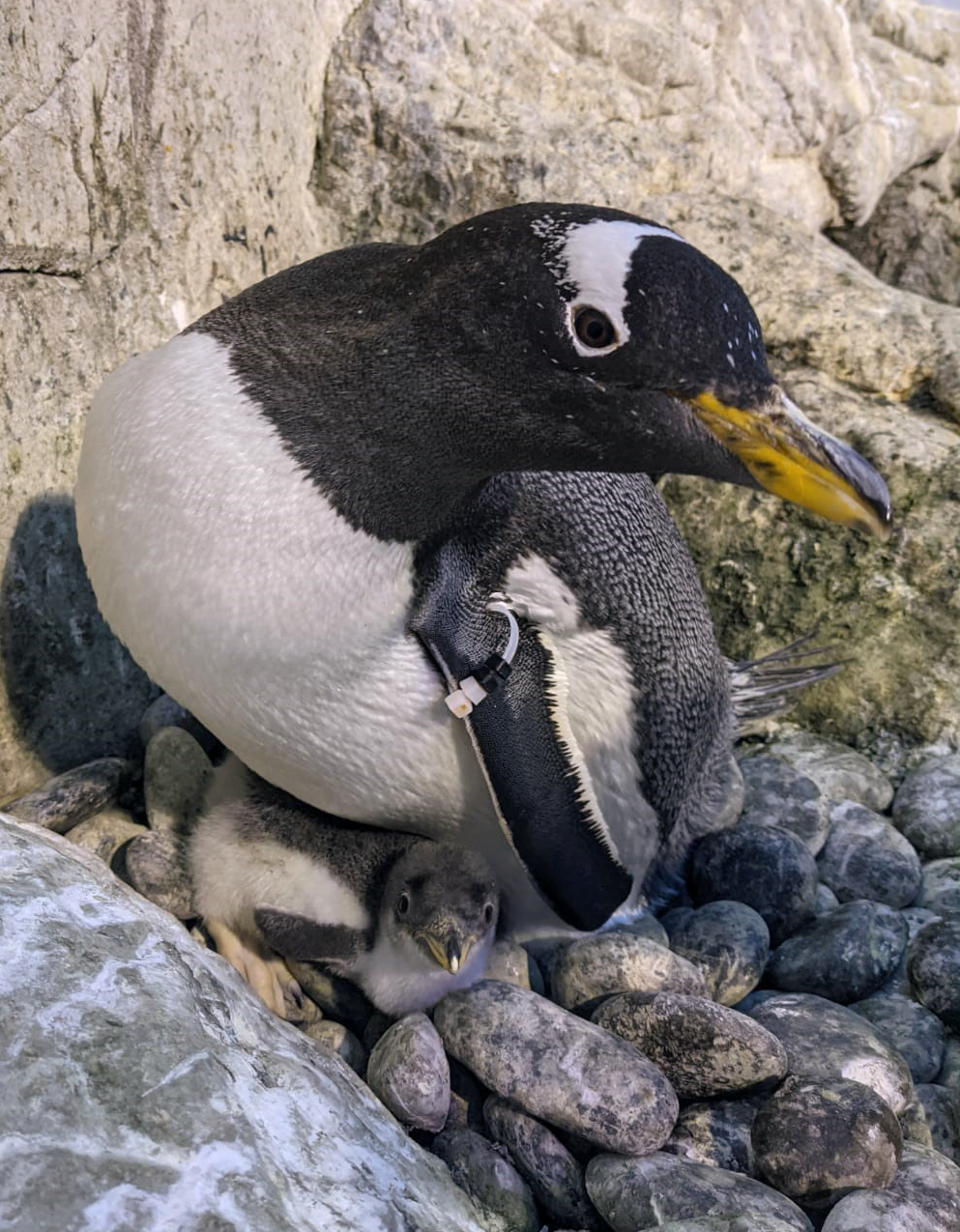
The Indianapolis Zoo is excited to welcome the arrival of two adorable Gentoo penguin chicks, hatched just days before Christmas. They’re also celebrating the beautiful differences of their families, because one of the newcomers was born to a same-sex pair — a first for the Zoo!
Same-sex pairings have also occurred with penguin species in the wild and in other zoos. The two male birds became first-time dads when their chick hatched on Dec. 15. A female that’s actually paired with another penguin laid the egg and left it with the all-male couple, who have been caring for it ever since. Gentoo penguins co-parent their young, and just as a female-male pair would do, the two fathers have taken turns tending the nest, incubating the egg and now feeding the chick.
The other chick hatched a week earlier on Dec. 8, to a female-male pair who are also first-time parents. All the adults are doing a great job as caregivers, and while they don’t know the sexes of the two chicks, the young birds are both growing quickly. The first-born chick weighed 99.7 grams at birth and has grown to 2,000 grams (4 pounds, 6 ounces) at its weigh-in today. The second chick has already grown to 1,405 grams (3 pounds, 1 ounce) from its birth weight of 114 grams.
These are the first two penguin chicks hatched at the Indianapolis Zoo since 2012, and the first for the Gentoo flock since 2011.
Ripley’s Aquarium of Myrtle Beach is pleased to introduce you to their newly hatched penguin chick—the first-ever penguin born at Ripley’s Aquarium of Myrtle Beach! Born October 7, 2020, the newest addition turned six weeks old yesterday and is being hand-raised by husbandry staff behind the scenes in the Penguin Nursery.
African penguin chicks can hold themselves upright at about six days old and begin walking at around three weeks. Both milestones were hit—an exciting and healthy sign for the Aquarium’s firstborn! The soon to-be-named chick is still being acclimated and will join the Penguin Playhouse colony in 2021.
CHICAGO – Shedd Aquarium is announcing the names and sexes of four Magellanic penguin chicks (Spheniscus magellanicus) the aquarium joyfully welcomed following a successful nesting and breeding season in May. These four new arrivals contribute to Shedd’s participation in a conservation effort among aquariums accredited by the Association of Zoos and Aquariums (AZA) in a cooperatively managed Species Survival Plan for Magellanic penguins, which are listed as nearly threatened by the International Union for Conservation of Nature (IUCN). The chicks have joined the full penguin colony at Shedd and can now be seen by guests on exhibit.
Select donors of the aquarium, who are long-time supporters of the non-profit organization, were given the exclusive opportunity to help choose a name for the penguins:
·Porter, male – named in honor of the aquarium’s founder John G. Shedd's wife, Mary Porter Shedd, by the Shedd Family
·Popi, male – named in honor of Pablo “Popi” Garcia Borboroglu, Ph.D., who is the founder and president of the Global Penguin Society, an international science-based conservation coalition dedicated to the survival and protection of the world’s penguin species, chosen by the Christopher Kim family and Museful Co.
·Sir Elio, male – fondly named by John and Carrie Morgridge and the Morgridge Family Foundation
·Dee, female – named in honor of Dr. Dee Boersma who is a University of Washington professor of biology and founder and director of theCenter for Ecosystem Sentinels, chosen by Shedd Aquarium’s animal care team
Regular check-ups with the animal care team continued to demonstrate that the four birds were hitting all their growth milestones. To determine the sex, since penguins’ reproductive organs are internal, the animal care team took biological samples from the chick’s eggshells and a routine blood test was completed.
After reaching important milestones along the way, including socialization, first swim, eating full fish and more, these birds have also joined the penguin colony in their habitat at the aquarium. Guests who plan a visit to the aquarium can potentially spot the penguin chicks by their slightly lighter grey feathers in the Polar Play Zone. Or visitors from around the world can participate in a virtual penguin encounter to come face-to-face with the penguins and an animal care expert, or symbolically adopt a penguin for regular updates about the birds.
By purchasing a ticket or participating in a program, you are helping to support the work of the aquarium and offset the financial impacts of COVID-19. For additional ways to support Shedd Aquarium and help fuel its mission, please visit https://www.sheddaquarium.org/about-shedd/support-us.
The aquarium is also encouraging the public to join us in safeguarding aquatic habitats that Magellanic penguins and thousands of other animals call home, by urging elected officials to support the protection of 30% of the world’s natural habitats by 2030. This goal of “30 by 30” secures a better future for wildlife, their habitats and humans.
The Maryland Zoo in Baltimore is excited to announce the hatching of three African penguin chicks – the first to hatch during the 2020-2021 breeding season at Penguin Coast. The chicks hatched on September 18th, September 22nd and October 4th.
“It’s amazing to me that we are in our 53rd year working with African penguins. We are always excited to watch the colony grow each year, and happy to announce that three chicks have hatched already this breeding season,” said Jen Kottyan, avian collection and conservation manager. “We expect to hatch 10 chicks during this breeding season, but of course that is all dependent on the penguins.”
Penguin breeding recommendations are made by the Association of Zoos and Aquariums’ (AZA) African Penguin Species Survival Plan (SSP). Breeding season for the African penguins (Spheniscus demersus) at Penguin Coast began in mid-August this year and will last until the end of February. “Right now it is spring in South Africa, when these penguins would normally begin breeding in their colonies,” continued Kottyan. “Although it is fall here, we like to mimic the breeding season so we can monitor the chicks as they hatch and grow during our winter, and then they make their debut as juveniles when temperatures warm up in April.”
Penguin chicks hatch 38-42 days after the eggs are laid. The Penguin Coast team monitors development of the eggs by candling them about a week after they are laid to see if they are fertile and that the chick is growing. The eggs are then placed back with the parents.
“With African penguins, both the male and the female take turns incubating the eggs,” said Kottyan. “Once the eggs hatch, parents take turns caring for their offspring; they each protect, feed, and keep the chick warm for 2-3 days and then switch off.”
At Penguin Coast, chicks stay with their parents for about three weeks after they hatch and are fed regurgitated fish from their parents. During this time, the animal care team and veterinarians keep a close eye on the development of the chicks, weighing and measuring them every few days to make sure that the parents are properly caring for each chick. When a chick is three-weeks-old, the team removes it from the nest, and starts to teach the chick that they are the source of food. This step is critical as it will allow staff to provide long term care for the birds including daily feeding, regular health exams and both routine and emergency medical care.
When they first hatch, chicks are about the size of a human palm. Covered in dark gray downy feathers, the chicks grow fast. They reach their full size, about six pounds, around three months of age. At the same time, their fluffy down is finished being replaced by waterproof feathers.
While the penguin chicks are not viewable to the public, juvenile and adult penguins can be seen
at Penguin Coast. Penguin Feeding programs are offered twice daily, free with admission, and Penguin Encounters are offered throughout the year for an additional fee.
The Maryland Zoo has been a leader in breeding African penguins for over 50 years, winning the prestigious Edward H. Bean Award for the “African Penguin Long-term Propagation Program” from the AZA in 1996. The Zoo has also won a Plume Award from the Avian Scientific Advisory Group (ASAG) recognizing excellence in husbandry and future management of a species or group of similar species. In 2016, Penguin Coast won Top Honors in the AZA Award for Exhibit Design category. Jen Kottyan is a member of the AZA African Penguin SSP Steering Committee, a group of penguin experts from all over North America, which guides and serves as a voting body for official SSP business and decisions that require more discussion. The members of the Steering Committee are available to all accredited zoos and aquariums which house African penguins to assist them with questions or issues regarding the penguins in their colonies.
The Maryland Zoo has the largest colony of African penguins in North America with 104 birds, including the newest hatchlings. Sadly, African penguins are extremely endangered. The 2019 penguin census showed another dramatic decline in South Africa, with approximately 13,500 pairs, a loss of 2,000 pairs from 2018. The global population, which includes Namibia, is now around 18,500 pairs, down from well over 2 million pairs in the 1920s, which is a 99.2% decline over the past 100 years.
The Maryland Zoo also participates in AZA’s Saving Animals From Extinction (SAFE) program. SAFE programs use the collective expertise within AZA-accredited zoos and aquariums to substantially improve the conservation status of species in the wild. Several Maryland Zoo staff currently serve in leadership or advisory roles in the Penguin SAFE program. Mike McClure, General Curator is Project Coordinator for the SAFE Marine Movement project which monitors marine foraging and movement patterns of African penguins in and around breeding colonies in South Africa. Jess Phillips, Area Manager for Penguin Coast, is the Project Coordinator for the SAFE Disaster Relief program, which has helped governmental and non-governmental organizations in South Africa and Namibia formalize a disaster management plan for the individual penguin colonies in South Africa, as well as providing equipment and identifying training protocols needed to train first responders and volunteers in the event of a disaster such as an oil spill or severe weather which could harm the penguins.
Two Humboldt Penguin chicks hatched at the Rosamond Gifford Zoo on May 1 and May 4. The chicks made their public debut in early June.
The chicks are both males and are named Peru and Lima (“Lee-ma”) in honor of their native habitat off the coast of Peru.
Photo Credit: Maria Simmons
Both chicks are the offspring of Penguin parents Frederico and Poquita. Foster parents Venti and Isa are helping to raise the older chick, Peru, to give both chicks a strong start. The adults will feed the chicks until they are big enough to take fish directly from keepers. Penguins at the zoo are hand-fed twice a day so animal care staff can keep records of how much food each bird consumes.
Weighing only a few ounces at hatching, the chicks have grown rapidly. Each now weighs well over five pounds.
The new chicks bring the number of birds in the zoo’s Humboldt Penguin colony to 34. They will remain off exhibit with their parents until their waterproof feathers come in, then they will practice their swimming skills in the small indoor pool before joining the rest of the colony later this year.
Zoo Director Ted Fox said the new chicks were bred as part of the Species Survival Plan (SSP) for Humboldt Penguins overseen by the Association of Zoos & Aquariums. More than 55 Penguin chicks have hatched at the zoo since it joined the SSP in 2005, and many have gone to other AZA institutions to help preserve the species.
Humboldt Penguins are listed as Vulnerable by the International Union for Conservation of Nature. In historic times, their nesting grounds were destroyed by guano mining, where deposits of their excrement were dug up and sold as fertilizer. In recent decades, changes in ocean temperatures, ocean acidification, and overfishing in the Penguins' hunting waters have pushed populations even lower. Today, about 32,000 mature individuals are estimated to live on the coasts of Peru and Chile.
The pitter patter of tiny flippers is being heard at the National Sea Life Centre in the United Kingdom as the staff celebrates the hatching of a Gentoo Penguin.
The chick was named Flash due to its speedy arrival just 12 hours after it began ‘pipping’ – the term used to describe how baby birds peck their way out of their eggs.
Photo Credit: National Sea Life Centre
The hatching is extra special because the parents traveled thousands of miles by airplane to pair up under a global breeding program.
Parents Prince, age one, and four-year-old Hyacinth are providing excellent care for Flash. The chick’s gender is not yet known.
Prince was unlucky in love during last year’s mating season, so the staff was happy to see Prince find a partner in Hyacinth.
Gentoo Penguins are difficult to breed in zoos, because they are particularly sensitive to their surroundings. The staff at the National Sea Life Centre worked hard to get every detail just right within the birds’ habitat.
In the wild, Gentoo Penguins nest on ice-free areas of Antarctica and sub-Antarctic islands. Some populations of Gentoo Penguins have declined rapidly in recent years suggesting that the birds could experience a larger decline from habitat loss, pollution, and illegal collection of their eggs.
Shedd Aquarium, a leader in animal care, recently welcomed two Magellanic Penguin chicks.
The chicks hatched following the annual breeding season that began with nesting. In late March, the Magellanic and Rockhopper Penguins began creating nests and preparing for the breeding season after animal care experts shifted the light cycle and scattered nesting materials in the aquarium’s Polar Play Zone exhibit.
Photo Credit: Shedd Aquarium/Brenna Hernandez
Both Magellanic Penguin eggs were produced by the same breeding pair: Chile and JR.
“Chick 420” hatched on May 17, and bonding with the biological parents began immediately. Chick 420 will remain in the nest with both adults who will rear the young bird.
“Chick 421” hatched a few days later on May 20. Attending chicks is a full-time job with duties shared by both parents. By having the chicks raised by two different pairs, each chick gets individualized attention and the parenting birds all get additional experience as they learn how to best care for chicks. Therefore, the second egg was given to foster parents, Howard and Georgia. According to keepers, the pair has been taking turns feeding and incubating the chick like it was their own.
“Having a chick successfully hatch from its egg is just the first of many milestones that we look for in these first few weeks, but our team is cautiously optimistic,” said Lana Gonzalez, manager of Penguins and Sea Otters. “We’ll continue to monitor both chicks closely over the next few weeks, looking for consistent weight gain and to see how the parents are doing with sharing their responsibilities.”
Woodland Park Zoo’s breeding season for Humboldt Penguins has closed with the successful hatching of two chicks.
Incubation for penguins takes 40 to 42 days, with both parents sharing incubation duties in the nest and day-to-day care for their chicks.
The new chicks bring the total number of successful hatchings of the species at the zoo to 70 since the zoo’s first breeding season in 2010, a year after the penguin habitat opened. The sex of the chicks is unknown until DNA testing can be conducted.
Photo Credits: Jeremy Dwyer-Lindgren/Woodland Park Zoo
The chicks are off exhibit in nesting burrows where they are under the care of the parents. To ensure they are achieving growth milestones, staff weighs them as they develop with minimal intervention to allow the parents to raise their chicks and gain parental experience.
The first chick hatched April 5 to mom, Claudia, and dad, Cortez; it is the third offspring for the parents. The second chick hatched May 1 and was placed under the care of foster parents, Mateo and Mini; the biological parents were moved to an aquarium under a breeding recommendation made by the Humboldt Penguin Species Survival Plan, a cooperative, conservation breeding program across accredited zoos to help ensure a healthy, self-sustaining population of penguins.
Before new chicks reach fledging age and go outdoors on exhibit, they are removed from the nest so animal keepers can condition the birds to approach them for hand feeding and other animal care activities. The chicks also are given round-the-clock access to a shallow pool where they can swim in a more controlled and less crowded environment. New chicks join the colony in the outdoor habitat sometime in early summer.
People do not usually think of penguins as a desert-dwelling species. Unlike their ice and snow-dwelling Antarctic cousins, Humboldt Penguins (Spheniscus humboldti) inhabit hot, dry coastlines in Peru and Chile. They live on rocky mainland shores, especially near cliffs, or on coastal islands. Humboldt Penguins have a body made to swim. Using their strong wings, they “fly” underwater, usually just below the surface, at speeds of up to 20 miles per hour. They steer with their feet and tail.
Humboldt Penguins are currently classified as “Vulnerable” on the IUCN Red List. Approximately 30,000 to 35,000 survive in their natural range. Woodland Park Zoo is committed to conserving Humboldt Penguins by supporting the Humboldt Penguin Conservation Center at Punta San Juan, Peru, breeding the birds through the Species Survival Plan, and encouraging visitors to choose sustainable seafood options as directed by Monterey Bay Aquarium’s Seafood Watch program. Punta San Juan is home to 5,000 Humboldt Penguins, the largest colony in Peru.
With the Midwest in the grip of a brutal winter, the Kansas City Zoo has welcomed two King Penguin chicks.
Photo Credit: Kansas City Zoo
The first chick hatched on January 13 during a blizzard and was given the name “Blizzard” by the care team. A second King Penguin chick hatched on February 2 during the polar vortex which brought below-zero temperatures to Kansas City. The zoo solicited name suggestions for the second chick on Facebook, and fans suggested wintry names for little ball of fluff. Top names included “Pothole,” “Snowball,” “Icee,” “Chilly,” and “Vortex.” Vortex was chosen as the winning name.
You can see the entire Penguin habitat and all its residents every day on the zoo’s Penguin Cam.
There, you’ll see “play pens” separating the two chicks and their parents from the rest of the flock. This allows the other penguins to see and hear the new arrivals, but gives the new families some privacy. Blizzard, the older of the two Penguin chicks, has his very own Blizzard Cam. On that camera, you’ll see Blizzard, who is covered in fuzzy gray feathers and stands almost as tall as his parents.
At up to 39 inches tall, King Penguins are the second largest of all Penguin species. They nest on temperate islands in the South Atlantic Ocean and on the coast of Antarctica. Diving to depths of more than 300 feet, King Penguins forage for fish, squid, and krill in the cold Antarctic waters. King Penguins as a whole are not under threat at this time, but certain populations, including those on Pig Island, have declined 90% in recent years. Scientists are not certain if this is due to changes in the ecosystem, or if the Penguins have dispersed to new breeding grounds.
While fluffy snow was recently blanketing Kansas City, Missouri and knocking out power metro wide, including at the Kansas City Zoo, something exciting was happening inside the Helzberg Penguin Plaza. The first King Penguin egg to be laid at the Zoo hatched on Sunday, January 13. The name “Blizzard” was chosen for this chick since it made its entrance into the world during one big snowstorm!
Photo Credits: Brian McCarty/Kansas City Zoo
Helzberg Penguin Plaza opened its doors in October 2013 and became home to several King Penguins. But it wasn’t until this winter that those penguins formed love connections. In late November, the Zoo’s first King Penguin egg was laid, and parents Jilly and Dwayne kept dutiful watch over it. For king penguins, that required them to hold the delicate egg on their feet to keep it warm, taking turns doing so for the 53-day incubation period. On January 13, the new chick was finally ready to hatch!
Zookeepers have been keeping an eye on the chick, weighing it periodically to make sure its gaining weight. Jilly and Dwayne are first-time parents but are doing a great job feeding and caring for little Blizzard.
Visitors can see the chick, Blizzard, and the rest of the flock in Helzberg Penguin Plaza.
The King Penguin (Aptenodytes patagonicus) is a large species of penguin, second only to the Emperor Penguin in size. There are two subspecies: A. p. patagonicus and A. p. halli; patagonicus is found in the South Atlantic and halli found at the Kerguelen Islands and Crozet Island, Prince Edward Islands, Heard Island and McDonald Islands, and Macquarie Island.