Carnivore keepers at the Smithsonian’s National Zoo and Conservation Biology Institute (NZCBI) in Front Royal, Virginia, are celebrating a litter of five cheetah cubs born to 8-year-old adult female Echo Tuesday, Sept. 12. Viewers can enjoy watching the cubs grow via the Cheetah Cub Cam. Note that Echo may move her cubs out of the den and around her habitat so they may be out of view at times.
Animal care staff will leave Echo to bond with and care for her cubs without interference, but as opportunities arise, staff will perform quick health checks. During a recent weight check, staff confirmed there are three males and two females. The cubs appear to be strong, active, vocal and eating well.
Following Public Vote, the Western Lowland Gorilla at the Smithsonian’s National Zoo and Conservation Biology Institute Receives Her Name
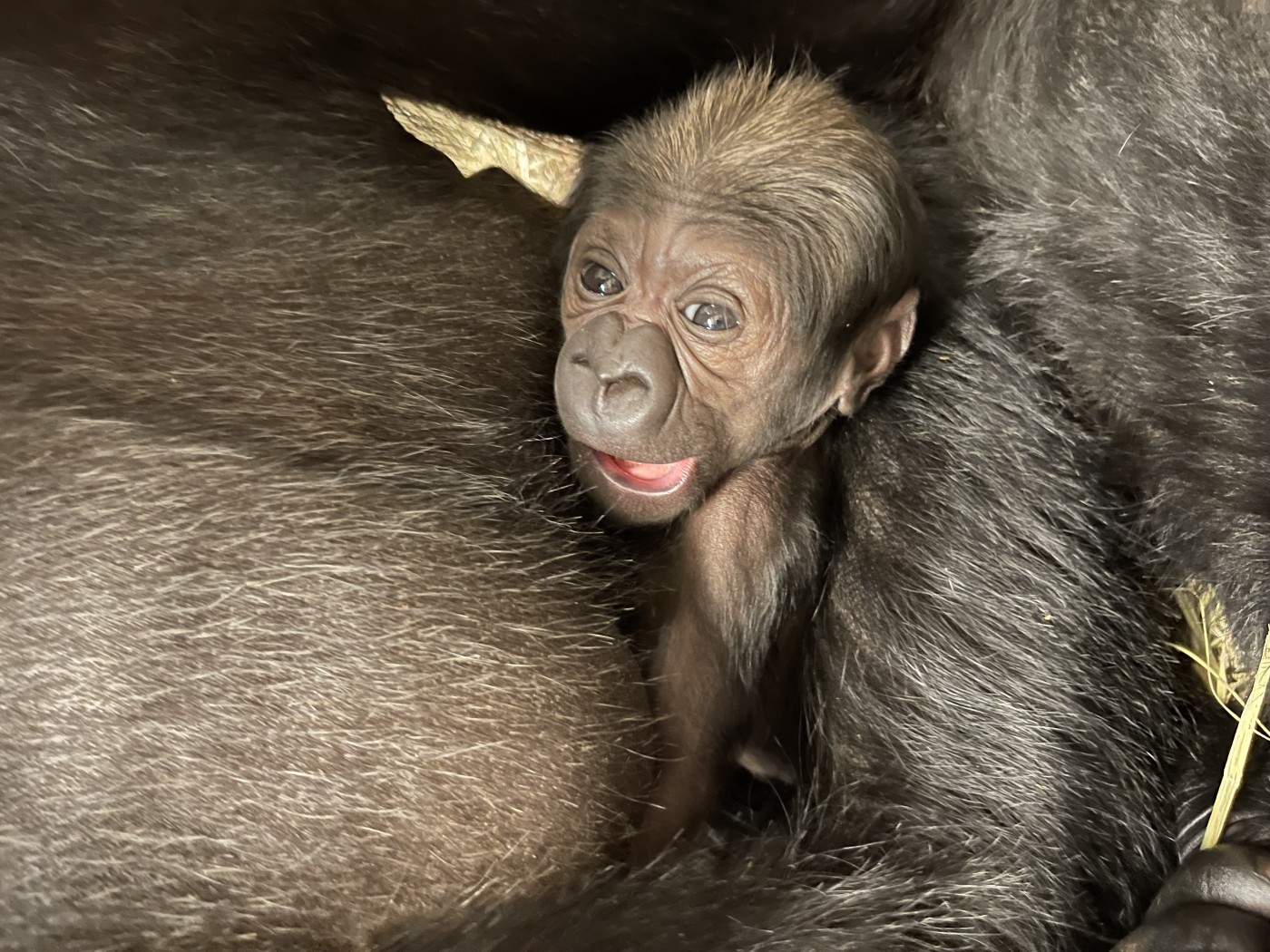
The Smithsonian’s National Zoo and Conservation Biology Institute’s (NZCBI) 2-week-old western lowland gorilla received her name today. After five days of voting and just over 25,000 votes, the winning name is Zahra [ZAH-rah], which means “beautiful flower” in Swahili. It was one of three names that were offered for a public online vote from June 5 to June 9 on the Zoo’s website. Zahra received 12,071 votes—50% of the total votes. Lola [LOH-la], Yoruba for “greatness,” came in second with 7,894 votes, or 30% of the total. In third place was Mkali [M-KAH-lee], Swahili for “fierce,” which received 5,563 votes, or 20% of the total.
Zahra was born at the Zoo’s Washington, D.C., campus May 27 and is the second offspring for both 20-year-old mother Calaya and 31-year-old father Baraka. Other members of NZCBI’s western lowland gorilla troop include Zahra’s brother, 5-year-old Moke, as well as a 41-year-old female named Mandara and her 14-year-old daughter, Kibibi. Virtual visitors can stay up-to-date on Zahra’s milestones on the Zoo’s Facebook, Twitter and Instagram accounts with the hashtag #GorillaStory. Great Ape House visitors can see the western lowland gorilla troop and meet an animal keeper at 11:30 a.m. daily.
Native to Africa, western lowland gorillas live in the forests of Gabon, Central Africa Republic, Cameroon, Angola, Equatorial Guinea and Congo. The International Union for Conservation of Nature lists the western lowland gorilla as critically endangered due to habitat loss, disease and poaching. The public can help protect western lowland gorillas’ natural habitat by making environmentally conscious decisions. One of the metals inside electronic devices, tantalum, is mined from areas in the Democratic Republic of the Congo where gorillas live. Recycling electronics that contain tantalum—including cell phones, computers, tablets, cameras, gaming consoles, hearing aids and GPS navigation systems—can help protect gorilla habitat by greatly reducing the demand for more expansive mining.
Following Public Vote, the Western Lowland Gorilla at the Smithsonian’s National Zoo and Conservation Biology Institute Receives Her Name
The Smithsonian’s National Zoo and Conservation Biology Institute’s (NZCBI) 2-week-old western lowland gorilla received her name today. After five days of voting and just over 25,000 votes, the winning name is Zahra [ZAH-rah], which means “beautiful flower” in Swahili. It was one of three names that were offered for a public online vote from June 5 to June 9 on the Zoo’s website. Zahra received 12,071 votes—50% of the total votes. Lola [LOH-la], Yoruba for “greatness,” came in second with 7,894 votes, or 30% of the total. In third place was Mkali [M-KAH-lee], Swahili for “fierce,” which received 5,563 votes, or 20% of the total.
Starting today, June 5, western lowland gorilla fans will have an opportunity to vote on a name for a baby gorilla born May 27 at the Smithsonian’s National Zoo and Conservation Biology Institute (NZCBI). Every western lowland gorilla birth is cause for celebration as this species is considered critically endangered by the International Union of Conservation of Nature. This morning, primate keepers threw a party for the gorilla troop, and festive enrichment revealed that the newborn is female. Voters can select their favorite names today through noon Friday, June 9, on the Zoo’s website. The winning name will be announced June 9.
For the first time in five years, primate staff at the Smithsonian’s National Zoo and Conservation Biology Institute (NZCBI) are celebrating the birth of a western lowland gorilla—a critically endangered species. It was born between midnight and 6:15 a.m. on May 27 to 20-year-old mother Calaya and 31-year-old father Baraka. They bred in September 2022 following a breeding recommendation from the Association of Zoos and Aquariums’ Species Survival Plan (SSP). This is the second offspring for both parents.
For the first time in 16 years, the Smithsonian’s National Zoo and Conservation Biology Institute (NZCBI) in Washington, D.C., is celebrating the birth of three meerkats. Keepers in the Small Mammal House reported for duty the morning of May 10 and observed that 5-year-old Sadie had given birth overnight. NZCBI had received a recommendation from the Association of Zoos and Aquariums’ Species Survival Plan (SSP) to breed Sadie and the pups’ 6-year-old father Frankie. These pups are the first offspring for Sadie; Frankie sired offspring previously at his former zoo. Meerkats live in groups called mobs that can include as many as 30 individuals, although the average mob size is around 10 to 15 individuals. Visitors can view NZCBI’s meerkat mob—which also includes Sadie’s sister, Stella—at the Small Mammal House.
Just in time for spring break, two male Andean bear cubs named Sean and Ian are now on view at the Smithsonian’s National Zoo and Conservation Biology Institute (NZCBI) in Washington, D.C. Over the past few weeks, the animal care team has worked with the brothers to prepare them for the transition. Cubs Ian and Sean began exploring the yard in mid-March alongside their mother, 4-year-old Brienne. For the past four months, members of the public have joined animal care staff in observing the cubs play and explore via a live Andean Bear Cub Cam and follow along with their growth through online “cubdates.”
Happy birthday, Kibibi! Smithsonian’s National Zoo and Conservation Biology Institute’s "little lady" celebrated her 14th birthday yesterday, January 10th, 2023. We’re turning back the clock with some archival footage highlights from herpast. First to 2009, the year of Kibibi’s birth. Then 2011, when 2-year-old- Kibibi received her first medical exam. And finally to 2020, when the staff dropped in on Kibibi’s husbandry training.
Look how far she’s come!
We can help western lowland gorillas like Kibibi by recycling. One of the metals inside electronic devices—tantalum—is mined from areas where gorillas live in the Democratic Republic of the Congo. We can protect their home—and reduce the need for more expansive coltan mining—by recycling our old electronics. Every small action has the potential to make a huge difference!
After an eight-year hiatus, the Smithsonian’s National Zoo and Conservation Biology Institute (NZCBI) in Washington, D.C., is celebrating the birth of two Andean bears. The cubs were born Nov. 15 to first-time parents, 3-year-old mother Brienne and 9-year-old father Quito. The first cub was born around 4 p.m. and the second around 8:30 p.m. Animal care staff is closely monitoring the mother and cubs via the Andean Bear Cub Cam on the Zoo’s website, allowing Brienne to care for her offspring without interference. Virtual visitors can also observe the Andean bear family on this temporary platform until the cubs leave the den.
Carnivore keepers at the Smithsonian’s National Zoo and Conservation Biology Institute (NZCBI) in Front Royal, Virginia, welcomed a litter of two cheetah cubs. First-time mother, 4-year-old female Amani, birthed the cubs Oct. 3 around 9:17 p.m. and 11:05 p.m. ET. This is also the first litter sired by 7-year-old father Asante. As the first offspring of both parents, the cubs are genetically valuable. They appear to be strong, active, vocalizing and nursing well. Animal care staff are closely monitoring Amani and her cubs’ behaviors via the Cheetah Cub Cam on the Zoo’s website. Virtual visitors can also observe Amani and her cubs on this temporary platform until the cubs leave the dens.