The Newest, Cutest Baby Animals from the World's Zoos & Aquariums

Category: Turtle & Tortoise

  • , ,

    Keeled Box Turtle Tennessee Aquarium 1.jpg

    For the second time in Tennessee Aquarium history, the institution welcomed a rare Keeled Box Turtle hatchling. Like many other Southeast Asian turtles, Keeled Box Turtles have been over-collected in the wild for food and the pet trade. Several conservation organizations are working to protect the remaining wild populations from illegal trade, while zoos and aquariums are building assurance populations so the species does not go extinct if these animals disappear in the wild. Currently the U.S. population of Keeled Box Turtles at AZA-accredited zoos and aquariums is less than twenty animals, seven of which are at Tennessee Aquarium.

    This baby was the only one to hatch out of seven eggs laid in July. The incubation time was 92 days at a toasty 82 degrees Farenheit and the tiny hatchling weighed just 0.41 oz (11.7 grams).

    Keeled Box Turtle Tennessee Aquarium 2.jpg

    Keeled Box Turtle Tennessee Aquarium 3.jpgPhoto credits: Bill Hughes / Tennessee Aquarium

    The Tennessee Aquarium has one of the largest turtle collections on public display with more than 500 individuals representing seventy-five species. Their Senior Hereptologist, Bill Hughes, manages the Keeled Box Turtle Studbook and serves as the Species Survival Plan Coordinator for Spiny Turtles, Four-eyed Turtles, and Arakan Forest Turtles. 

  • ,

    Cooter hero

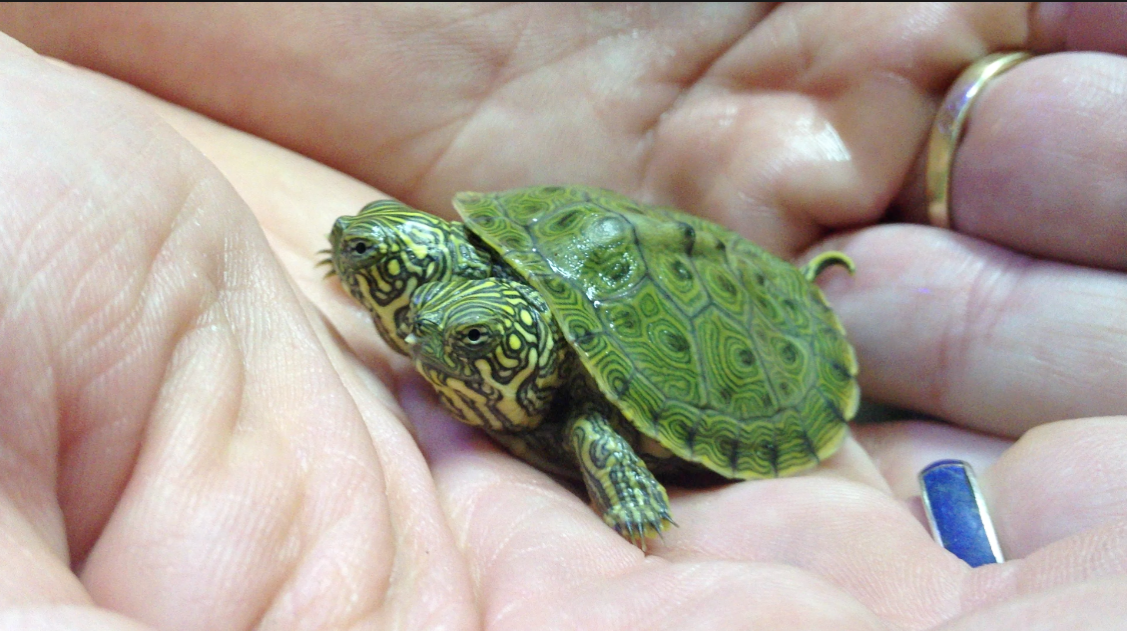
    The San Antonio Zoo welcomed a very special arrival to their aquarium: a two-headed (bicephalic) Texas River Cooter named Thelma and Louise! Thelma and Louise were part of a quartet of Texas Cooters hatched at the zoo on June 18 that made their public debut on June 25.

    Craig Pelke, Curator of Reptiles, Amphibians, and Aquatics, notes that while this is uncommon, it is not unheard of in both the wild and captive populations. Bicephalic animals are actually twins that did not separate, resulting in two or more heads on one animal. Bicephaly occurs most commonly with snakes and turtles, without any accompanying health issues. Pelke said, “At this time, Thelma and Louise are doing well on exhibit and eating with both heads!”

    Cooter size 2

    Cooter duo


    Cooter hand
    Photo Credit: San Antonio Zoo

    The San Antonio Zoo is no stranger to two-headed reptiles. A two-headed Texas rat snake named Janus lived there from 1978 until it passed away in 1995. Visitors can see the Cooter hatchlings in the Friedrich Aquarium located inside the zoo.

    See more photos below the fold:

    (more…)

  • ,

    Bigheadhatch

    A few months ago, ZooBorns reported on two endangered Madagascar Big-headed Turtles who laid a total of 33 eggs at the Houston Zoo.  Because the ground was too cold for the eggs to develop, the females were induced to lay the eggs in the safety of the zoo clinic.  On May 18 and 19, three of the eggs hatched!

    IMG_2456a

    IMG_2463-1
    Photo Credits:  Beth Moorehead/Houston Zoo (1); Tina Carpenter/Houston Zoo (2,3)

    Though the remainder of the 33 eggs were infertile, zoo keepers say this result is not unusual in young female turtles who have just reached maturity. 

    The hatchlings are currently behind the scenes until they are old enough to be on exhibit.  In the meantime, zoo visitors can see their older siblings, who hatched on September 15, inside the reptile house.

    The Big-headed Turtles live in the moat of the zoo's Lemur exhibit.  Zoo keepers have created a sandy spot for the female turtles to dig in and lay their next clutch of eggs.

    The hatching of these Turtles is significant because they are one of the world's most endangered Turtle species.  Found only on the island of Madagascar, they are traded illegally for use in traditional Asian medicine.

    Related articles

    Prague Zoo is the First to Hatch Rare Turtles
    Jacksonville Zoo celebrates hatching of three endangered Temple Turtles
    UPDATE! It's Nap Time for Point Defiance Zoo's Sumatran Tiger Cub
    Otter Pup Trio Makes a Splash at Oakland Zoo
  • ,

    _TTT1675

    Eleven tiny Brown Roofed Turtles hatched at the Czech Republic's Prague Zoo this month, the first of the species to hatch in any zoo in the world. 

    _TTT1729

    _TTT1803

    _TTT1765
    Photo Credit: Tomáš Adamec, Zoo Praha

    Brown Roofed Turtles are native to South Asia, including Bangladesh, India, and Pakistan.  They are listed as Near Threatened by the International Union for Conservation of Nature.

    Many Turtle species in this region of the world are in decline.  They are often collected illegally for the pet trade and for use in traditional Asian medicine.  The Turtles' shells are ground up, mixed with herbs, and marketed as remedies for a wide variety of ailments, but there is scant evidence that these potions are effective.

    Related articles

    Tiny Parrot Parrot Born at Prague Zoo
    Chester Zoo's Penguin Chicks Named After TV Icons
    Przewalski's Horse Colt Continues Zoo Praha's Success With Species
    Coming Soon to the Houston Zoo: Baby Big-headed Turtles!
  • ,

    WST2

    The Perth Zoo in Australia had another successful season in their efforts to conserve Western Swamp Tortoises with 33 successful hatches. The zoo has been working hard since 1989 to help conserve this critically endangered species by rebuilding their wild population through a captive breeding and reintroduction program. Since the program's initiation, the zoo has hatched more than 800 tortoises, 600 of which have been successfully reintroduced to the wild. 

    In order to help increase the hatching success, after tortoises lay their eggs, keepers dig them up and place them in incubators. They remain here for four to six months until the hatchlings emerge. This year, the zoo was able to capture rare footage of two tortoises emerging from their shells, which can be found below. After they are born, the hatchlings are weighed and marked with nail polish on their shells so that they can be individually identified.

    WST3

    WST6
    Photo credits: Daniel Scarparolo / Perth Zoo

    Hatchlings are raised at the zoo for about three years until they reach 100 grams in weight. At this point they are released into one of four sites that are managed by the Western Australian Department of Environment and Conservation to help boost the wild population. In addition, the zoo maintains an "insurance population" of 150-200 Western Swamp Tortoises in case of an unforseen  drastic decline in wild number.

    See more photos after the fold!

    (more…)

  • ,

    Tortoise 1

    Three Pancake Tortoises have hatched at Gladys Porter Zoo in Texas. The first tortoise began to pip on March 31st, followed by two more hatchlings on April 1st and 10th. 

    Found on rocky hills and savannas of east Africa, Pancake Tortoises have unusually flat and thin shells. These flexible and agile tortoises are excellent climbers, and escape from predation by fleeing or squeezing into tight crevices instead of hiding in their shells. Due to habitat loss and poaching, they are listed as a vulnerable species by the IUCN.  

    Tortoise 2

    Tortoise 3

    Tortoise 4
    Photo credits: Gladys Porter Zoo

    In the wild, Pancake Tortoises live in isolated groups, and many individuals may be found sharing the same rocky crevice. Males compete for females during the breeding seaon in January and February, and nesting occurs in July and August. Females generally lay one egg at a time, but may lay several eggs over the course of a few months. In captivity, females will breed year-round, with an incubation period of four to six months.  The tiny young are independent as soon as they hatch.

    Related articles

    Update! Cincinnati Zoo Gorilla Gets Fuzzy Surrogates
    Tiny Parrot Parrot Born at Prague Zoo
    Rare Pygmy Hippo Baby Debuts at Gladys Porter Zoo
    New Baby Orangutan Makes It Three Generations at Gladys Porter Zoo
  • ,

    Houston Zoo MBHT Egg X-ray

    Lurking in the murky waters of the Houston
    Zoo’s
    Lemur exhibit moat are seven critically endangered Madagascar Big-headed
    Turtles.  When the Turtles received their
    annual veterinary checkup, radiographs and ultrasounds revealed that two of the females had
    eggs. 

    Houston Zoo MBHT-7572

    Houston Zoo MBHT-7763a

    Houston Zoo MBHT-7648a

    Houston Zoo MBHT-7622a
    Photo Credits:  Houston Zoo

    The females would normally lay their eggs in nests excavated near the water’s
    edge, but the Houston Zoo staff determined that ground temperatures were too
    cold for the eggs to develop successfully. 
    Instead, the zoo veterinarian induced the females to lay their eggs in
    the safety of the clinic.  The two females laid a total of 33 eggs! 

    The eggs were collected and placed in two separate incubators in the reptile
    house, with temperatures set at 28.5° Celsius (83.3°F) and 30.5° Celsius
    (86.9°F).  The Houston Zoo is the first in North America to incubate eggs
    from Madagascar Big-headed Turtles, and little data exists.  The staff expects the first hatchlings to
    emerge sometime in May.

    Madagascar Big-headed Turtles are found only on the island of Madagascar,
    where they inhabit slow-moving streams. 
    Though they are among the world’s most endangered turtle species, they
    are still eaten for food and illegally shipped to Asia, where they are used for
    traditional Asian medicine. 

    Related articles

    Ever Seen a Frog This Tiny? Smithsonian Conservation Biology Institute and Collaborators Successfully Breed Endangered Species
    Houston Zoo's Baby Masai Giraffe Named After Yao Ming
    Houston Zoo Staff Expert at Weighing New Baby Sifaka
    Just Say 'Mo': Oregon Zoo's Baby River Otter Gets A Name
  • ,

    Turtle CU

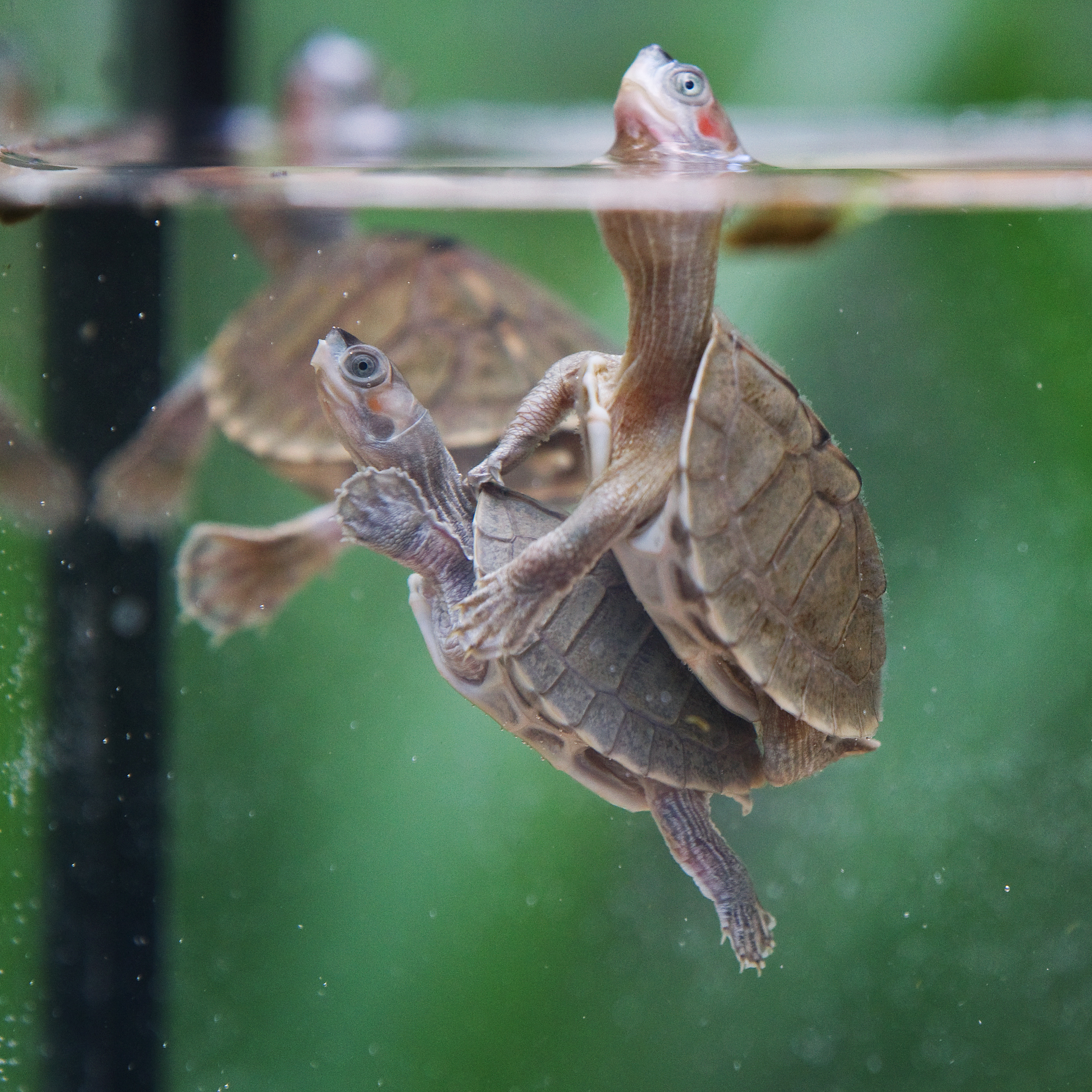
    The UK's Bristol Zoo announced some very good news: Six new Roti Island Snake Neck Turtles hatched and are all doing very well. They are just about a month old. It can take up to ten years for them to reach full adulthood.

    The Roti Island Snake Neck Turtle has an extremely limited distribution and has been subjected to intense collection pressure for the international pet trade market, which has driven it into virtual commercial extinction. Recent field surveys have documented extremely depleted remaining populations still being impacted by persistent collection efforts, with remaining habitat areas also being reduced by agricultural development and conversion of swamps and marshland to rice fields.

    The turtles will eventually be put out on display, although they’re still very young and fragile so are currently kept safely behind the scenes.

    906283_10151366061781872_1534826281_o

    893952_10151366106841872_1146833456_o

    Photo Credit: Bristol Zoo


  • ,

    Baby Sea Turtle Monterey Bay Aquarium 1.jpg

    After a full day of travel on December 20, this baby Loggerhead
    Sea Turtle (Caretta caretta) touched
    down in Monterey, California, around 10 p.m. Steve Vogel, the Monterey Bay
    Aquarium’s
    Husbandry Curator who accompanied the little turtle on its journey, brought it immediately to the Monterey Bay Aquarium, where it went straight into the water behind the scenes.

    Turt swim

    Turt cu

    The next morning, Veterinarian Dr. Mike Murray examined
    the hatchling. At just four months old, it weighs almost half a pound (0.22
    kg), and its shell measures about 4.4 inches (11.2 cm) long and 3.4 inches (8.7
    cm) across. The turtle passed the exam, but is being keep it behind the scenes until after Christmas to acclimate to a regular feeding routine. 

    Baby Sea Turtle Monterey Bay Aquarium 2.jpg

    Turt vetPhoto Credit: Monterey Bay Aquarium

    This Loggerhead is one of nine on loan to various U.S. zoos and
    aquariums from the North Carolina Aquarium at Pine Knoll Shores. They were late
    hatchlings that didn’t make it to the water with their nest-mates. All of them
    were rescued from nests on North Carolina beaches and will eventually be
    returned to the wild. This little turtle will stay at the Monterey Bay Aquarium for as
    long as two years before its return release back in North Carolina.

    This new turtle will serve an important role during it’s stay, acting
    as an ambassador for its species. The Aquarium will make it the focal point
    of an exhibit that highlights the threats facing sea turtles and other ocean
    animals from unsustainable fishing practices. In the wild, sea turtles often
    die when they’re accidentally caught in fishing gear, primarily in trawls and
    longlines. sea turtles around the world also face deadly threats from ocean
    pollution – particularly plastic debris.

    Since the turtle eventually will be released back into the wild, the aquarists will take a “hands-off” approach and not hand-feed it or spend more time with it than necessary, though they will continue to keep track of the hatchling’s weight through routine exams.

    Related articles

    Bronx Zoo Hatches Extremely Rare Yellow-headed Box Turtles
    Nine Endangered Borneo River Turtles Hatch at Dresden Zoo
  • ,

    Turt bod

    Five Chinese Yellow-headed Box Turtles have hatched at the
    WCS Bronx Zoo.They are a part of WCS’s strategy to save some of the
    most critically endangered turtle species in the world. 

    Chinese Yellow-headed Box Turtles are considered to be one
    of the 25 most endangered turtles in the world, with fewer than 150 individuals
    remaining in the wild. They once thrived in streams in the highlands of the Anhui Province of eastern China. But the population collapsed due to human consumption, use in traditional medicine, pollution, habitat loss, and the pet trade. 

    Chinese Yellow-headed Box Turtles require the artificial manipulation of specific environmental and climatic conditions in order to be stimulated to breed. But the experts at WCS’s Bronx Zoo were able to successfully recreate these conditions in propagation areas in the zoo’s Reptile House. 

    Turt hatch

    “The biology of the species requires the adults to hibernate prior to breeding,” said Don Boyer, Curator of Herpetology at WCS’s Bronx Zoo. “We carefully monitor the environment and gradually reduce the temperature in order to induce a natural state of hibernation. Following hibernation, turtle pairs are introduced and carefully monitored to watch for evidence of courtship and breeding activities.”

    Turt CU
    Photo Credit: Julie Larsen Maher

    Read more about WCS's fine conservation efforts below the fold:

    (more…)