The Newest, Cutest Baby Animals from the World's Zoos & Aquariums

Category: Vienna Zoo

  • , ,

    PA_Riesenqualle1

    The Giant Jellyfish, Rhizostoma luteum, has a bell diameter of up to 60 cm (2 ft) and can reach a max weight of 40 kg (88 lb).

    Zoo Vienna has now successfully bred this rare sea dweller for the first time in captivity. The baby jellyfish are about 4 centimeter tall and are now on exhibit in the Zoo’s Aquarium.

    PA_Riesenqualle2

    PA_Riesenqualle3Photo Credits: Image 1,2:Daniel Zupanc / Image 3:Karen Kienberger

     “The Giant Jellyfish was first discovered in the Western Mediterranean Sea in 1827. It is such a rare species that some scientists even doubted its existence. During the last couple of years, some specimens were stranded on the beaches of Morocco and Spain, and it could finally be proven that Rhizostoma luteum does indeed exist,” said Dagmar Schratter, director of Zoo Vienna.

    The story behind this breeding success is as spectacular as the jellyfish itself. Schratter continued, “The marine researcher Karen Kienberger from Jellyfish Research, South Spain, collected an adult Giant Jellyfish in the coastal waters of South Spain for her scientific research. At the laboratory, she discovered that the jellyfish was sexually mature and collected planula larvae which she sent to Zoo Vienna.”

    Almost nothing is known about this jellyfish. It was a real challenge even for the jellyfish experts at Zoo Vienna to successfully breed this species. But they were successful and raised 30 baby jellyfish from the planula to the polyp— and finally to the jellyfish.

    The Zoo successfully took photos of all developmental stages and collected important data, which will be forwarded to Kienberger for further collaborative research.

    French naturalists, Quoy and Gaimard, first described the Giant Jellyfish, Rhizostoma luteum, in 1827. Since its discovery, it has only been mentioned in scientific literature six times due to its rarity. Some researchers even doubted its existence until the recent discovery of specimens off the coast of Southern Spain.

  • ,

    20130427_114613_Zoo_Vienna

    Named for the word “snow” in Finnish, Lumi the female Reindeer
    calf was born on April 25 at Austria’s Vienna Zoo.  Only minutes after the 11-pound
    (5 kg) calf was delivered by female Reindeer Helmi, Lumi stood up on her thin and wobbly
    legs.

    20130427_113245_Zoo_Vienna

    20130427_112333_Zoo_Vienna

    20130427_120300_Zoo_Vienna
    Photo Credits: Norbert Potensky


    According to Zoo Director Dagmar Schratter, “Reindeer live in the barren expanses of
    the Arctic tundra and taiga. Females and young animals have to move on a few days
    after birth to seek new pastures with the herd.”

    Vienna Zoo’s Reindeer
    herd includes five adult females and one male named Hank.  With Lumi’s birth, Hank has become a father
    for the fifth time.  Lumi is the second
    calf born to Helmi.

    Unlike other
    members of the deer family, where only the males have antlers, both male and
    female Reindeer have antlers.  Little
    Lumi will begin to grow her antlers when she is about seven months old.

    Reindeer are
    widespread across extreme northern North America and Eurasia, but many herds
    are shrinking in numbers, possibly due to climate change and habitat
    disturbance.

    See more photos of Lumi below the fold.

    (more…)

  • ,

    Vienna_Sloth_1

    On April 16th, Zoo Vienna welcomed a new member to their zoo in the form of a baby Two-Toed Sloth. Since then, the baby has been hitching a ride on its mother, where it will spend the next six months of its life. "Newborn Sloths use their mother for the first half year as a hammock and cling to her belly fur and cuddle," explained zoo Director Dagmar Schratter.

    This is already fourth baby for parents Alberta and Einstein in the six years they have lived at Zoo Vienna. "Alberta is already an experienced mother. She nurses her baby, grooms it and shows him how to nibble lettuce leaves," Schratter said. Visitors can try to catch a view of the baby, whose sex has yet to be determined, clinging to its mother's belly in the zoo's aviary.

    Vienna_Sloth_2

    Vienna_Sloth_3
    Photo Credits: Norbert Potensky / Zoo Vienna

    Two-Toed Sloths, native to the rainforests of South America, spend their lives in the trees crawling through the canopies clinging upside down to branches. They have specially adapted long curved claws to help assist them in this lifestyle. Another notable adapation for this inverted lifestyle is the way sloths' hair parts. In order to allow rain water to drain easily, their hair is parted along their bellies, not their backs. Sloths generally move very slowly, simply because they don't have to move any quicker. With a fantastically camouflaged coat there is little worry about predation and sloths can slowly make their way through the canopy searching for their diet of fruits, leaves and buds.

    Related articles

    Introducing a Fuzzy White Snowball Baby at Buffalo Zoo!
    Just Say 'Mo': Oregon Zoo's Baby River Otter Gets A Name
    It's Breakfast Time for Baby Sloth
    Mystic Aquarium Visits Baby Sloth at Sloth Sanctuary Costa Rica
  • , ,

    ANteater_1

    A new arrival is delighting keepers at Austria's Zoo Vienna. On Sunday, the 27th of November, a baby Giant Anteater was born and dubbed 'Hombrecito' by zoo veterinarians. Immediately following the birth, mother and child were allowed much needed rest and privacy. Visitors are now able to see the little one clinging tightly to his mother's back.

    Little Hombrecito weighs around 3 pounds and measures about 14 inches in length. His mother will nurse the pup for about six months. His coloration is so similar to his mothers that it provides an almost perfect camouflage for him when he is positioned on her back.

    Anteater_2

    Giant Anteaters are among the most endangered animal species in Central and South America. This uncommon captive birth is a testament to the success of the European Endangered Species Programme (EEP), of which Vienna Zoo is key participant.

    Vicuna_1

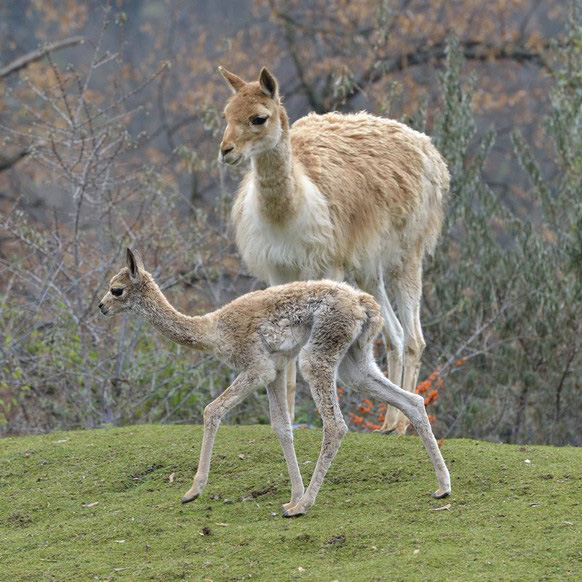
    Hombrecito's birth was followed closely by the birth of a Vicuna calf, just three days later. Keepers believe this calf, the second Vicuna to be born at Vienna this year, is a female.

    Vicuna_2
    Photo credits: Norbert Potensky

  • , ,

    Long considered a "royal delicacy" in Cambodia, the Batagur turtle has been hunted to near extinction throughout Southeast Asia. Today the turtle is critically endangered and it is unclear where wild Batagurs still live. With the hatching of two baby Batagurs at Vienna's Schoenbrunn Zoo last week, the total number of this rare species in captivity climbs to 20. To breed the rare turtles, a father and son team of herpetology experts, Peter and Reinger Praschag, were brought in to recreate just the right natural environment for egg laying.

    Baby batagur baska turtles 2

    Baby batagur baska turtles 1

    Baby batagur baska turtles 3

    Photo credits and copyright: Photos 1 and 2 – Daniel Zupanc. Picture 3: Zoo Vienna / Norbert Potensky