
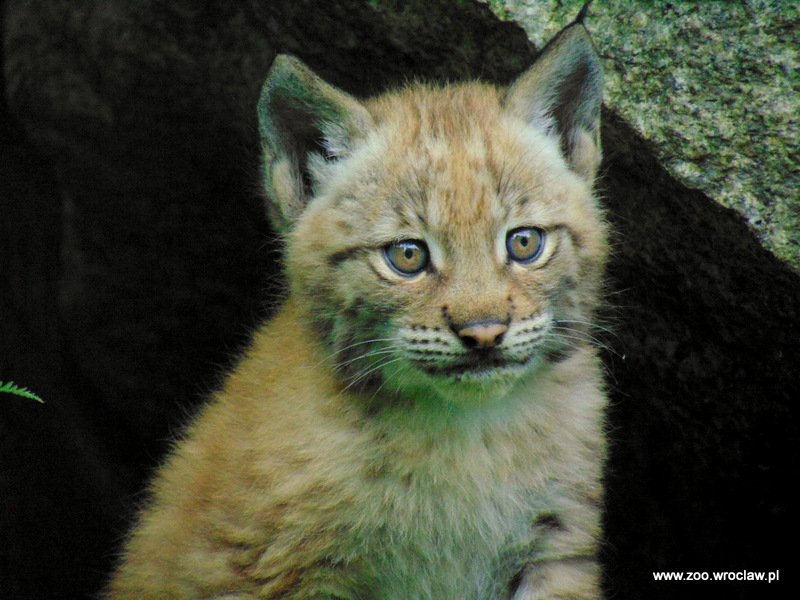
Around June 4th, an adorable female European Lynx was born at ZOO Wroclaw.
The late birth was quite a surprise for keepers, but fortunately, the kitten has been growing like a weed, jumping form 0.5 kg to 3 kg in just four to five weeks.
The parents are Pandora and Orkan, both 14 years old. Zoo staff reports they are a great match and very caring parents. Since their paring, they have produced a healthy litter every year: 20 offspring so far!
One of the cats born to this couple, three-year-old Orpan, is living on the Baltic coast. His offspring will be released into the wild. Keepers have their fingers crossed that the new girl will be just as lucky.
The little Lynxes’ keepers are now looking to name the kitten, and they are extending the invitation for ZooBorns fans to submit their ideas. The only request from the Zoo is that the name relate to Poland or the city of Wroclaw. However, all inspirations will be greatly appreciated!


 Photo Credits: ZOO Wroclaw
The European or Eurasian Lynx (Lynx lynx) is a medium-sized cat native to Siberia, Central, East, and Southern Asia, North, Central and Eastern Europe.
It has been listed as “Least Concern” on the IUCN Red List since 2008, as it is widely distributed, and most populations are considered stable. Eurasian Lynx have been re-introduced to several forested mountainous areas in Central and Southeastern Europe; these re-introduced subpopulations are small, less than 200 animals.
The Eurasian Lynx is the largest Lynx species, ranging in length from 80 to 130 cm (31 to 51 in) and standing 60–75 cm (24–30 in) at the shoulder. The tail measures 11 to 24.5 cm (4.3 to 9.6 in). Males usually weigh from 18 to 30 kg (40 to 66 lb), and females weigh 8 to 21 kg (18 to 46 lb).
Lynx prey largely on small to fairly large sized mammals and birds. Although they may hunt during the day when food is scarce, the Eurasian Lynx is mainly nocturnal or crepuscular, and spends the day sleeping in dense thickets or other places of concealment. It lives solitarily as an adult.


