

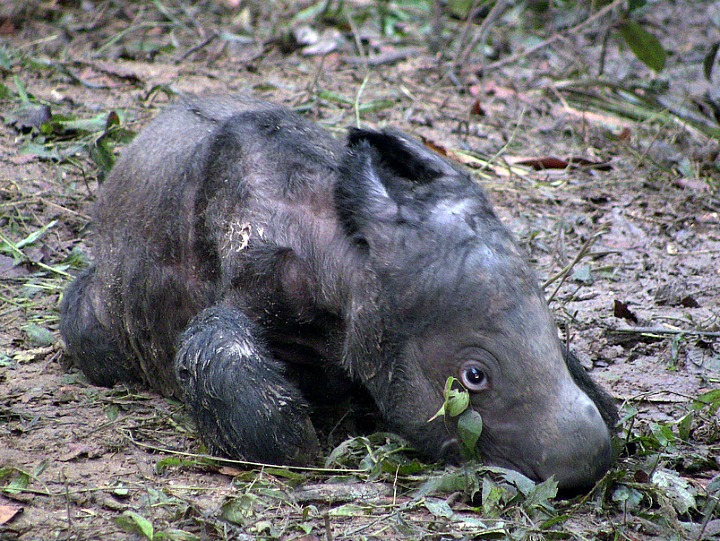
The International Rhino Foundation (IRF) and the Cincinnati Zoo & Botanical Garden are pleased to announce the birth of a bouncing baby boy Sumatran rhino! The calf was born to mother, “Ratu”, a 12-year-old Sumatran rhino living at the Sumatran Rhino Sanctuary in Indonesia’s Way Kambas National Park and father, “Andalas,” born at the Cincinnati Zoo in 2001 and the first Sumatran Rhino calf born in captivity in 112 years. In 2007 he was sent to the Sumatran Rhino Sanctuary with hopes that he would eventually sire calves with one or more of the females at the Sanctuary.
The baby was born on June 23 and weighs 60-70 pounds. He was attended by Sumatran Rhino Sanctuary veterinarians, Ratu’s keepers and advisors from the Cincinnati Zoo and Taronga Conservation Society Australia. Ratu gave birth after two hours of second-stage labor and several days of restlessness. The calf stood about an hour after birth and began nursing almost immediately. Ratu is a very good mother and the baby is healthy and active.
“To say that we are thrilled is an understatement,” said Dr. Terri Roth, Vice President of Conservation and Science and Director of the Cincinnati Zoo’s Lindner Center for Conservation and Research of Endangered Wildlife (CREW). “When we celebrated the monumental birth of Andalas at the Cincinnati Zoo in 2001, we never imagined he would play such a pivotal role in the survival of his species. This international collaboration is conservation work at its finest.” Dr. Roth has been working in SE Asia for over a decade.
There are currently fewer than 200 Sumatran rhinos living in Indonesia and Malaysia. This is the first birth of a Sumatran rhino in an Indonesian facility and the first birth in an Asian facility in 124 years.


Photo Credit: International Rhino Foundation
Read more after the jump:
Dr. Roth added, "We have been waiting for this moment since the sanctuary was built in 1998. The International Rhino Foundation is honored to play an important role in protecting rhinos. We are hopeful the Sumatran rhino population will thrive once again.”
Dr. Dedi Candra, head veterinarian and animal collections manager at the Sumatran Rhino Sanctuary, has been monitoring Ratu’s pregnancy by weighing her weekly and conducting regular ultrasound exams, using methods developed by CREW at the Cincinnati Zoo. “We have been waiting for this moment since Ratu wandered from the forest in 2005,” Candra said.
To assist her in having a successful pregnancy, Ratu was prescribed a hormone supplement that was given orally every day. It was gradually withdrawn as the expected delivery date neared. Dr. Terri Roth provided the protocol and dosage. Andalas’s mother, who also experienced pregnancy complications prior to his birth in the Cincinnati Zoo, was given the same hormone.
“We are overjoyed that Ratu delivered a healthy calf and are cautiously optimistic that the calf will continue to thrive,” said Dr. Susie Ellis, executive director of the International Rhino Foundation. “The little guy is absolutely adorable, and none of us has been able to stop smiling since the moment we were sure he was alive and healthy.The Sumatran rhino is seriously threatened by the continuing loss of its tropical forest habitat and hunting pressure from poachers, who kill rhinos for their valuable horns. The IRF operates Rhino Protection Units in two of the three remaining habitats to ensure that the wild population and its habitat are protected. Every successful birth is critical for the survival of the species, which runs the risk of extinction by the end of this century.
The International Rhino Foundation was created in 1993 and is dedicated to the survival of the world’s rhino species through conservation and research. IRF through its on the ground partner, the Rhino Foundation of Indonesia, funds the operation of the Sumatran Rhino Sanctuary and supports Rhino Protection Units that safeguard the last remaining wild populations of Sumatran and Javan rhinos.


Leave a Reply to Classic SteveCancel reply