

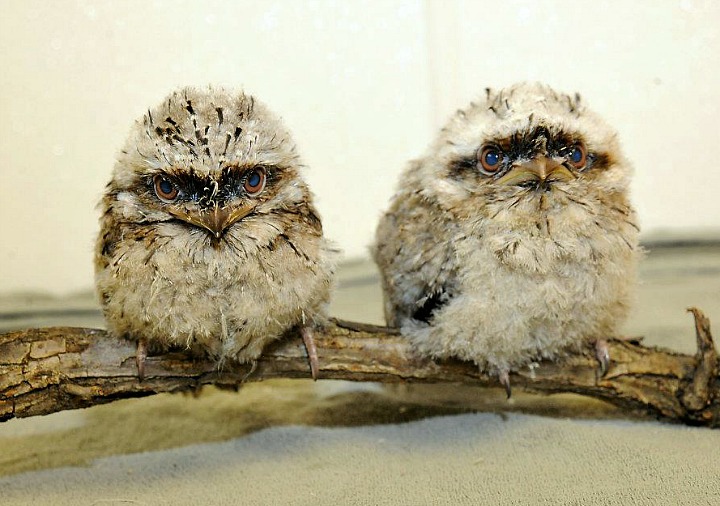
On July 9th and 11th, the Brookfield Zoo welcomed two Tawny Frogmouth chicks. Often mistaken for owls, these Australian birds also hunt at night, but prefer to relax and let their prey come to them, sometimes literally waiting for insects to crawl onto their feathers before snacking.
For reasons unknown, these chicks' parents—Eunice, who is on loan from Riverbanks Zoo in South Carolina, and Gullet, who is from SeaWorld Orlando—abandoned the nest about halfway during the incubation period. To give the unborn chicks a chance at life, staff pulled the eggs and placed them in an incubator. Once the eggs hatched, they received round-the-clock care. Now at 3 weeks old, they have grown, are eating well, and appear to have a bright future ahead of them.


The pairing of the adults was based on a recommendation from the Association of Zoos and Aquariums’ (AZA) Tawny Frogmouth Species Survival Plan (SSP). An SSP is a cooperative population management and conservation program for select species in accredited AZA zoos and aquariums. Each SSP manages the breeding of a species to maintain a healthy and self-sustaining population that is both genetically diverse and demographically stable. Until the chicks are a little older, they will remain off exhibit while being cared for by Animal Programs staff. Guests are able to see the adult pair in the zoo’s Feathers and Scales building. The species is monogamous.
 Photo credits: Brookfield Zoo
More info below the fold
Breeding takes place from August to December (year-round in zoos). Parents share incubation duties—the male during the day, the female at night. The incubation period is between 28 to 32 days, and chicks hatch covered in white down that turns gray in a few weeks. They fledge at approximately 35 days. Tawny Frogmouths have mottled gray, black, white, and silver plumage, with a darker tail and paler undersides. They have a heart-shaped bill and a huge, wide mouth that resembles a frog’s gaping mouth when open—hence their name. Their eyes are very large and perfectly round; the gold iris is encircled with a ring of orange-brown and the pupil is coal black. Males are about 20 inches tall; females are slightly smaller.
Unlike their closest relatives, which include nightjars, nighthawks, and whippoorwills, Tawny Frogmouths are weak flyers. They remain very still on a low perch in the dark until their prey comes close, then they pounce on their meal. At times, the birds adopt a “wait-and-see” technique by perching with their beak open, waiting for insects to brush into their stiff, whiskerlike feathers, which surround their wide-open mouth.



Leave a Reply