

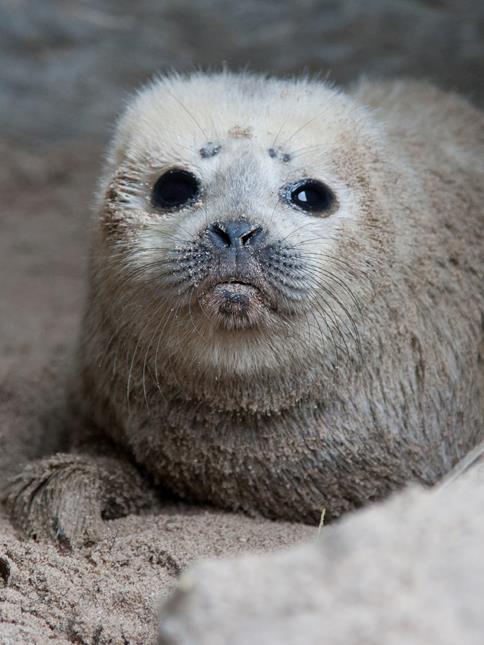
It was a pleasant surprise when Burgers' Zoo found that a Ringed Seal had been born during the night on Friday, March 1st. Zoo staff had observed several matings but were not sure if the seals were mature enough to reproduce successfully.
Burgers' Zoo is the only zoo where Ringed Seals have been born. In the past, caretakers have supplemented pups with bottle-feeding because inexperienced mothers can have difficulty caring for their first young. This year, the new pup seems to be suckling regularly, and caretakers are hopeful that the mother will be able to care for her pup.

Below: The pup, whose sex has not been determined yet, bonds with its mother.

Photo credits: Burgers' Zoo
Learn more about Ringed Seals after the fold.
The most common and widespread of Arctic seals, Ringed Seals live along the coasts of Northern Europe, Iceland, Greenland, Canada, Alaska, and Russia. Generally solitary creatures, they only form large groups to mate. When reproducing in the wild, a mother crawls onshore to dig a snow cave where she gives birth. The caves can be up to seven meters long, and have several corridors and rooms. After a gestation period of about fourteen weeks, the mother gives birth to one pup, or very occasionally two, inside her snow cave.
The mother at Burgers' Zoo gave birth not in a snow cave, but in a sheltered nook in her exhibit habitat. Born with a dense fur coat, the pup is well prepared to be outside in the present cold weather in the Netherlands.
The pups learn to dive shortly after they are born. At two months old, the pups are weaned and begin to fend for themselves. In the wild, these cubs must be wary of polar bears, arctic foxes, walruses, and predatory birds. Ringed Seals spend most of their time in nearshore waters, where they maintain breathing-holes in the ice. Hunting for fish and plankton, these seals can stay under water for forty-five minutes and travel to depths of up to nintety meters (300 feet).
Related articles


Leave a Reply