

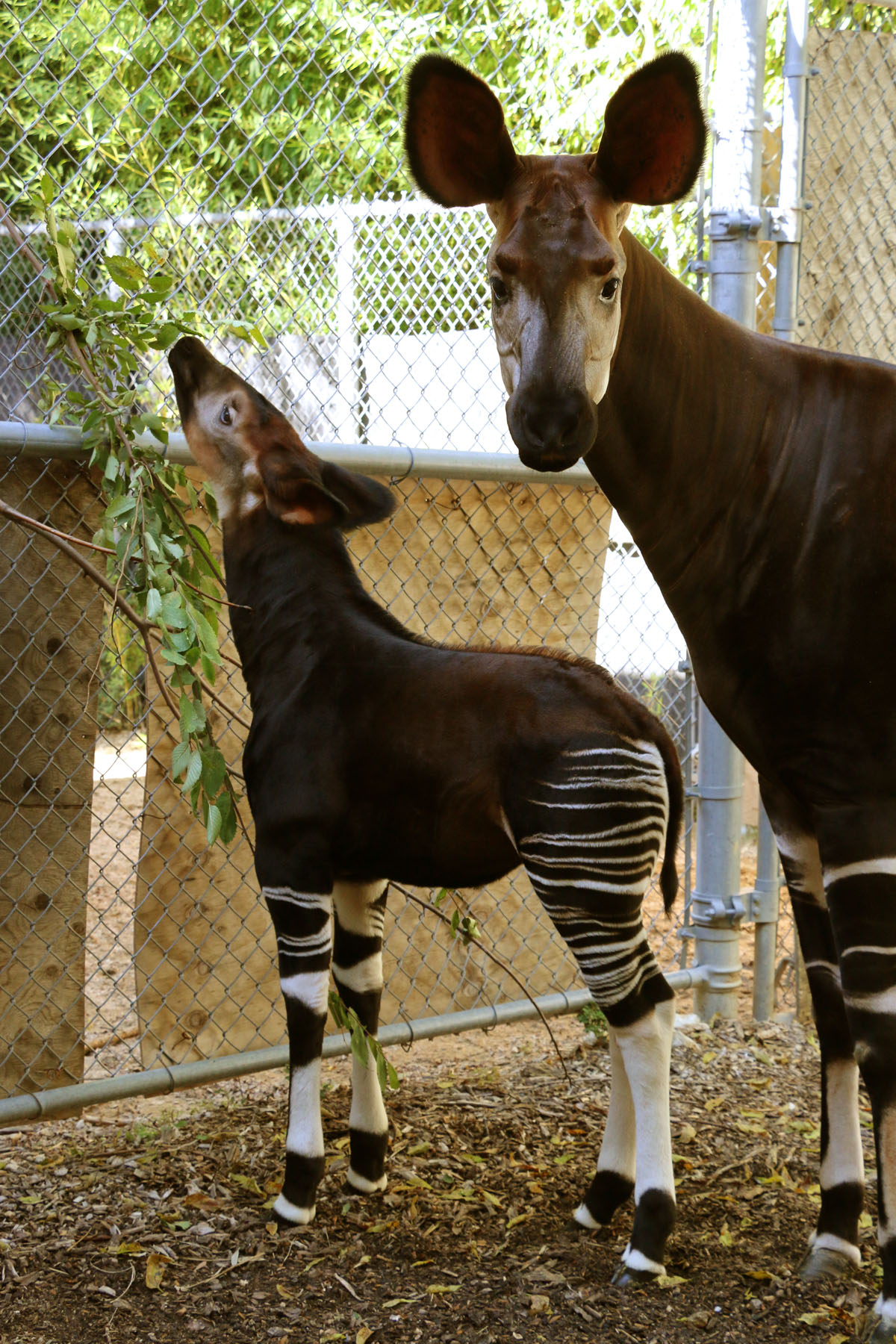
The Dallas Zoo welcomed a healthy baby Okapi, born on August 14. Keepers have named her Almasi, the Swahili word for diamond. After a long 14-month gestation, Almasi weighed 47 pounds (21 kg) at birth, and is now up to 190 pounds (86 kg). When fully grown, she’ll stand more than 5 feet (1.5 m) tall at the shoulder and weigh more than 700 pounds (317 kg). This past weekend, she made her debut at the zoo's outdoor Okapi habitat.
Almasi is the second calf born to her mother, Desi, who is taking very good care of her little one. For now, both remain in their nesting stalls, although Almasi is getting more adventurous every day.
“Almasi’s birth is another major success in efforts to ensure that this incredible animal species survives,” said Lynn Kramer, D.V.M., vice president of animal operations and welfare for the Dallas Zoo. “The Dallas Zoo has a long history of caring for and learning about Okapi, and we will continue to be a leader in the fight to educate the world to protect these animals.” Almasi is the 36th calf born in the zoo’s 50-year history of caring for this rare species.


 Photo credits: Cathy Burkey / Dallas Zoo
See a video of the playful calf:
Okapi (pronounced oh-KOP-ee) are a unique and mysterious animal, so elusive that they have been nicknamed the African unicorn. Their black-and-white striped legs and horselike bodies resemble a zebra, but the okapi is most closely related to giraffes. Like giraffes, their heads have large ears that give them keen hearing and their long prehensile tongues let them strip leaves and shoots from trees.
Okapi in the wild are found exclusively in the Ituri rain forest of the Democratic Republic of Congo. They are difficult to see in the rain forest because of their striking camouflage. Because they’re very elusive and the Congo rain forest is so rugged, little is known about their behavior in the wild. However, researchers have found that their numbers are declining rapidly due to destruction of their rain forest home, despite their popularity in the African country. Okapi are even featured on the Congo’s 1,000-franc note.
“These animals have irresistible charm and behave unlike any other mammal,” said Megan Lumpkin, the Dallas Zoo’s lead keeper for the okapi. “They communicate using infrasound, a low-frequency sound undetectable to humans. It is critically important that they be protected.”
Learn more about Okapi conservation after the fold.
The Dallas Zoo is internationally known for Okapi breeding success and research breakthroughs. The zoo is a key part of the Okapi Species Survival Plan (SSP), a collaborative conservation and breeding program of the Association of Zoos & Aquariums that manages efforts to help ensure survival of this endangered species. As a member of the SSP, the Dallas Zoo supports conservation efforts to protect wild Okapi, while striving to ensure a future for them by maintaining a healthy and genetically sound gene pool.
To further those efforts, in April the Dallas Zoo sent two Okapi to Zurich, Switzerland, as part of an SSP recommendation to help improve the genetic lineage of Okapi in Europe. Such a move from the United States had not been done in more than 20 years, and was a strategic success more than three years in the planning. The intricate process was overseen by Jan Raines, D.V.M. and associate veterinarian at the zoo, and Lumpkin.
“From a veterinary standpoint, we still have much to learn about Okapi,” Raines said. “The more we find out about them, the more we realize how remarkable they are. Having such a dedicated Okapi program at the Dallas Zoo is advancing knowledge that is vital to preserving this species.”
Lumpkin traveled overseas with the Okapi, which handled the trip very well and are now thriving at the two European zoos where they now live. Ann, a female, lives at Zooparc de Beauval in France, while Imba, a male, resides at Zoo Basel in Switzerland.
As recently as 1982, only 16 Okapi lived in U.S. zoological parks, and seven of those were being cared for in Dallas. In the late 1980s and ’90s, Dallas Zoo researchers detailed the norms of behavior for Okapi mothers and calves, leading to guidelines for the species and enabling other zoos to successfully breed the species. Now there are nearly 100 Okapi in 23 zoos across the United States, and 69 live in 17 European zoos.
The Dallas Zoo studies established behavioral norms for the length of time Okapi spend on their nest, nest site choice and permanency, and mother and calf interactions such as nursing behaviors and grooming behaviors. This research indicated the need for a visual barrier between calf nest and mother’s area. The study also established norms for developmental landmarks following birth such as birth weight, first time standing, first time attempting to nurse, first time to nurse, and first defecation. This information helps identify problems quickly in calves born later. Studies have since focused on normal calf weight growth and female pregnancy gain patterns, stress levels during breeding introductions, and measuring behaviors in housing conditions.


Leave a Reply