The Newest, Cutest Baby Animals from the World's Zoos & Aquariums

Posted in ,

DSC_7117--1-1
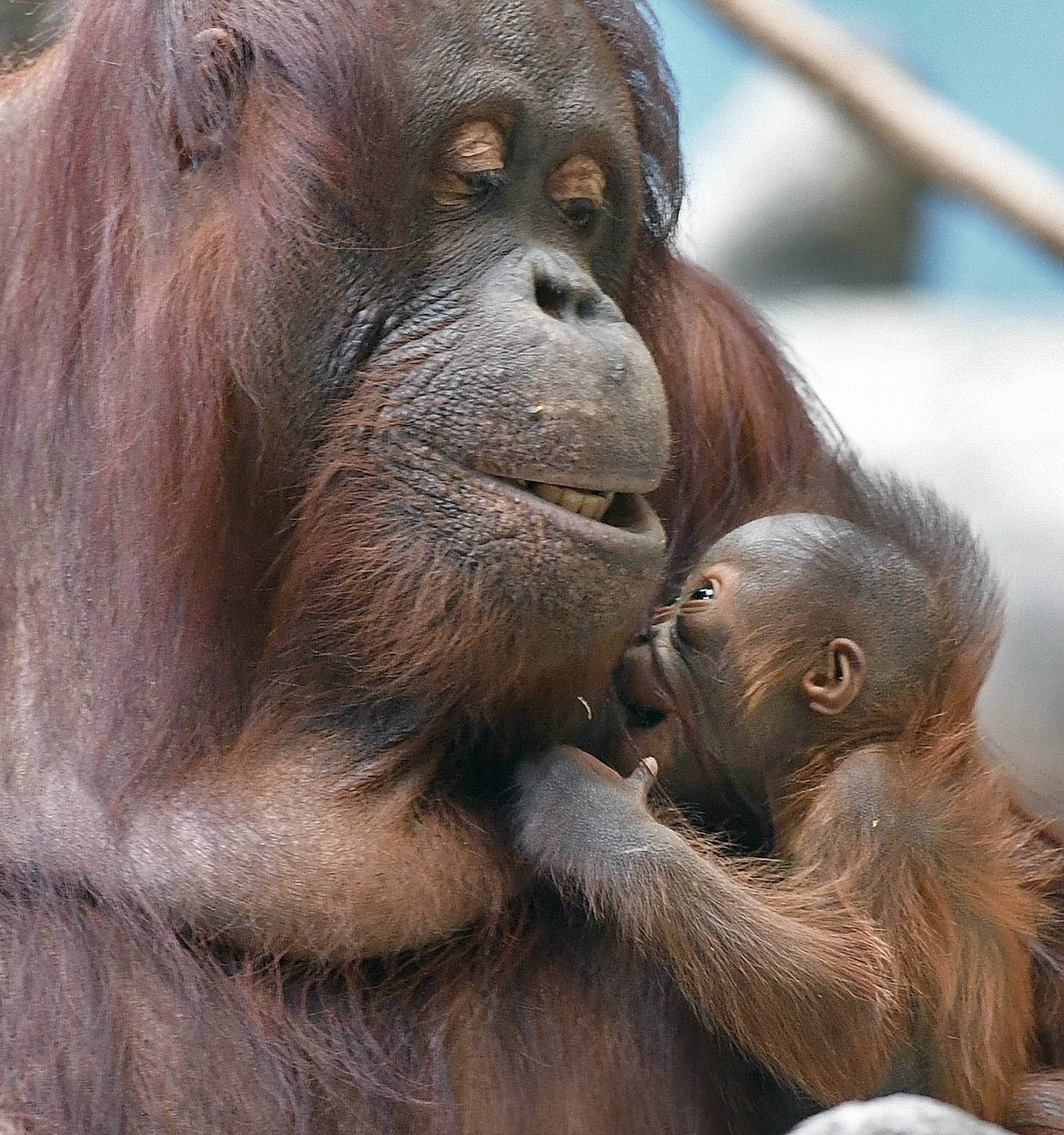
A 2-week-old female Bornean Orangutan born at Brookfield Zoo on December 20 made her official public debut this week to the delight of zoo staff and guests.

As she clings to her mother, the unnamed female infant demonstrates a baby Orangutan’s amazing ability to hold on tight as her mother moves through the treetops.  This infant is the sixth for 35-year-old Sophia, so she is experienced at raising babies.

DSC_6288--12-29
DSC_7152--1-1Photo Credit: Jim Schulz/Chicago Zoological Society

For about the next 10 months, the infant will continuously cling to Sophia. An infant Orangutan relies on its mother longer than any other mammal except humans. An infant may nurse from its mother for up to five years and stays close to her up to age eight. Because of this long dependency, there is a six- to eight-year interval between births. A female remains with her mother into her teens, which gives the young Orangutan the opportunity to observe her mother raise an infant and gain the knowledge she will need once she becomes a mother herself. This birth will be a great opportunity and experience for Sophia’s daughter Kekasih, 8, to watch her mother care for and raise a baby.

Orangutans, a critically endangered species, once lived in much of Southeast Asia, but their range and population have been dramatically reduced due to deforestation, the illegal pet trade, and poaching. According to the International Union for Conservation of Nature, the Bornean Orangutan population declined by more than 60 percent between 1950 and 2010, and a further 22 percent decrease is projected through 2025.

Brookfield Zoo participates in the Association of Zoos and Aquariums’ (AZA) Orangutan Species Survival Plan (SSP), which is a cooperative population management and conservation program for the species. The program manages the breeding of Orangutans in zoos to maintain a healthy, self-sustaining population that is both genetically diverse and demographically stable. The pairing of Sophia and her mate Ben was based on a recommendation by the Orangutan SSP. Currently, 94 Bornean Orangutans and 87 Sumatran Orangutans live in North American zoos.

DSC_6266--12-29
DSC_7145--1-1

Related articles

Amur Leopard Twins Debut in Indiana – ZooBorns
Zoo's First Malayan Tiger Cub Makes Her Debut – ZooBorns
One of the World's Rarest Turtles Hatches at Chester Zoo – ZooBorns
Longleat's Cheetah Cubs Enjoy a Day-Out – ZooBorns

5 responses to “Baby Orangutan Debuts at Brookfield Zoo”

  1. Maria Avatar
    Maria

    The 3rd picture is lovely – Mom Sophia looks so proud of her baby!

  2. Michael Avatar
    Michael

    The math doesn’t work, does it? Sophia is 35. Wikipedia indicates first birth is usually no younger than 14. That’s 21 years. Six babies means 5 intervals between babies. (I find no mention of orangutans having multiple births, and considering the intensity of care the babies require, that makes sense — a mother couldn’t care for more than one at once.) That’s scarcely over 4 years between babies, where the average is supposed to be 6 to 8 years (according both to Wikipedia and the text above). I’ve made a mistake somewhere. Either Sophia started having babies earlier than I think, or had multiple births, or had babies closer together than we’ve been told. The first is possible; Wikipedia says first ovulation can be as young as 6 but is typically followed by a period of infertility. Maybe in captivity orangutans can breed younger than in the wild. Thirty-five minus 6 is 29 divided by 5 is almost 6, still barely the stated interval between births.
    Sophia’s been busy.
    Also, Wikipedia indicates that 30 is a typical lifespan for an orangutan, so Sophia is elderly. Yet another example that animals other than humans apparently don’t have menopause; they keep reproducing till they die. Seems like that’d be bad for the last baby, in a species that requires so many years of upbringing.

  3. Andrew Bleiman Avatar

    Birth intervals in zoos may be shorter than in the wild. Also, orangutans in zoos often live for up to 50 years as opposed to their counterparts in the wild, whose life expectancy is shorter.

  4. Michael Avatar
    Michael

    Thanks for the reply, Andrew. I guess that makes sense. The babies are safer in a zoo — need less guarding, less maternal supervision, so it’s feasible to have two fairly young at once. Still, if they’re used to nursing one at a time, can’t have the next one till the last one’s ready to wean. Also, endangered species, they want to get all the offspring possible out of each fertile female. Valuable resource.

  5. Suzanne Avatar
    Suzanne

    Sophia is also fostering 3 year old Kecil. She is a super mom.

Leave a Reply

Discover more from ZooBorns

Subscribe now to keep reading and get access to the full archive.

Continue reading