

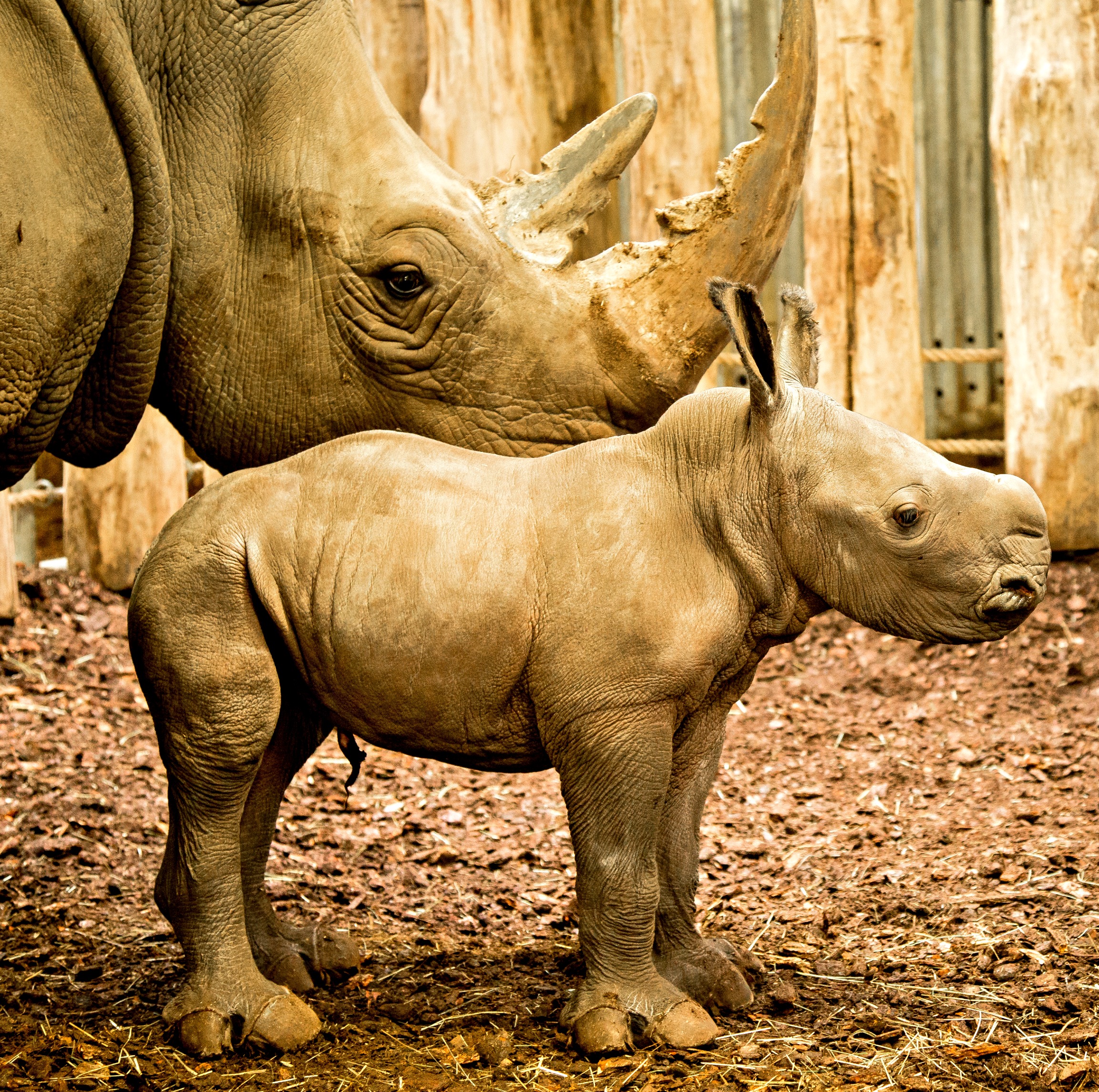
As thousands of viewers watched via live webcam on August 10, Izala the Southern White Rhinoceros gave birth to a healthy female calf at Burgers’ Zoo.
Zoo staff members were anxious about the birth because Izala’s first calf was stillborn in January 2016. It is not uncommon for a White Rhino’s first pregnancy to be unsuccessful. Fortunately, this calf appears healthy and strong, and she was walking and nursing within just hours of birth.
The lively calf, named Wiesje, runs and plays in her large exhibit, with Izala usually trotting close behind.
 Photo Credit: Burgers' Zoo

Seven Rhinos have been born at Burgers’ Zoo in the past 17 years, and around 12 are born each year in European zoos. Last year, 22 Rhino births occurred in European zoos, due in part to increased cooperation among zoos. This cooperation resulted in more Rhinos being transferred among zoos into more favorable breeding situations.
While other Rhino species live mostly solitary lives, White Rhinos live in small social groups which typically include adult females and their young. Males’ territories overlap those of females. Researchers have learned that the hormonal cycles of lower-ranking females in these groups are suppressed, resulting in only higher-ranking females being bred.
In zoos, this research has a practical application: moving a young female to a new environment increase the odds that her hormonal cycle will be restored, which improves the odds that she will breed. Thus Izala, who lived at the Kolmarden Zoo with her mother, was brought to Burgers’ Zoo so she could successfully breed and rear her own baby.
Southern White Rhinos are the largest of all five Rhino species, and are also the most numerous in the wild, with about 20,000 individuals found mainly in South Africa, Namibia, Zimbabwe, and Kenya.
Southern White Rhinos are listed as Near Threatened by the International Union for Conservation of Nature (IUCN). The main threat remains poaching for the illegal Rhino horn trade. As prices for Rhino horn increase, hunting increases as well. Rhino horn, which is used for ornamental purposes and in Traditional Asian Medicine, is made of solid keratin, the same material in human fingernails. It has no proven medical benefits, yet has driven some Rhino species to the brink of extinction: only about 60 Javan Rhinos and 200 Sumatran Rhinos remain in Asia.
See more photos of Wiesje and Izala below.


Related articles


Leave a Reply