
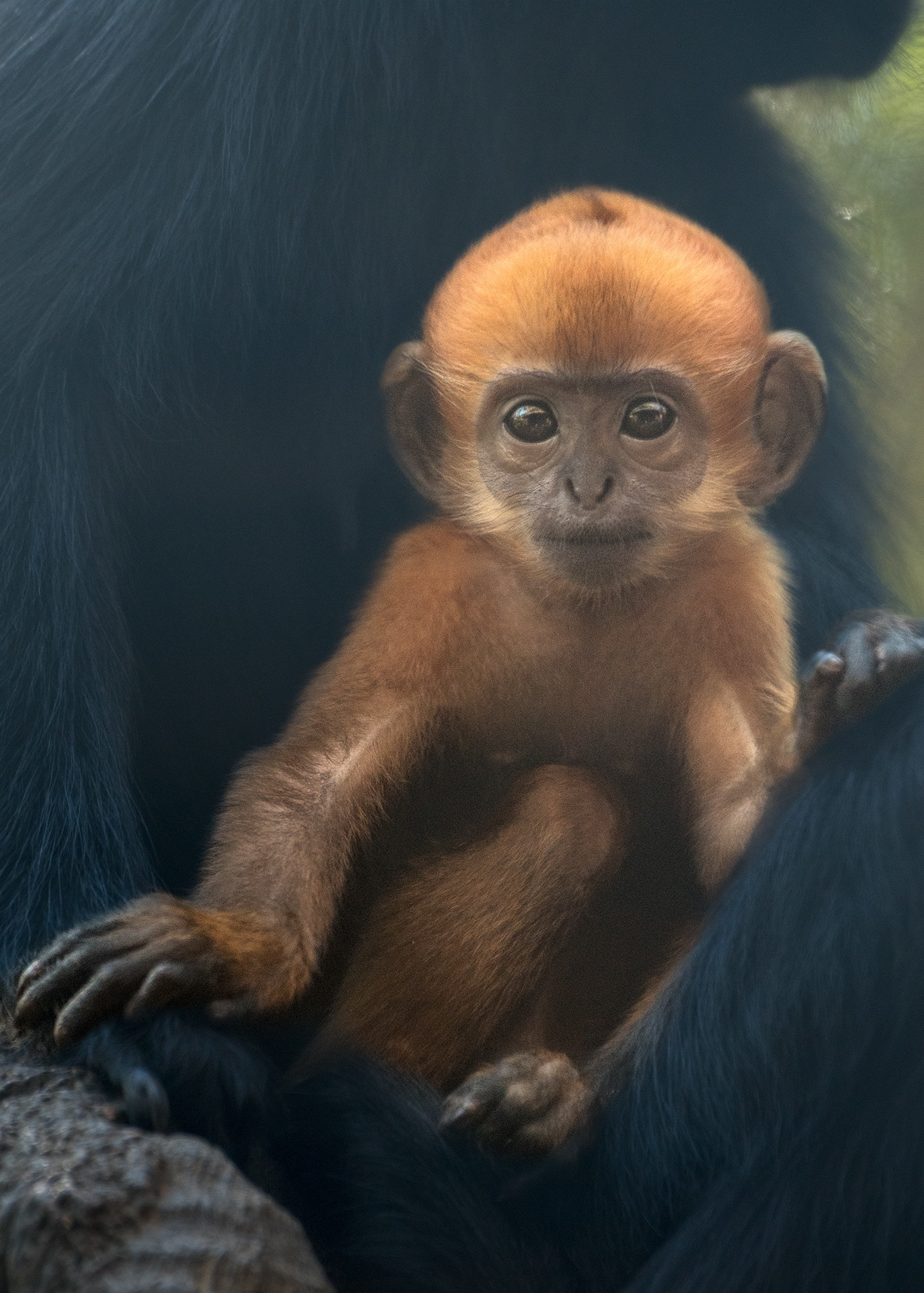
The Los Angeles Zoo welcomed two bright orange male François’ Langur babies this summer. The first born was on June 23 to eight-year-old mother Vicki Vale and the second on July 12 to five-year-old mother Kim-Ly. The infants recently joined their mothers and 19-year-old father Paak in the outdoor habitat, a dense forest filled with tall trees and plenty of branches for climbing and swinging. The babies will eventually be introduced to the rest of the family on exhibit, 26-year-old female Mei-Chi and two-year-old Tao.

 Photo Credit: Jamie Pham
“We’re very excited for guests to be able to observe this blended family in their new group dynamic,” said Roxane Losey, Animal Keeper at the Los Angeles Zoo. “Once the two boys are a little older, they will join their brother Tao and things will probably get a little rough and tumble when they play. These Monkeys are very acrobatic and like to jump and leap from branch to branch.”
The Monkey babies have a long tail, striking eyes, and orange and black fur that will fade to full black over time. François’ Langur infants nurse for close to a year, so they can often be seen in the arms of their mothers. This sometimes proves difficult for mother Vicki Vale who suffered a past injury that left her with limited mobility on her left side. Vicki Vale’s baby has adapted to the unique situation by sometimes hoisting himself onto his mother’s back to leave her hands free when navigating the branches in the habitat. This is not a trait you would find in the wild, as it leaves the baby open to capture by predators or being knocked down by tree branches.
The babies will also spend time with the other adult female members of the group through a practice called alloparenting. This trait lets young females gain experience caring for infants and builds bonds within the troop. It also gives mom a break! Sometimes, though, the animals disagree over how to raise the babies or how they interact with each other.
“The whole family will have minor squabbles from time to time, but you will actually see them come to each other and make up, sometimes with a hug,” said Losey. “You won’t see a lot of Monkeys with this hugging behavior, but Francois’ Langurs are a very gentle species.”
Native to southern China and northeastern Vietnam, François’ Langurs feed on shoots, fruits, flowers, and bark collected in the treetops or on the forest floor. François’ Langurs are listed as Endangered on the International Union for Conservation of Nature’s (IUCN) Red List due to deforestation and illegal capture for use in traditional Asian medicines sold on the black market.
See more photos of the baby Langurs below.


Related articles


Leave a Reply