The Newest, Cutest Baby Animals from the World's Zoos & Aquariums

Category: Albuquerque Biological Park

  • , ,

    The ABQ BioPark has more exciting great ape news! Samantha the gorilla gave birth yesterday at 10:29 a.m. Mom and baby are doing well, and have started nursing.

    ABQ BioPark caregivers were present during the birth, but watched remotely via camera in order to avoid disturbing the natural process. At 15 years old, Samantha is a first time mom, so staff were ready to intervene for the health and safety of mom and baby. Luckily, this was unnecessary! Samantha did great!

    Mom and baby will have access to their outside yard today. Guests should be prepared for the Ape Walk to be intermittently closed to allow for privacy and a quiet environment while baby and mom bond.

    The father is 20-year-old Kojo, who came to the BioPark in early 2021. This is the first time the ABQ BioPark has welcomed a baby gorilla since 2004. We do not yet know the baby's sex. We look forward to sharing more photos and footage in the coming days and weeks!

  • , ,

    Albuquerque BioPark’s Baby Bulan is just over 2 months old and it's time for his first well baby check! Learn from animal care staff how they are able to help keep the youngest animals in their care healthy.

    Previously on ZooBorns: https://youtu.be/LVJMWQdotB0

  • ,

    Karen, a 19-year-old Nile hippopotamus, gave birth to a healthy baby on Monday, July 19, 2021.

    The sex of the baby is not yet known.

    This is her third calf with 47-year-old Moe.

    “Karen’s pregnancy was a bit of a surprise, as she had been on birth control, but we are so delighted to welcome this new addition to the family,” said Lynn Tupa, Zoo manager.

    “Karen is an experienced mother, and both she and baby are doing great.”

    Karen gave birth in the water in the hippopotamus exhibit, and some Biopark guests witnessed the birth.

    Limited opportunities for viewing the baby will be offered at the exhibit as long as mom and baby are doing well.

    Hippos are native to sub-Saharan Africa.

    The International Union for Conservation of Nature (IUCN) lists the species as vulnerable to extinction.

    They suffer from habitat loss and poaching for the illegal ivory trade.

    The ABQ BioPark participates in a number of Species Survival Plans (SSP) for vulnerable, threatened and endangered species;

    This birth was part of the Nile Hippopotamus SSP.

  • ,

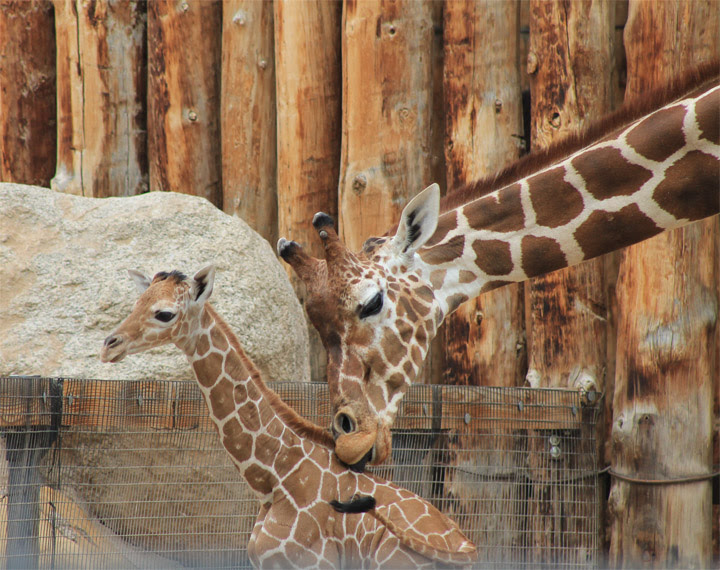
    UnnamedThe latest addition to the Albuquerque BioPark zoo is a male Reticulated Giraffe, born overnight July 16-17. The baby's mother, June, is very experienced with newborns, as this is her tenth calf. 

    Unnamed (1)
    20065314755_8836605f19_kPhoto Credit:  Albuquerque BioPark

    June is 21 years old and has been at the ABQBioPark Zoo since 1998. Buccaneer, the father, has been at the zoo since 2006. This is their fourth calf together. 

    "The baby is doing great, and was up and moving very quickly," said Paul Huang, senior zoo keeper.  "June is a very calm and casual mother, she's an old pro at this."

    Giraffes are pregnant for about 15 months. After dropping six feet to the ground during the birth process, baby Giraffes typically stand within an hour of birth.  They walk shortly thereafter and usually will hide for a few days before starting to follow their mother around.

    June and Buccaneer are paired as part of the Species Survival Plan (SSP). The SSP is a program developed by the Association of Zoos and Aquariums to help maintain a healthy and genetically diverse animal population within the zoo community.

    As part of the plan, after about two years,  the newest generation of Giraffes are often eventually located to other zoos. June has offspring all over the county, including San Francisco, Detroit and Topeka. 

    Once plentiful, wild Giraffe populations in Africa are rapidly declining.  Of the nine subspecies of Giraffes, two are listed as Endangered by the International Union for Conservation of Nature.  Only about 1,100 Reticulated Giraffes remain in the wild.


  • ,

    Baby Chimp3

    The Albuquerque BioPark Zoo welcomed new twin Chimpanzees on November 4, 2014. The pair have stayed very close to their mother, ‘Elaine’, for the past four months.  

    Baby Chimps_6

    Baby Chimps_2

    Baby Chimps_4

    Photo Credits: by Ray Watt / ABQ Biopark Zoo

    Zoo staff were finally able to determine that both babies are male, and now, the BioPark wants your help in choosing the names of the two baby Chimpanzees, through an online contest. The two names with the most votes will be chosen. The options being presented are:

    • Rio
    • Dezi
    • Alby (short for Albuquerque)
    • River
    • Moyobi


    You can vote for your favorite name by visiting the ABQ BioPark's Facebook page at facebook.com/abqbiopark or at  http://woobox.com/pt6x4e.

    "It is fairly unique to have chimp twins, but Elaine is an experienced mother and is doing extremely well," said Lynn Tupa, Zoo Manager, "The twins are getting stronger and more active every day.  Elaine is teaching them to hang on by walking around and letting them hang on to her without being held."

    The ABQ Biopark Zoo was asked to breed their chimps as part of the Species Survival Plan. This plan helps zoos around the country coordinate breeding programs for threatened and endangered species and helps to maintain good genetic diversity.

    More great photos, below the fold!

    (more…)

  • ,

    10060682743_f95e8df8e6_h
    After a 22-month wait, the Albuquerque BioPark
    in New Mexico welcomed a healthy female Elephant calf on October 2.

    10060657023_bb63ccb447_h
    10060529505_a076b8152b_h
    10060645993_51a37fbcbe_h
    Photo Credit:  ABQ Biopark


    "Rozie and her calf are doing well and are getting to
    know each other behind-the-scenes," said Rhonda Saiers, Elephant Manager.
    "She is learning to nurse and getting more steady on her feet. She'll get
    to meet her sister, Daizy, and grandmother, Alice, within a few days."

    The newest addition is the third Elephant born in New
    Mexico. Rozie was the first Elephant born at the ABQ BioPark Zoo back in 1992.
    She gave birth to Daizy, her first calf, in 2009. The multi-generation herd
    includes Rozie, her mother Alice, daughter Daizy and brand new calf. An
    unrelated female, Irene, is also part of the herd and has been a good auntie.
    Samson and Albert, two young males, have formed a bachelor herd, and can be
    seen in yards adjacent to the females. 

    "We're proud to be part of Elephant conservation
    through our breeding program," said Rick Janser, BioPark Director.
    "Our diverse herd represents how Elephants socialize in the wild, living
    in groups and raising calves together. These Elephants show how conservation
    programs can help ensure a future for endangered species."

    Asian Elephants are endangered with only 40,000 left in the
    wild. The ABQ BioPark participates in the Elephant Species Survival Plan (SSP),
    which is managed by the Association of Zoos and Aquariums. The SSP boosts Elephant
    reproduction efforts and promotes genetic diversity to build a self-sustaining elephant
    population in North America.

    The new calf will make her public debut in
    coming weeks.  Rozie's new calf is an
    important addition to the Elephant population and to Albuquerque's herd. She
    will learn how to be an Elephant with the guidance of older Elephants. And
    Daizy, now 4 years old, will learn what it's like to raise a calf, which will
    help prepare her to be a mother in a few years.

    See more photos of the Elephant calf below the fold!

    (more…)

  • , ,

    1-20224_10151084756816971_1189591059_n

    A
    male Southern White Rhinoceros calf born on an unusually cold night at Florida's
    White Oak Conservation Center is now being hand-reared by the staff at New Mexico's ABQ
    BioPark
    , thanks to a unique arrangement between the two facilities. 

    After the baby was born in Florida on October 30, the White Oak staff observed
    that the 169-pound calf was slow to start nursing and did not establish a
    strong bond with his mother, so they decided to hand-rear the calf. 

    Because
    the calf’s father is Bully, a male Rhino sent from the BioPark on a special loan
    to White Oak, the calf belongs to the BioPark.  White Oak Conservation Center partners with
    zoos to conserve threatened species through breeding and other programs.

    5-536779_10151084757226971_815969136_n

    4-407723_10151084772301971_1753195950_n

    3-302722_10151084756206971_1807015326_n

    2-21784_10151085057691971_249346021_n

    The
    calf is bottle-fed a mixture of skim and 1% cow's milk with extra dextrose and
    vitamins added. This formula mimics the very sweet, low-fat milk of Rhino
    mothers. The baby Rhino is hand-fed around the clock, every 3-4 hours, at the BioPark.

    "We are pleased that
    Albuquerque can offer a good home to this Rhino calf," said Mayor Richard
    J. Berry, shown feeding the calf in the photo above. "We know that our Zoo
    will give him top-notch care, and what a great treat for families to watch this
    little guy grow up."

    "The calf is very playful and
    rambunctious," said Zoo Manager Lynn Tupa, who traveled with the two-week-old
    calf from Florida. "He did great during the trip, and we enjoyed getting
    to know him. He loves his fuzzy blankets, which he rolls around on and drags
    with him."

    The calf's first few months at the
    BioPark will be spent behind-the-scenes as he gets accustomed to staff and the
    three adult Rhinos Bertha, Lulu and Bernie.

    The Southern White Rhinonoceros (Ceratotherium
    simum simum
    ), native to southern Africa, is the world’s third largest land
    animal, but nearly became extinct in the early 1900s, when hunting reduced the White Rhino population to 100 animals. Today, there are more than 20,000
    individuals. Conservation efforts such as captive breeding have been an
    integral part of this success story. Zoos and other facilities have been able
    to provide social, open spaces for Rhino groups to breed and thrive.
    Unfortunately, poaching for Rhino horns continues to threaten the future of the
    species.

    Photo Credit:  ABQ BioPark

  • , ,

    ABQ_Snow_Leopards_9

    The ABQ BioPark is thrilled to announce the birth of two male Snow Leopards. Kiran and Kalmali, born July 21, 2011, are beginning to venture into their exhibit with their mother, Kachina, on the Zoo’s Cat Walk.

    “Kachina is a great mother, very fierce and protective of her cubs,” said Shelly Dicks, Mammal Supervisor. “The cubs are peeking out after her and coming into the exhibit, but still shy when people are watching. However, when we arrive in the morning, it’s clear they’ve been having a grand old time. They’ve torn up the enrichment and made a mess of the exhibit!”

    ABQ_Snow_Leopards_3

    ABQ_Snow_Leopards_8

    ABQ_Snow_Leopards_5
    Photo credits: Katie Mast/ABQ BioPark

    Snow leopards are endangered, and zoos and conservation organizations around the world are helping to protect them through a Species Survival Plan (SSP). Organized by the Association of Zoos and Aquariums, the SSP helps arrange adult pairs to maintain genetic diversity. Lynn Tupa, ABQ BioPark Zoo Manager, helps to coordinate the snow leopard SSP. Check out the additional photos beneath the fold…
    (more…)

  • ,

    Harbor Seal Pup at Albuquerque Zoo 1

    On April 13, eight-year old Harbor Seal Gracie, gave birth to a bouncing baby pup in a special birthing pool. Gracie arrived at the Albuquerque BioPark in 2004 after sustaining a gunshot wound which caused significant eyesight loss. BioPark staff were concerned that her impaired eyesight might be a problem in motherhood, but Gracie relies on her other senses to communicate. “Seals use scent and vocalization, so we’re finding that her eyesight is not an issue at all,” said Lynn Tupa, Zoo Manager. “The pup is so cute. She nurses often and communicates with mom constantly, so there is a lot of vocalization. Usually after nursing, they play in the pool together.”

    Harbor Seal Pup and Mom Albuquerque Zoo 1

    Harbor Seal Pup and Mom Kiss at Albuquerque Zoo

    Harbor Seal Pup at Albuquerque Zoo 2Photo credits: Katie Mast, courtesy of ABQ BioPark

    The pup will remain off exhibit with her mother in the birthing pool until able to eat solid food. See more below the fold…

    (more…)

  • , ,

    The Albuquerque Biological Park's two month old Caribbean Flamingo chick is learning the ins and outs of life on top of stilt like legs in the pictures below. Looking like something out of the age of dinosaurs, the chick is being hand-reared but gradually introduced to the flock it will join once it is fully grown.

    Baby flamingo chick abq biopark 1

    Baby flamingo chick abq biopark 1

    Baby flamingo chick abq biopark 1

    Baby flamingo chick abq biopark 1

    (more…)