The Newest, Cutest Baby Animals from the World's Zoos & Aquariums

Category: Berlin Zoo

  • ,

    531591_10151394262517557_1738990514_n

    Two South African Springhares hopped
    onto the scene at Zoo Berlin this winter: 
    One was born on December 14, and the other arrived on January 12. 

    Because Springhares are nocturnal,
    they live their days in reverse at the zoo. 
    Daytime exhibit lights are dimmed to moonlight levels so zoo guests can
    see the Springhares when they are most active. 
    At night, when the rest of the zoo goes dark, the lights come up and the
    Springhares go to sleep. 

    407582_10151394262702557_1316321172_n

    In the wild, Springhares burrow into
    tunnels during the day, plugging the entrance with loose soil, and forage on
    leaves and tubers at night.   When
    threatened, Springhares retreat to their burrows for safety. 

    With powerful back legs for jumping,
    Springhares can leap more than 15 feet (5m). 
    They are one of the largest of all rodents, and are hunted for food by
    indigenous peoples in Botswana, South Africa, and Zimbabwe.  Despite being extensively hunted, Springhares
    are listed as a species of Least Concern by the International Union for
    Conservation of Nature (IUCN).

    426025_10151394262542557_310206424_n

    541387_10151394262792557_1975153773_n

    382215_10151394262527557_826293252_n
    Photo Credit:  Zoo Berlin

    Related articles

    Zoo Berlin Welcomes Baby Giraffe
    Tiny Mouse Deer Born at Berlin Zoo
    UPDATE: Maned Wolf Pups Come Out of Hiding to Visit the Vet
    Two Handfuls of Clouded Leopard Born at Smithsonian National Zoo
  • ,

    Giraffe 1

    It’s
    been four years since a Giraffe was born at Zoo Berlin, so the arrival of a
    male baby to 10-year-old female Kibaya on February 26 was cause for
    celebration.

    Zoo
    keepers estimate the baby’s height at 72 inches (1.85 meters) and its weight at
    220 pounds (100 kg) – a relatively large newborn, even for a bull calf.

    563451_10151435760567557_380534121_n

    Giraffe 2
    Photo Credit:  Zoo Berlin

    The
    zoo’s historic Antelope and Giraffe house was closed for a few days to let the
    newborn gain strength and bond with his mother. 
    The baby’s arrival brings the total number of Giraffes in the zoo’s herd
    to four.

    Though
    he’s already big compared to other zoo babies, this little Giraffe still has a
    lot of growing to do before he reaches maturity.  He’ll spend an entire year nursing from his
    mother, with tastes of hay and solid foods being introduced within the first
    few months.  

    Related articles

    Tiny Mouse Deer Born at Berlin Zoo
    Odense Zoo Welcomes Baby Giraffe
    Mozo Zoo's Visitors in Awe at Birth of Baby Rothschild Giraffe
    Baby Giraffe is Standing Tall at Burgers' Zoo
  • ,

    Deer side

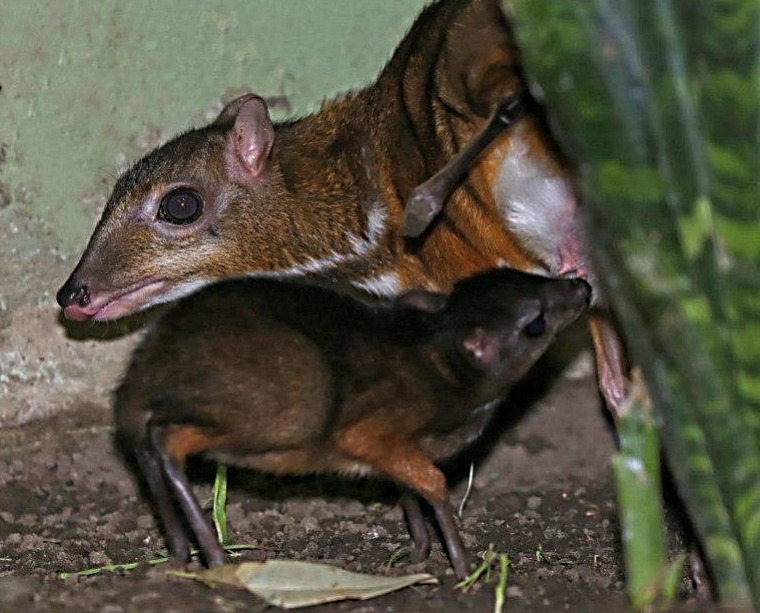
    This tiny baby Mouse Deer was born on Valentines Day at the Berlin Zoo. It fits perfectly into a man's hand. These shy animals are actually are the smallest hoofed mammals in the world, and are members of the animal family that includes pigs, antelopes, sheep, goats, and hippos! This baby will grow to a maximum weight of only about 5 pounds (2.5 kg) in adulthood, and its legs will be no bigger than the circumference of a pencil!  

    Mouse Deer reach sexual maturity very early – at age five to six months. A female may give birth to a single fawn at any time of year. As is the norm with hoofed animals, newborn fawns are precocial and stand within thirty minutes of being born. The does wean their fawns at around twelve weeks. In the wild they roam mostly at night within a certain home range amid forest undergrowth, feeding on the leaves, roots and tender shoots found there, aided by their long tongue!

    Deer nurse

    Deer sit

    Photo Credit: Zoo Berlin and cfrey@alice.de

    The birth of this baby at the Berlin Zoo was coordinated within the EEP (European Endangered Species Programs). In it's native home, Southeast Asia, the Mouse Deer is hunted, even though they are so small and have hardly any meat. With the good care found in a zoo, these animals can live for up to 10-12 years.

    See more pictures after the fold:

    (more…)

  • ,

    Cat 3

    The Berlin Zoo is celebrating the first birth of Rusty-Spotted Cats in its 168-year history.  Rusty-Spotted Cats are the world's smallest wild cats, weighing only 2.0 to 3.5 lb (0.9 to 1.6 kg) as adults. 

    The two kittens were born on August 5, and have only recently begun to leave their den to explore their exhibit.  Playful, clumsy, and a little awkward, the two female youngsters are a delight to zoo guests.  At birth, kittens typically weigh just 2.0-2.7 ounces (60-77 g).

    Cat 2

    Cat 6

    Cat 4

    Cat 1

    Native only to Sri Lanka and India, these diminuitive cats are classified as Vulnerable due to habitat loss and the conversion of wild lands to farms.  Rusty-Spotted Cats prefer dense forests and grasslands, emerging at night to hunt for rodents, birds, and lizards. 

    Little is known about these secretive cats, and few zoos display this species, making these two kitttens especially important for the captive population.

    Photo Credits: Berlin Zoo

    0.9 to 1.6 kg (2.0 to 3.5 lb)
  • ,

    Hog 11

    On September 1 this little Red River Hog was born in a padded corner nest filled with wood shavings at the Berlin Zoo. Mom Dagmba lay on her side to encourage the baby to nurse, and somehow the baby, who did not have to fight with any siblings or share milk, ended up choosing the most out-of-reach teat. 

    This lively little one, named Tonka by his keepers, has already begun to follow his mother outside into their habitat when the weather permits. When mom sits down or stops, Tonka hugs her side, where he feels safest. The rest of the gang, Boar pig Kivu, Tomu and sow Gundi, are curious, but the baby will not be introduced to them for a few more days; Keepers are letting mom and baby be for now, to ensure further bonding and to give Tonka the time to grown stronger and bigger before romping with the rest.

    Hogs are native to West and Central Africa. With its reddish
    coat, dark face mask, white beard and conspicuous ear tufts, they
    are among the most colorful mammals. In zoos, the population trends of the Red
    River hogs are controlled by conservation breeding
    programs such as the one at Berlin Zoo.

    Hog 1

    Hog 2

    Hog 5

    Photo Credits: Berlin Zoo

  • ,

    Side by side

    The Berlin Zoo is celebrating the safe
    arrival of their newest baby Asian Elephant, a healthy female. She
    was born just after midnight on August 12, standing 3.28 feet tall (one meter) and weighing 353 pounds (160 kg), after
    a 654 day gestation – that's nearly two years! Last week she made her public debut to the delight of the many zoo guests who came to see her.

    Asian Elephants are endangered, the major threat being loss of habitat, poaching for their ivory tusks and conflict with human encroachment.

    Solo

    Nurse
    Photo Credit: Zoo Berlin

    This is the fourth baby for mother, Pang Pha. Since Mom was a gift to the the zoo from the Royal Thai Government, zoo staff has named her new calf Anchali, which means 'greeting' in Thai. Victor, Anchali’s father, is 18 years old. Like most male Elephants, he has little contact with his offspring. Anchali has been successfully nursing on her own, though it makes her sleepy… In the video below you can catch her napping peacefully afterwards at her mother's feet. 

  • ,

    9511eb13eb

    Berlin's Tierpark has the good word that on May 8th, a male Asian Elephant calf came into the world. The little bull and his 18 year old mother Nova are doing well and the family was presented to the public on on May 10th. This is the second birth for Nova. The yet to be named new arrival is about 35 inches tall and weighs around 225 pounds!

    0dfdd88ed7

    F0130e4aa2
    Photo credits: Tierpark Berlin

    The major threat facing the endangered Asian Elephant today is the loss  of its habitat Southeast Asian habitat (from India in the west to Borneo in the east) resulting from deforestation. Other causes for their population decline include poaching for ivory, isolation of Elephant populations and Human-Elephant conflict.

  • ,

    Forest-Buffalo-2

    Born January 8th, this African Forest Buffalo joined Zoo Berlin's herd to the excitement of zookeepers and visitors alike. The African Forest Buffalo is slightly smaller than its close relative, the Cape Buffalo. Its native habitat is the equatorial forests of Central and West Africa. Forest Buffaloes feed primarily on grasses, twigs and shoots. Their main predators in the wild are Leopards.

    Forest-Buffalo-1

    Forest-Buffalo-3

    Forest-Buffalo-4

    Forest-Buffalo-5
    Photo credit: Zoo Berlin

  • ,

    Mom noses

    A baby hippo, born at the Berlin Zoo on October 23, has been delighting keepers and guest alike. The as yet unnamed calf remained behind the scenes in the pools for several days to bond with it's mother Nicloe. Then she confidently led the baby to the water in the exhibit, and introduced the little one to the other members of the herd.

    This is the third baby for this experienced mom, and the baby's interactions with her siblings and the other adults is wonderful to watch. The wee one made this public debut on Nov. 1. Underwater, they run or walk along the bottom with their ears and nostrils clamped shut by special small muscles. Their heart rate slows, allowing them to stay under for up to 30 minutes, though they commonly come up for air every 6-7 minutes.

    Hippopotamus live on both land and water. Their natural habitat is grassland where there is permanent still water that is not too deep. Sadly, this species has been declared endangered because of habitat loss due to man's encroachment, and because they are hunted for meat.

    Wmom

    Hi

    Swim

    More pics beneath the fold…

    (more…)

  • ,

    Last week, veteran photographer and ZooBorns contributor A.J. Haverkamp snapped pictures of Likemba, Zoo Berlin’s baby Bonobo. Only defined as a separate species in 1929, Bonobos differ from chimps largely for their more peaceful and easy going social dynamics.

    Bonobo

    Bonobo2
    Photo Credits: Arjan Haverkamp

    Team ZooBorns is off to Houston today for the Association of Zoos and Aquariums’ annual conference. We’ll be posting from the road and we hope to see some of you in the lonestar state!