Nyx the Palm Cockatoo chick was hatched on 5/8/21 at San Antonio Zoo. This timelapse takes place from 5/8/21 – 8/22/21, 105 days in all.
Since 2017, San Antonio Zoo has been the only AZA facility to successfully breed palm cockatoos, both by hand and parent rearing.
While this species is a popular pet trade animal, it’s still crucial that their populations are managed in zoos. Management in Association of Zoos & Aquariums (AZA) facilities via Species Survival Plans (SSPs) ensures that a healthy, genetically diverse population exists in human care.
They’re just one of the many animals the zoo is helping secure a future for through participation in AZA Species Survival Plans!
Brevard Zoo animal care staff are doting over two tiny galahs. The older chick hatched on March 21, and the younger sibling emerged from its egg six days later. The latter has yet to open its eyes. They are the first galahs to ever hatch at the Zoo.
The eggs were placed in a climate-controlled incubator several weeks ago because the chicks’ parents had not successfully hatched out young in the past. The chicks—who have not yet been named or sexed—are syringe-fed a specialized parrot formula nine times throughout the day.
These youngsters will stay behind the scenes for at least a few weeks, then move to a public-facing habitat with the rest of the Zoo’s galah flock.
Galahs are members of the cockatoo family native to Australia. As adults, they are famed for their vibrant pink plumage.
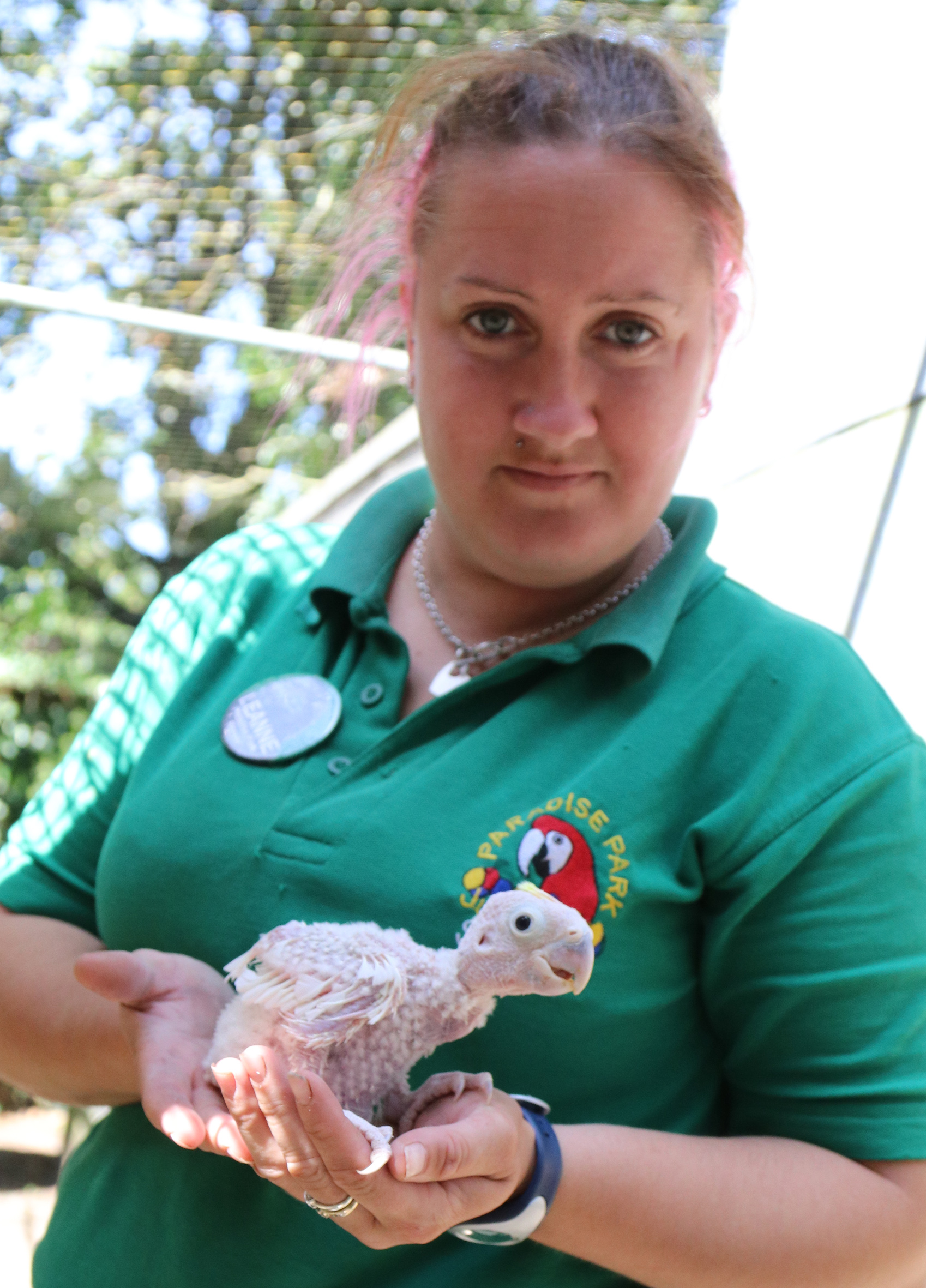
A Palm Cockatoo chick named Herbert is being hand-reared at Paradise Park in the United Kingdom, and he is charming the zoo keepers who care for him.
Photo Credit: Paradise Park
Keepers are raising the chick because his parents, Tess and Ziggy, have produced eggs before but the eggs broke before they could hatch. When keepers noticed Tess and Ziggy squabbling over their newly-laid egg, they were concerned that the egg would be crushed. “We stepped in and took the egg to an incubator,” says keeper Leanne Gilbert.
Parrots, including Palm Cockatoos, are completely featherless upon hatching, and Herbert was no exception. Despite his tiny size and helpless state, Herbert managed to be quite demanding of his keepers, who of course meet Herbert’s every need.
Now three months old and covered in sleek black feathers, Herbert is almost ready to eat solid food. For now, he eats a mixture of blended carrot, apple, broccoli, macadamia nuts, smooth peanut butter, Macaw formula, called “Witches Brew,” from a syringe. He is already interested in nibbling carrot sticks with his sharp and powerful beak.
Herbert is the first Palm Cockatoo chick to successfully hatch at Paradise Park in more than 20 years.
Parrot chicks start small but grow rapidly, reaching near-adult size within just a few months. One way to tell adults from juveniles is by the length of the tail feathers – those of adults are longer.
Paradise Park Wildlife Sanctuary, in Cornwall, UK has a new Yellow-crested Cockatoo chick. Park Keeper, Leanne, was more than happy to give the chubby little bird a clean bill of health at his nest check. She reported, “The parents are very attentive, so the chick has grown well, and it’s good to see feathers appearing now.”
Paradise Park Director, Alison Hales, explained further, “Yellow-crested Cockatoos are ‘Critically Endangered’ in the wild – this species and its sub-species now only remain in small, scattered populations through the islands of Indonesia. In an ongoing project with the World Parrot Trust, a recent survey indicated that the species is in much greater peril than previously thought, so this little chick is very important and will play a key role in the breeding program. Previous youngsters have been placed on breeding loan with other bird collections and zoos; they will be available if needed for a reintroduction scheme in the future.”
Photo Credits: Paradise Park Wildlife Sanctuary Cornwall
The Yellow-crested Cockatoo (Cacatua sulphurea), also known as the ‘Lesser Sulphur-crested Cockatoo’, is medium-sized (approximately 34 cm long) with white plumage, bluish-white bare orbital skin, grey feet, a black bill, and a retractile yellow or orange crest.
The species is found in wooded and cultivated areas of East Timor and Indonesia's islands of Sulawesi and the Lesser Sundas.
The bird's diet consists mainly of seeds, buds, fruits, nuts and herbaceous plants.
The keepers at Australias' Taronga Conservation Society have proudly announced a very special new arrival, a Glossy Black Cockatoo chick. The chick hatched on the 25th of May, and initially only resembled a small ball of yellow fluff with one very large beak making it very cute looking indeed.
First time mother Gloucester was hatched at Taronga in 2004 with the help of bird keepers as her mother had never raised a chick properly before. Poor Gloucester also fell ill 12 months ago, so has really come around to pair up, lay, incubate her own egg and now also be a great mum!
Photo Credit: Taronga Conservation Society
At seven weeks of age the chick is doing very well and will be expected to fledge from its tree hollow in around three weeks time. This will be when visitors may glimpse Gloucester and her chick exploring their dense Bush bird aviary opposite the Koala Walkabout at the top of the zoo.
It has been seven years since Taronga Zoo was last successful at hatching a Glossy Black Cockatoo — Being both complex and specialised in their needs, there have been many challenges along the way. But they finally led to this very welcome event.
After 19 years of trying, Keepers at Chester Zoo in the UK have finally succeeded in the breeding of an extremely rare parrot. These three Philippine Cockatoo chicks are the first to be born at the zoo and are being hand-reared after recently hatching in incubators. The chicks, which look a bit like tiny dinosaurs, are now receiving round-the-clock care in their precious early days – and yes, they are nestled in a Walls ice cream tub!
Andy Woolham, Team Manager of Parrots and Penguins, said, “The species has a very aggressive nature and that makes successful breeding a very rare occurrence. That’s why this is incredibly significant for their conservation."
"We have been trying to persuade them to breed since the first birds arrived at the zoo in 1992, Woolham continued. "During this time there has been a program of dietary and environmental review, which has helped us to make changes to how we look after them and ultimately resulted in this success. It has been a long burning ambition of mine and I just can’t stop smiling! It is so important that a secure safety net population of this species is established in zoos.”
Photo Credit: Chester Zoo
Also known as the Red Vented Cockatoo, the species is critically endangered in the wild due to a combination of illegal trapping for the pet trade and habitat loss.Chester Zoo supports conservation programs for the species in its natural home and works closely with organisations in the Philippines. These efforts have seen numbers increase over recent years but the species still remains under threat.
Denver Zoo recently welcomed two Palm Cockatoos from two different breeding pairs. The chicks hatched on January 18 and February 10 and their genders are still unknown. Though the hatchlings will eventually be on display at the zoo's Nurture Trail exhibit, they are currently growing and developing under the watchful eye of bird keepers in the zoo's Bird Propagation Center. These are the second and third Palm Cockatoo chicks to be hatched at North American Zoos in the last year.
On October 5 an egg hatched at Adelaide Zoo in South Australia and out popped a Palm Cockatoo chick with a face that only a mother Palm Cockatoo could love! She has since grown into a gorgeous bird! This is the first successful Zoo birth of a Palm Cockatoo in Australia since 1973 and Adelaide Zoo is the only Zoo in Australia to house Palm Cockatoos. Adelaide Zoo keepers decided to take the egg away from her parents as they had a poor history of incubating their own eggs. The egg was then placed in an incubator and once hatched the chick was cared for by keepers. For the first few weeks of her life she needed feeding every hour and a half. This kept the keepers very busy who in turn took her home over night for those 2am feeds! Since the Palm Cockatoo are native to warm regions such as northern Queensland, Australia, New Guinea island in Indonesia and Papua New Guinea, the chick had to be kept at a constant temperature of 35C/95F degrees during her early development.