Exmoor Zoo staff had an extra special Christmas present when they were greeted by two new arrivals first thing Christmas morning. Two baby Capybara pups! They have been delighting visitors with their antics over the holidays.

The Newest, Cutest Baby Animals from the World's Zoos & Aquariums
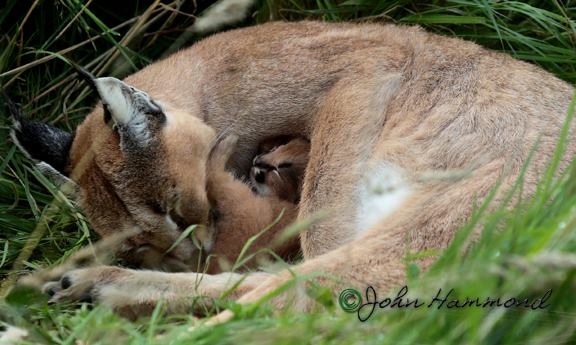
A tiny caracal, born in December at Exmoor Zoo in the U.K. tags along with watchful mom.
 Meet ‘Mumbles’ and ‘Wiggles’, also known as the ‘Weasley Brothers’! The two Yellow Mongoose brothers were born, in late January, at Exmoor Zoo.


 Photo Credits: John Hammond/Exmoor Zoo
According to Zoo Curator, Danny Reynolds, the zoo has looked after the species for more than 15 years, but this is the first time they have had success with babies reaching the age of Mumbles and Wiggles. The parents had a litter in the past, but due to the mothers advanced age, she was unable to produce enough milk. This time around, zoo staff decided it would be in the best interest of the brothers to intervene, and they began hand rearing the pair.
Zoo staff will be providing extended hands-on care for the brothers, over the next eight weeks. Then, the duo will be placed on exhibit, for visitors to observe.
The Yellow Mongoose is sometimes referred to as the ‘red meerkat’. Their average adult weight is about 1 pound, and they generally reach a length of about 20 inches. Their native habitat is in open country, from semi-desert scrubland to grasslands in Angola, Botswana, South Africa, Namibia, and Zimbabwe.
The Yellow Mongoose is carnivorous, consuming mostly arthropods, but they are known to dine on other small creatures, such as: lizards, snakes, and eggs of others species.
They generally mate between July and September, and they usually give birth between October and December. Usually, two offspring are produced, and they are weaned at about 10 weeks of age. They reach adult size after 10 months.
The Yellow Mongoose is currently classified as “Least Concern” on the IUCN Red List.
More adorable pics, below the fold!

The dog days of summer may be coming to a close, but the cat days seem to be just starting: Exmoor Zoo in England welcomed a Caracal kitten in mid-August, and it is a joy to see the mother completely devoted to caring for her new baby. Mom and kitten were spotted taking a lunchtime bath and snooze together about a week ago on August 24. The kitten is pictured at just one week old. The little one still has eyes closed and gets carried around everywhere by mom. Caracal kittens will open their eyes between four and ten days old, and nurse until they are weaned at about ten weeks.


See more nap-time photos after the fold!

A pile of pups has arrived at the United Kingdom’s Exmoor Zoo: a litter of seven Asian Small-clawed Otters,
born in 2012, is enchanting zoo visitors with adorable antics. The smallest of the world’s Otter species,
Asian Small-clawed Otters are native to the swamps and wetlands of Southeast
Asia.


Photo Credits: John Hammond (1,2,6,8), Exmoor Zoo (3,4,5,7,9)
Reaching a length of about three feet (90 cm) including the
tail, these Otters are excellent swimmers.
Streamlined torpedo-shaped bodies, flattened heads, and short legs allow
Otters to move through the water quickly.
Partially-webbed paws give these Otters the ability to manipulate the
mollusks, crabs, and other aquatic animals on which they feed.
Asian Small-clawed Otters build dens in riverbanks, where
they live in extended family groups.
Scent is very important for communication: their feces, called spraint, are used as territorial
markers to establish boundaries. The
Otters also construct small mounds of gravel, sand, or mud, then mark these
mounds with their scent glands.
Listed as Vulnerable by the International Union for
Conservation of Nature, Asian Small-clawed Otters are threatened by rapid
habitat loss and pollution.
See more photos below the fold!

Two tiny and very delicate Johnston’s
Chameleons hatched the UK’s Exmoor Zoo. Just over an inch (3 cm) long, the
babies had an auspicious start in life:
they were laid by a female that was part of an illegal shipment en route
to the Czech Republic and seized by customs agents in Belgium.
Because Johnston’s Chameleons occur
only in the western branch of Tanzania’s African Rift Valley – the Albertine
Rift – they are extremely rare in captivity, according to Danny Reynolds of the
Exmoor Zoo. “They are probably the first
of this species ever born in captivity within UK zoos,” he said.


The illegal shipment of 59 Chameleons
was due to be destroyed when the UK’s Specialist Wildlife Services and UK
Customs officials intervened and placed all the lizards in UK zoos. Females at
several other zoos have laid eggs, but those at the Exmoor Zoo were the first
to hatch.
Like all Chameleons, Johnston’s
Chameleons are zygodactylous – they have two toes pointing forward and two toes
pointing backward, which enables them to easily cling to tree branches (or toothpicks, as seen in the photos above). They capture insects with their long,
extrudable tongues. In captivity, the
babies are fed fruit flies and day-old crickets.
Photo Credit: Exmoor
Zoo

Two baby Coatis are charming visitors at the U.K.’s Exmoor
Zoo. The pair was born earlier this month.
Native to Central and South America, Coatis use their long, flexible
snout to search for insects, spiders, fruit, and small animals.


As close relatives of raccoons, Coatis exhibit agility,
intelligence, and adaptability. They can
be found in a variety of habitats, from tropical rain forests to high mountain
slopes. Coatis commonly forage on the forest floor, using their pig-like snout
to push aside leaf litter as they look for food. They are easily identified by their long,
striped tail. Coatis may travel in loose
groups of up to 25 individuals.
While not listed as threatened, Coatis face pressures from
habitat destruction and unregulated hunting.
Photo Credit: Exmoor
Zoo