The Newest, Cutest Baby Animals from the World's Zoos & Aquariums

Category: Great Plains Zoo

  • ,

    1_Rhino_calf_10-11-16

    A rare Eastern Black Rhino was born September 12 at the Great Plains Zoo. The male calf is the third Rhino born at the Zoo and was the first Eastern Black Rhino, born as part of the Association of Zoos & Aquarium’s (AZA) endangered species breeding program, since 2014. The calf weighed 103 pounds at birth and will be viewable to the public in several weeks.

    With the calf and his parents, Jubba and Imara, the Great Plains Zoo now holds three of only 57 Eastern Black Rhinos in North America. It is estimated that fewer than 740 Eastern Black Rhinos are left in the wild, and they are considered to be a critically endangered species. While they do not have natural predators, their numbers are drastically low due in large part to illegal poaching for their valuable horns.

    2_GPZ_Imara and Baby Boy Rhino_2016_fb

    3_GPZ_Imara and Baby Boy Rhino_2_2016

    4_Rhino_calf_10-11-16Photo Credits: Great Plains Zoo

    The Zoo is a critical player in the AZA’s endangered species breeding program; the Zoo’s Senior Director of Animal Care, Lisa Smith, is the coordinator for the national Species Survival Plan (SSP). The Zoo’s “Rare Rhinos of Africa” exhibit includes a state-of-the-art breeding facility that was built in 2010. The space was designed to facilitate birthing and care of these large animals, with adaptable birthing suites, in-floor heat, and padded flooring. The Zoo’s veterinarian, vet tech and animal caregivers were able to monitor the mother’s progress toward delivery, both in person and remotely from home, using video cameras and the Internet.

    “The baby Rhino’s birth is important for our Zoo, and even more important for the population of Black Rhinos in the Species Survival Plan,” said Elizabeth A. Whealy, President and CEO. “The Zoo is increasing our conservation efforts with zoos around the world to raise awareness of the plight of Rhinos, and to work with partners in the field to protect this amazing animal.”

    Jubba and Imara are an important breeding pair. In addition to the new calf, their offspring include Kapuki, a female born in 2005, and Kiano, a male born in 2010. While both Kapuki and Kiano were born at the Great Plains Zoo, both have moved on to become critical breeders within the SSP. Kapuki had her first calf in 2013, and now resides at the Lincoln Park Zoo in Chicago, while Kiano’s home is the Blank Park Zoo in Des Moines, Iowa.

    The Eastern Black Rhinoceros (Diceros bicornis michaeli), also known as the East African Black Rhinoceros, is a subspecies of the Black Rhino. Its numbers are very low due to poaching for its horn, and it is listed by the IUCN as “Critically Endangered”.

    The Eastern Black Rhino is distinguishable from the southern subspecies by its longer, leaner, and more curved horn. Its skin is also very grooved. Diceros bicornis michaeli is also reportedly more aggressive than the other three subspecies of Black Rhino. They are browsers and are usually found in highland forest and savanna habitats.

    All three of the Zoo’s Rhinos are a part of the Zoo’s “Rare Rhinos of Africa” exhibit. The Rhinos can be viewed daily, free with Zoo admission. Visit the Great Plains Zoo online at www.greatzoo.org or call 605-367-7003 for more information.

    5_Rhino_calf_10-11-16

  • ,

    Great Plains Zoo Giraffe Calf 1

    The Great Plains Zoo and Delbridge Museum of Natural
    History
    welcomed a new Giraffe to its herd on Sunday, September 2.  The Zoo’s 13-year-old Reticulated
    Giraffe “Libby” gave birth to her fourth calf, a male weighing 147 pounds and
    standing about six feet tall.  The Zoo’s
    animal care staff monitored the birth from the lobby of the Giraffe Barn. 

    Great Plains Zoo Giraffe Calf 3

    Great Plains Zoo Giraffe Calf 4

    After a 15-month gestation, Giraffes give birth standing
    up, and the calves drop more than five feet to the ground.  The fall doesn’t hurt the calf; it just
    causes it to take a breath.  After about
    an hour, the calf can stand, walk, and begin to nurse – a trait essential for survival on the African savannah.    

    “The birth of a Giraffe calf is latest in a long list of
    significant births we’ve had in the past year,” said Elizabeth A. Whealy,
    President and CEO of the Great Plains Zoo. 
    “This is an exciting time for the Zoo, as we work to help create healthy
    populations of these precious animals.” 

    Photo Credits:  Great Plains Zoo & Delbridge Museum

  • ,

    Great Plains Zoo Red Panda Cubs 1

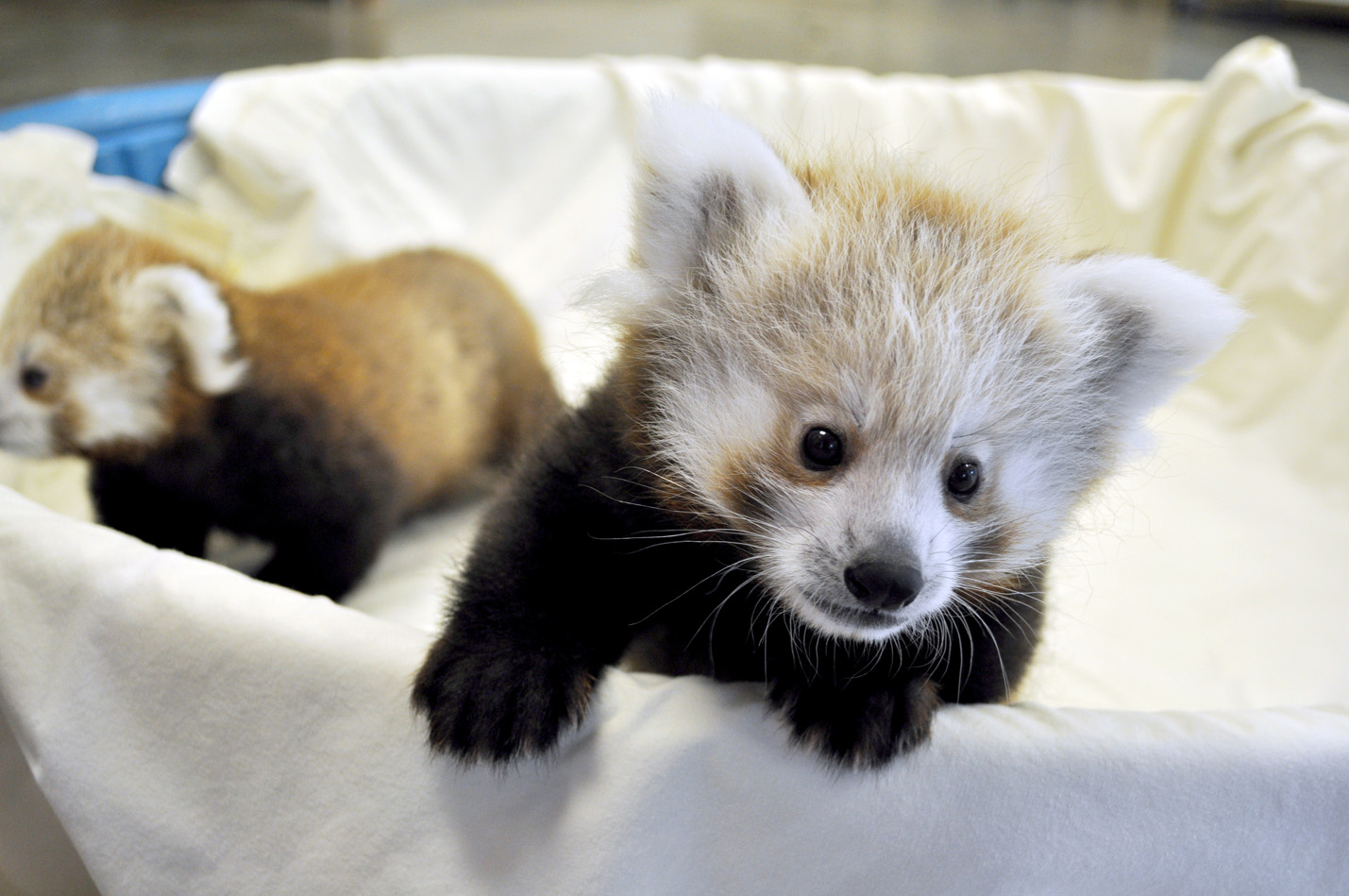
    It seems love was in the air for two Red Pandas earlier this year at South Dakota's Great Plains Zoo and Delbridge Museum of Natural History. Zoo officials are now hearing the pitter-patter of little feet. The Zoo’s eight-year-old Red Panda “Ruth” gave birth to a litter of cubs earlier this summer. The two cubs weighed 3.45 ounces and 4.23 ounces at birth, and were born with their eyes and ears closed.

    Both in the wild and in captivity, Red Panda cubs have trouble with thriving in their first year of life. Zookeepers recognized that the cubs needed additional care, and began hand-rearing them in the Zoo’s Veterinary Hospital. The Zoo’s animal care staff continues to monitor the cubs, and bottle feeds them three times a day. They now weigh 3.7 and 3.1 pounds. Until last week, one cub was separated in an oxygen chamber. She continues to do well and now only receives oxygen treatments twice a day.

    Great-Plains-Zoo-Red-Panda-Cubs-2

    Great-Plains-Zoo-Red-Panda-Cubs-3

    “Our animal care staff has worked tirelessly to ensure the Red Panda cubs receive the best care possible,” said Elizabeth A. Whealy, President and CEO of the Great Plains Zoo. “We have high hopes for these cubs – not just for the fun it will be for us to watch them grow up, but for their importance to the Red Panda population worldwide.”  

    Red Pandas are part of the Zoo’s endangered species breeding program. This species faces a tenuous future in the wild; fewer than 10,000 Red Pandas survive in the wild. The forests they inhabit are shrinking due to logging and the spread of agriculture.

  • ,

    Trio

    The Great Plains Zoo in South Dakota announced the birth of three rare Red Wolf pups. There are only about 100 Red Wolves left in the entire wild population! Four-year-old mom Ayasha gave birth to a litter of three pups last month – two females and a male. They weighed less than a pound at birth and fit into the palm of a zookeeper’s hand. The zoo’s animal care staff monitored the birth through video
    cameras and continues to observe the new family.

    “These are important births to our zoo and to the survival of the entire Red Wolf population,” said Elizabeth A. Whealy, President and CEO of the Great Plains Zoo. “Red  Wolves are one of the world’s most endangered animals. These pups are important ambassadors for their species, and are helping to shine a light on the plight of these vanishing animals.”

    Just like human newborns, the pups will spend much of their time sleeping, eating and settling in with their mother. The pups are expected to be on exhibit, viewable by the public, in the next few weeks. The pups father Tamaska can be seen daily in the Red Wolf exhibit.

    Pup

    3
    Photo Credit: Great Plains Zoo

    Read more about Red Wolf Pups below the jump:

    (more…)

  • ,

    CU

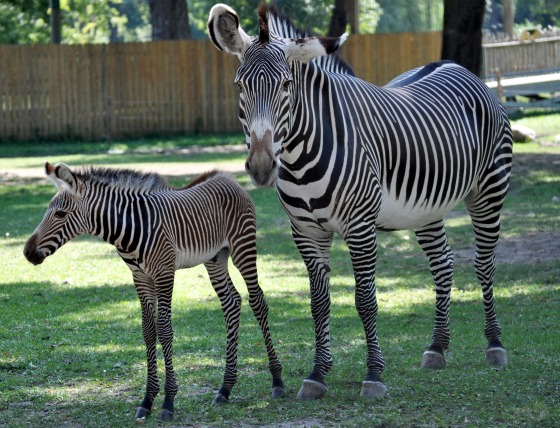
    Trinity, the 10-year-old Grevy's Zebra at Great Plains Zoo in South Dakota gave birth to a male foal weighing 80 pounds (36.28 kg). After a 13-month gestation, zebras give birth to a single foal. The foal typically weighs between 50 and 80 pounds. The Zoo’s animal care staff monitored the new family through the video camera system.

    “Grevy’s Zebras are facing extinction, so this is a very important birth, not only for the Zoo, but for the survival of the entire Grevy’s Zebra population,” said Elizabeth A. Whealy, President and CEO of the Great Plains Zoo. “Our Zoo plays a crucial role in maintaining the captive breeding population.”

    Just like human newborns, the foal will spend much of his time sleeping, eating and settling in with his mother. He and his mother can be seen in the arena of the Hoofstock winter viewing building. This is the second foal born at the Zoo — in September, the Zoo’s other 10-year-old Grevy’s named Demani also gave birth to a male weighing 100 pounds. That foal is thriving. The Zoo plans to ask the public for help in naming the pair of zebra foals in the new year.

    Mom_foal

    Side
    Photo Credit: Great Plains Zoo

    (more…)

  • ,

    Foal 1

    The Great Plains Zoo in Sioux Falls, South Dakota has a new Grevy's Zebra baby born over Labor Day weekend to mother Demani.

    "It's a healthy baby boy. He's pretty cute," said Allison Douglass, area supervisor at the Zoo.

    The newborn has no name yet and is not seeing visitors. He's secluded in a birthing stall with his mom.
    He weighs 100 pounds and his mother close to 1,000. Douglass said everything about the delivery was normal. Labor lasted a half-hour. The foal came out of the birth canal front feet first and then the head. He was up and moving around in 30 minutes and nursing within an hour.

    If any birth is routine, then the dramatic element in Demani's delivery is her son's place in the world. He is a Grevy's zebra, a species that scientists say is endangered. Africa had 15,000 Grevy's zebras in the late 1970s. The population now is one-sixth that, about 2,500 in the wild, after 30 years of disturbance from people and competition from domestic grazing animals.

    Foal 2

    Foal 4

    Foal 3

    Photo Credit: Great Plains Zoo

    (more…)

  • ,

    The Great Plains Zoo is pleased to announce the birth of a rare Eastern Black Rhino calf. The Zoo’s 13-year-old Eastern Black Rhino “Imara” recently gave birth to her second calf, a male weighing 92 pounds. The zoo is inviting the public to help name the calf.  After a 15-month gestation, rhinos give birth to a single calf.  The calf typically weighs between 80-100 pounds. “Black rhinos are on the brink of extinction, so this is a very important birth, not only for the Zoo, but for the survival of the entire Eastern Black Rhino population,” said Elizabeth A. Whealy, President and CEO of the Great Plains Zoo.  “Our Zoo plays a crucial role in maintaining the captive breeding population.”

    GPZ-Eastern-Black-Rhino-Calf-10-13-10

    GPZoo_10.29.10_1021

    GPZoo_10.29.10_0924

    GPZoo_10.29.10_0917

    GPZoo_10.29.10_1280
    Photo credits: Great Plains Zoo

    (more…)