The Newest, Cutest Baby Animals from the World's Zoos & Aquariums

Category: Koala

  • ,

    KoalaExam_001_LG
    Photo credits: Zoological Society of San Diego

    Less than a year old and barely out of their mothers' pouches, two young joeys visited the San Diego Zoo Safari Park's veterinary hospital for their first medical exam. The two youngsters, named Thackary and Milo, were born last year in the Zoo's Koala Colony. Both babies received clean bills of health.

  • ,

    Cf470e5

    Meet the as-yet-unnamed joey Koala, one of a whopping 11 baby Koalas at Australia's Dreamworld’s Wildlife Experience who are getting close to emerging from their mother's pouches . They will be the latest additions to the Koala colony there. Mom Beejay and her little 5 month old joey is featured in today’s post.

    While gestation is only 34 days, the baby koala then lives in it's mother's pouch for about another 6 months, where it continues to grow to the point of making an appearance.

    0099 CU crop

    Xxx

    0132 Mom and joey

    0138_CU joey and mom
    Photo Credit: Dreamworld Australia

    (more…)

  • , , ,

    Georgie-&-Baby-Fergie-2-14-11_Tad-Motoyama-8706
    Photo credits: Tad Motoyama

    The Los Angeles Zoo’s Koala joey, Peninsular Pronghorn twins and desert Bighorn Sheep made their media debut yesterday.

    The Zoo’s baby boom kicked off last year with the July 6 birth of a female Koala. Since newborn Koalas spend about six months developing in the mother’s pouch, this joey has just recently begun to emerge. Baby Koalas are commonly referred to as joeys. When a Koala is born, it is just three-fourths of an inch long. After birth they climb into the mother’s pouch and stay there for six months. For the following six months, they are weaned from milk to eucalyptus as they stick their heads out of the pouch to eat partially digested leaves. After a year, they leave the pouch for good.

    Koala-Joey-2-14-11--070-Tad-Motoyama-

    Although they are often referred to as a “Koala bear,” Koalas belong to the marsupial family. Marsupials are mammals whose females typically rear their young in a pouch through early infancy. Other members of the marsupial family are Kangaroos, Wallabies, Wallaroos, Wombats and Opossums. Native to Australia, Koalas have a very low metabolic rate requiring them to conserve energy and to sleep between 18 and 20 hours a day. They spend about three of their five active hours eating a diet that consists entirely of eucalyptus leaves. Koalas consume 2 ½ pounds of leaves per day and rarely drink water due to the moisture found in eucalyptus leaves.

    Big-Horn-Sheep-Dad-&-Baby-4-7-11-097-Tad-Motoyama-

    March 20, brought the birth of a female Desert Bighorn Sheep. This species is native to the high mountains and deserts of the south western United States and northern Mexico. Preferring to reside in places with rocky terrain and access to water, they completely avoid forested areas.

    Big-Horn-Sheep-Mom-&-Baby-4-2-11_Tad-Motoyama-1669

    Bighorn Sheep can be seen in our local San Gabriel Mountains, though their population is threatened by many factors including drought, predators, disease and fires. The most recognizable characteristic of the Bighorn Sheep is the male’s massive, spiraled horns and their majestic faces. These horns may add up to one third of their total body weight when they’re full grown. Females have much smaller horns.

    Big-Horn-Sheep-Baby-Chewing-on-Mom's-Horn-4-2-11_Tad-Motoyama-1599

    On March 1, two Peninsular Pronghorn, one male and one female, were born. Native to Baja California Sur, Mexico, these graceful animals are mostly active at dawn and dusk. Hunting, cattle ranching and agriculture have resulted in the significant decrease of this critically endangered species.

    065-Twin-Pronghorns-3-3-11-Tad-Motoyama

    Newborn Pronghorns take their first steps within 30 minutes of birth. By the time they are four days old, they can outrun humans. After just a week, fawns can run faster than dogs and horseback riders over short distances. They are the second fastest land mammal and the fastest ungulate (hoofed mammal), clocking in at anywhere from 40 to 60 miles per hour. They can maintain this speed, without showing any sign of distress, for an hour or longer.

    Pronghorn-Twins-3-3-11_Tad-Motoyama-9887

    Typically, a Pronghorn mother will have one or two fawns weighing in at around seven or eight pounds. When they reach adulthood, pronghorns weigh up to 125 pounds and reach a height of 35 inches. The females are usually 10 to 25 percent smaller then males.

  • ,

    SF-Zoo-Koala2

    The San Francisco Zoological Society is proud to announce the birth of a female Queensland, Koala. This is the first Koala birth at the Zoo since 2000 and the new joey began to emerge from her pouch in January. She will make her first public debut today. San Francisco zookeepers confirmed the birth during a pouch check in December and caught their first glimpse of the bean-sized joey in mid-January. A small hand appeared and over the next few months, little by little, she slowly made her way out of the pouch. It wasn’t until February that the joey made it all the way out and onto her mother’s back.

    5494420217_2140254662_o

    SF-Zoo-Koala4
    Photo credits: San Francisco Zoo


    http://www.youtube.com/e/NFpHzt45QZo

    (more…)

  • ,

    Bebe_koala_EORA-(c)ZooParcdeBeauval-(5)

    Excitement is in the air at Beauval Zoo, as France's newest little Koala joey, Eora, has just fully emerged from her mother's pouch. Named after the aboriginal word for "here" the tiny Joey was only 2 cm long when she was born in late May. Koala joeys typically spend the first six to eight months of life hidden safely inside their mother's pouch. While Eora may have outgrown the cozy pouch, she's definitely not too old for piggy-back rides! In the wild, Koala's are threatened by human encroachment, which carves up their range into tiny parcels and increases the threats of fire and attacks by domestic animals.

    Bebe_koala_EORA-(c)ZooParcdeBeauval-(1)

    Bebe_koala_EORA-(c)ZooParcdeBeauval-(4)

    Bebe_koala_EORA-(c)ZooParcdeBeauval-(3)
    Photo credits: Beauval Zoo

  • , ,

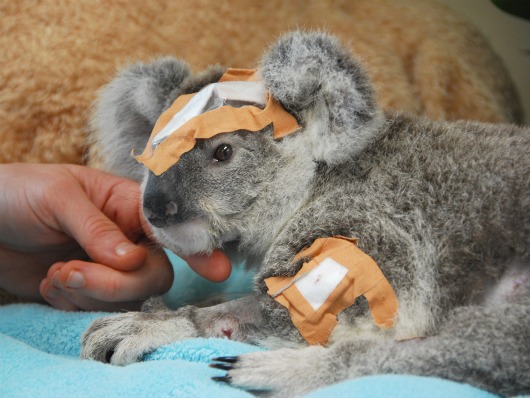
    Bandaged Koala joey Frodo at Australia Zoo 1a

    When Frodo the baby Koala arrived at the Australia Zoo Wildlife Hospital three months ago, she had 15 shotgun pellets in her tiny body and no mother. The victim of a vicious, inexplicable attack, this heartbreaking but sensational story made international news. Well now ZooBorns brings you an under-reported, but hopeful update on this special little orphan joey.

    Bandaged Koala joey Frodo at Australia Zoo 2

    Koala X-Ray

    While the odds were certainly stacked against her, Frodo has made outstanding progress, so much so that veterinarian Dr. Amber Gillett moved her to an outdoor enclosure.

    Dr. Gillett detailed Frodo's progress: “I am so happy to see Frodo's health continuing to improve every week. She now weighs a healthy 2.6kg since being in care at the Australia Zoo Wildlife Hospital which is a great indicator of how well she is doing. [Her recent check-up] was very pleasing. There were no signs of deterioration, her blood lead levels have, so far, been within normal limits and her fur has completely grown back over old wounds making her virtually unrecognisable to the Frodo who came into care three months ago.”

    Frodo the Koala with keeper taking a peek

    Frodo says helloPhoto credits: Australia Zoo

    Unfortunately caring for Frodo has been extraordinarily expensive. Explained Dr. Gillett “A patient like Frodo costs thousands of dollars to treat and care for before returning to the wild,” Dr Amber said.“[She requires] fresh leaf, paste, and fluids; not to mention associated medical costs such as antibiotics, x-rays, surgery, and around the clock veterinary treatment, all of which adds up. Without donations from the general public, we couldn't continue our vital work here at the Australia Zoo Wildlife Hospital.”

    Help Frodo's recovery by contributing to her care with a donation on the Australia Zoo Wildlife Hospital's special Frodo support page

    More pictures below the fold

    (more…)

  • ,

    Owen the Koala clings to mom at the Riverbanks Zoo 2

    Too big for mom's pouch, Baby Koala Owen has finally emerged for visitiors at the Koala Knockabout exhibit at the Riverbanks Zoo. Born to mom Lottie back in May, Owen started out as a jellybean-sized joey nestled deep within mom's pouch, but has since grown to a perfect Koala-sized backpack. For the most part, Australian animals in non-Australian zoos are rare and the Riverbanks Zoo was lucky to receive Lottie from South Carolina's sister Australian state of Queensland in 2003. In the early 20th Century, Koalas were almost hunted to extinction for their fur, which was exported to Europe and North America. Today, anyone who even thinks of buying a Koala fur jacket should probably be slapped, or at the very least, de-friended on Facebook.

    Owen the Koala clings to mom at the Riverbanks Zoo 2

    Owen the Koala clings to mom at the Riverbanks Zoo 2

    Owen the Koala clings to mom Lottie at the Riverbanks ZooPhoto credits: Richard Rokes / Riverbanks Zoo

  • ,

    Photographer Paula Longshore captured these expressive images of mother koala 'Colliet' with her six-month-old joey at Cleveland Metroparks Zoo's Gum Leaf Hideout yesterday. Koala moms like Colliet bear one young every two years and may even adopt abandoned babies.

    Colliet and Joey Snuggling

    Meet Colliet's Joey

    Colliet and Joey

  • ,

    ZooBorns contributor ysaleth got this great shot of San Diego Zoo's proud Koala Mom Orana giving a "bear" hug to joey Miah yesterday. Despite the powerful grip, Koalas are not bears. They are not placental or 'eutherian' mammals, but marsupials, which means that their young are born immature & they develop further in the safety of a pouch. It’s incorrect to call them ‘koala bears'. Their correct name is simply 'koalas'.

    4352389925_79c8e0f868_b

    There is a myth that koalas sleep a lot because they ‘get drunk’ on gumleaves. Fortunately, this is not correct! Most of their time is spent sleeping because it requires a lot of energy to digest their toxic, fibrous, low-nutrition diet and sleeping is the best way to conserve energy.

  • ,

    Little Oliver the Koala was born back in April at the Riverbanks Zoo in South Carolina but, like other marsupials, spent his first months in mom's pouch. The little joey is only now too large for mom "Lottie's" pouch but still spends his days close by, usually clinging to her back or tucked under her stomach. 

    Baby koala riverbanks zoo lottie and oliver 1 rs 

    Baby koala riverbanks zoo lottie and oliver 2 rs

    Baby koala riverbanks zoo lottie and oliver 3 rs

    Baby koala riverbanks zoo lottie and oliver 6 rs2  

    Baby koala riverbanks zoo lottie and oliver 5 rs 

    Photo credits: Riverbanks Zoo

    Follow ZooBorns on Twitter!

    (more…)