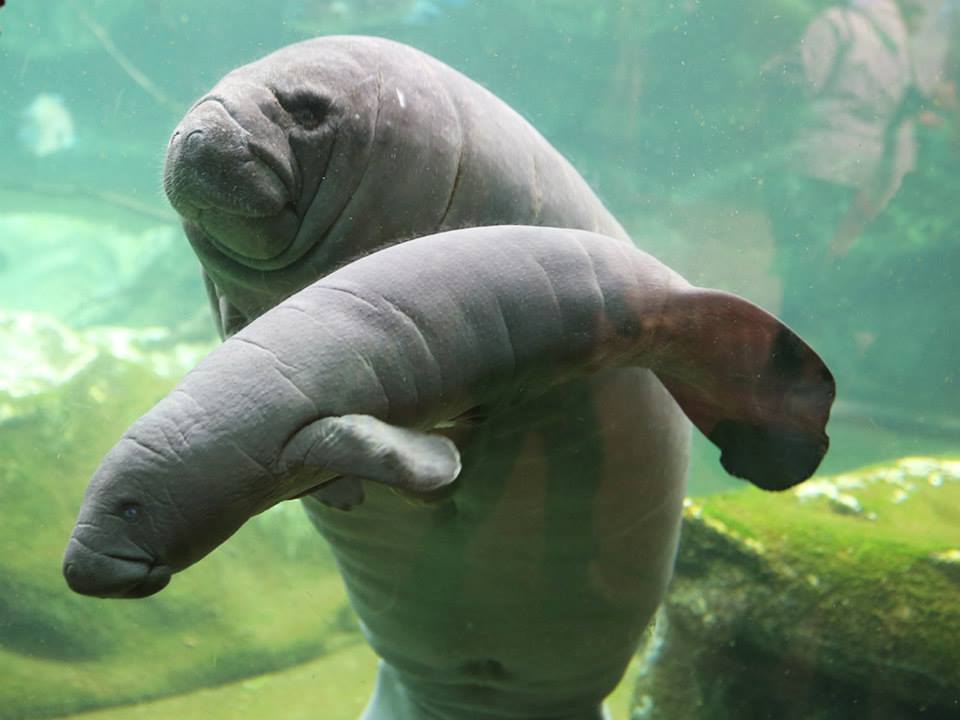
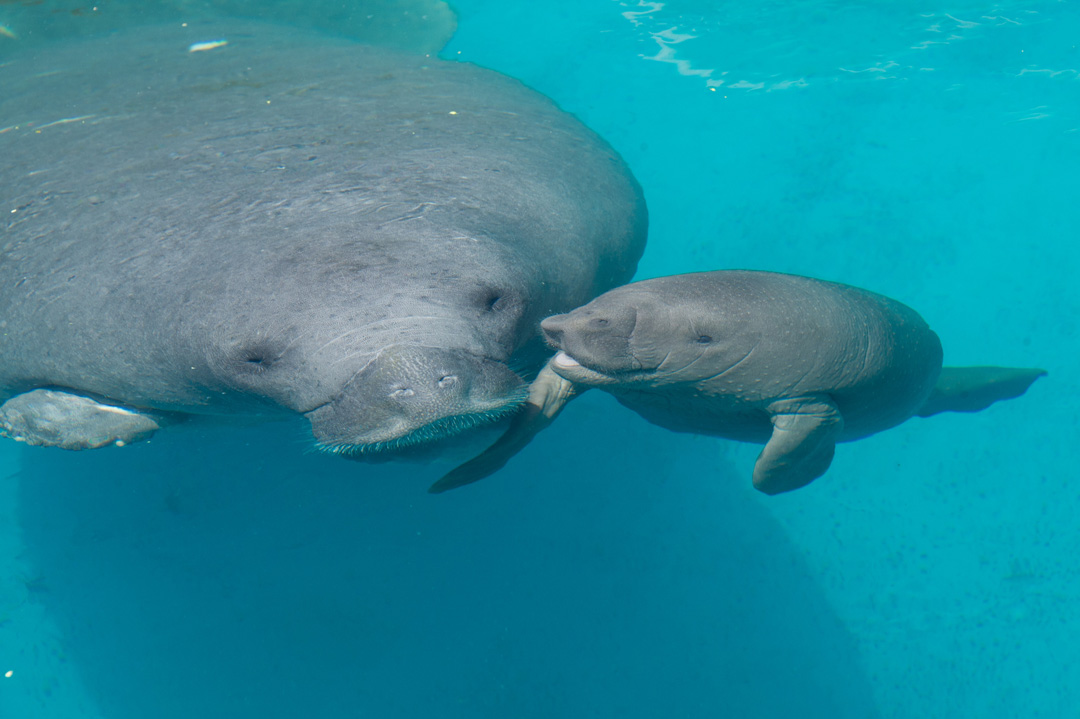
The Newest, Cutest Baby Animals from the World's Zoos & Aquariums

Category: Manatee

  • ,

    DSC_2893

    A two-year-old Manatee rescued in Florida arrived at the Cincinnati Zoo to continue his rehabilitation before being released back into the wild.

    Djjam (1)
    Djjam (8)Photo Credit:  Cincinnati Zoo
     
    BamBam was rescued from a canal in Brevard County, Florida in January 2015.  He was treated for severe cold stress at SeaWorld Orlando before moving to the Cincinnati Zoo in October.

    “He is quite energetic, which is what you’d expect from a young Manatee in a new environment. The cold stress on his tail has caused some tissue damage, however it does not appear that his mobility is compromised at all,” said Cincinnati Zoo curator Winton Ray. “Upon his arrival in Cincinnati, BamBam weighed 335 pounds, which represents a healthy, 100-pound weight gain since June.”

    He joined 25-year-old Manatee Betsy, who weighs almost seven times as much as he does, in the zoo’s Manatee Springs tank. “Since being introduced to Betsy, keepers have seen exactly what they expected and were hoping for,” says Ray. “He is very ‘clingy’ towards her, and she is patient and gentle with him.”

    The Cincinnati Zoo is one of two United States zoos outside of Florida that participate in the U.S. Fish and Wildlife Service’s Manatee Rescue, Rehabilitation and Release Program. The goal of this program is to rescue and treat sick or injured Manatees and then release them back into the wild.

    A subspecies of West Indian manatees, Florida Manatees are listed as Vulnerable by the International Union for Conservation of Nature.  They are at risk from both natural and man-made causes of injury and mortality. Exposure to red tide, cold stress, and disease are all natural problems that can affect Manatees. Human-caused threats include boat strikes, crushing by flood gates or locks, and entanglement in or ingestion of fishing gear.

    See more photos of BamBam below.

    (more…)

  • ,

    IMG 1 Baby manatee Canola

    Born August 6th, 2014, female Manatee calf ‘Canola’ is the offspring of Wildlife Reserves Singapore’s largest Manatee, 23-year-old ‘Eva’. For unknown reasons, Eva abandoned her latest calf, despite having successfully raised eight offspring in the past and being a grandmother of two.

    IMG 2 Aquarist Keith So bottle-feeds baby manatee Canola

    IMG 4 Aquarist Keith So conducts physical check on baby manatee Canola

    Baby manatee Canola swimming with manatee herd at River Safari's Amazon Flooded ForestPhoto Credits: Wildlife Reserves Singapore

    To ensure that animals in River Safari retain their parental behaviors, zoologists strive to have the parents raise their offspring. In the case of Canola, there was no other option but to have aquarists hand-raise the newborn.

    The 33kg (73 lb) abandoned calf, at River Safari’s Amazon Flooded Forest exhibit, had to be watched 24 hours for the first few days, fed every two to three hours during the first three months, and re-introduced gradually to her family. It was a Herculean task that the team of aquarists dived into to give baby Canola a fighting chance to live.

    Mr. Wah Yap Hon, Curator at River Safari, said, “Hand-raised animals tend to imprint on their human caregivers. The babies will attach themselves to, and learn certain behaviors from their human foster parents, and may not have a chance to bond with their family or other members of their species. In the case of Eva and Canola, we stepped in as a last resort to ensure the survival of this precious baby.”

    Similar to caring for a human baby, hand-raising an animal baby requires planning and hard work. For Canola, it involved bottle-feeding every two to three hours, from 8am to 10pm daily, for the first three months. To increase her fat intake and substitute her mother’s highly nutritious milk, Canola was given a special milk formula infused with canola oil, which inspired her name. To ensure Canola’s safety, the aquarists moved her to a shallow holding pool, to minimize the risk of other manatees crowding her and making it challenging for her to rise to the water’s surface to breathe.

    “Under the doting care and great team effort of her human caregivers, Canola steadily gained weight and hit all the important developmental milestones of a healthy calf. By December, Canola started swimming with the rest of the herd in the main aquarium, forming close bonds with her species,” said Wah.

    Since February, Canola’s caregivers have gradually cut down on her milk intake to four feedings a day, to accommodate her increasing diet of vegetables. Manatees spend six to eight hours a day grazing on aquatic plants, which is why they are also known as ‘sea cows’. Adults typically consume 50-100kg 110lb to 220lb) of vegetation a day, equivalent to 10-15 percent of their body weight.

    (more…)

  • ,

    1965056_837133672978247_1570058561706588178_n
    On April 24, France’s ZooParc de Beauval welcomed a male Manatee who weighed 55 pounds at birth!  The not-so-little baby will spend the next two years living with his mother, Femore, in the zoo’s tropical exhibit. 

    10410137_837133669644914_522927104216601376_n
    10455867_837133679644913_2499966666182626343_n
    10390110_837133642978250_6056935410077492482_nPhoto Credit:  ZooParc de Beauval

    Manatees are the world’s only herbivorous aquatic mammals.  At the zoo, the Manatees collectively eat more than 500 pounds of vegetables each day.  Their favorites?  Lettuce and potatoes.  In the wild, Manatees feed on underwater grasses.  They live only in warm coastal waters and inland marshes. 

    All three species of Manatees (South American, West Indian, and West Africa) are listed as Vulnerable by the International Union for Conservation of Nature.  People are the main threat to Manatees, through collisions with boat propellers, toxic algae blooms, pollution, and entanglement in fishing gear.

    The birth of this Manatee calf is important to the European Breeding Program. 

    See more photos below.

    (more…)

  • ,

    Bottle feeding orphaned manatee calf 82013

    Tampa’s Lowry Park Zoo is well-known
    for its ongoing work rescuing, rehabilitating, and releasing sick or injured
    West Indian Manatees found in Florida waters.

    Their most recent addition is an orphaned Manatee named Jobin.  He was just a few days old and weighed
    just 55 pounds when he arrived at the zoo’s Manatee Hospital.  Now six weeks old, Jobin has gained almost 20
    pounds! 

    Bottle feeding orphaned manatee calf 3 82013

    Bottle feeding orphaned manatee calf 2 82013

    Virginia with newborn.jpg
    Photo Credit:  Lowry Park Zoo

    West Indian Manatees, also known as
    sea-cows, weigh up to 1,300 pounds as adults. 
    Manatees are mammals – hence, they nurse their young and give birth to
    live babies.  They feed on underwater
    vegetation and inhabit coastal waters, estuaries, and freshwater springs.  Manatees prefer warm shallow waters and often
    gather in large groups.

    Manatees are listed as Vulnerable by
    the International Union for Conservation of Nature.  They face threats from propeller strikes and
    toxic algae blooms.

    The Lowry Park Zoo works in partnership with the U.S. Fish
    and Wildlife Service, Florida Marine Research Institute, and the Florida Fish and
    Wildlife Conservation Commission to rescue, rehabilitate, and release injured
    or sick Manatees.  The zoo’s Manatee Hospital
    is one of three critical care facilities in Florida to care for West Indian Manatees
    and the only non-profit facility. 

  • ,

    Manatee2

    An adult female Manatee named Joannie, who was rescued from a Florida river, gave birth July 13 to a full-term male calf at Tampa’s Lowry Park Zoo. The birth marks only the fourth in the zoo’s history, with the first occurring in May 2000. While at the Zoo, Joannie has also became a surrogate mother to an orphaned calf.

    The male newborn, nicknamed Lad, is healthy and weighed 66.8 pounds after birth, and has been growing at the rate of approximately 10 pounds per week.

    At the time of her rescue on January 31, Joannie was suffering from cold stress, which can be likened to hypothermia in humans.  The consequences of cold stress can be severe and often result in death.  Aware that she was expecting, the Zoo's Manatee rehab team monitored Joannie carefully to find out if the calf had survived its mother's life-threatenting condition.

    Manatee1

    Manatee3

    After the birth of Lad, Joannie became a surrogate mother to an orphan Manatee nicknamed Cheeno.

    Cheeno arrived at the Zoo on February 15 suffering from cold stress as well. Though not a newborn, he has now established a bond with Joannie. On occasion, Lad and the 142-pound Cheeno can be observed nursing at the same time, on opposite sides. With Joannie’s help, Cheeno is packing on the pounds. 

    The Zoo’s Manatee rehab team hope to release the mother Manatee with her own dependent calf and “adopted” orphan calf this fall or winter. 

    Photo Credits:  Dave Parkinson

  • ,

    Manatee-and-Calf-close-up

    A pregnant Manatee rescued by SeaWorld’s Animal team in June has given birth to a healthy Manatee calf. Born early on Wednesday morning, between 3 and 6 a.m., the newborn calf has been nursing and bonding with mom in a back area pool. SeaWorld’s Animal Care team is on 24-hour watch keeping a close eye on the pair, who are both doing well.

    Manatee-and-Calf-Kiss

    Manatee-and-Calf-swimming

    SEAWORLD-ORLANDO-Manatee-1

    20120608_Merritt-Island-Manatee-Rescue_19
    Photo credit: SeaWorld Orlando


    Read the story of the rescue and the birth below the fold.

    (more…)

  • ,

    Pic-1

    Singapore Zoo celebrated the latest addition to its family on February 13, 2012 when one of its grand dames, Eva the 20-year-old Caribbean or West Indian Manatee, gave birth to male twins.

    Unfortunately only one of her offspring survived. The other died soon after birth and was found to have a heart defect. Twin births are extremely rare for Manatees, which are listed as vulnerable on the IUCN Red List of Threatened Species.

    Pic-3

    Pic-2
    Photo credits: Wildlife Reserves Singapore 

    Female Manatees reach sexual maturity as young as three years, and typically give birth to a single calf every two years, after a gestation of 12 months. It takes a further 12-18 months to wean the calf. With seven children and two grandchildren to her name, Eva is truly a star. Singapore Zoo now boasts nine of these fascinating creatures, the largest collection among the world’s ISIS institutions.


    The newborn has been christened Valentine, and can already be seen independently exploring the pool although calves usually do not stray from their mothers for the first one to two years of their lives. The last manatee birth was in 2010, a male named Junior that is often seen playing with his baby brother.

    (more…)

  • ,

    Cu

    Though not a traditional time of year for manatee births, Zoo Parc de Beauval in France welcomed a manatee calf yesterday! The little one has been seen suckling and swimming near mom in its first 24 hours.

    Manatees are born underwater and mom helps the calf get to the surface to take its first breath. The babies can usually swim on their own within the first hour after birth. While they only nurse as calves, they will grow to become hearty grazers…eating up to a tenth of their weight in algae, weeds and grasses in a single day!

    Sometimes called sea cows, manatees are actually graceful swimmers despite their size. They never leave the water but need to come to the surface to breathe like all marine mammals. Often the only thing visible at the surface of the water is their nose, but below, their powerful tails can propel them along at 5 mph (8 kmph).

    There are three species of this highly endangered animal, and they each live in different areas – one in the Amazon River, another along the west coast and rivers of Africa, and a third along the east coast of North America. Beauval Zoo is the only Zoo in France to have a manatee, which was born as part of as the European breeding program for this species (EEP). 

    Baby and mom

    Cu
    Photo Credit: ZooParc de Beauval

  • ,

    SeaWorld Orlando animal care specialists are a little bleary-eyed this week as they provide 24-hour care for a weeks-old, baby manatee. Orphaned by her mother, the female calf arrived at the park's rehabilitation center on July 24 after being rescued from the waters of Daytona Beach, Fla.

    Every three hours the 3½-foot and 41-pound orphan is bottled-fed with the park's nutrient-rich baby formula that promotes weight gain. Her weight is taken every other day as animal care specialists closely monitor her progress. She remains in guarded condition and park veterinarians hope to eventually return her back to the wild.

    Baby manatee orphan SeaWorld

    Photo and video credits: SeaWorld Orlando

    The animal was transported to SeaWorld by the Florida Fish & Wildlife Conservation Commission.

  • ,

    A baby manatee or “sea cow” was born recently at the Singapore Zoo and is now on display to the public. This “little” guy may be cuddly looking now, but adult manatees can weigh over 1.5 tons.