The Newest, Cutest Baby Animals from the World's Zoos & Aquariums

Category: Marwell Park Zoo

  • , ,

    SN_Tortoise_solent_10

    A Quartet of tiny Tortoises (critically endangered Egyptian Tortoises to be exact) has hatched at Marwell Wildlife in Hampshire, U.K. The first youngster to hatch weighed just 3.9g and measures slightly taller than the height of a nickel! New hatchlings may be small but this species can go on to live for up to 50 years.

    Egyptian Tprtoises are nearly extinct in the wild. Their habitat (two small populations remain in Libya) has been largely destroyed by human activity. The species is also threatened by the illegal pet trade.

    SN_Tortoise_solent_4-(4)

    SN_Tortoise_solent_2

    SN_Tortoise_solent_12

    SN_Tortoise_solent_11-(4)
    Photo credit: © Solent Newsagency

    Marwell currently houses 10 adults in its Cold Blooded Corner. A full size adult can grow to around 15 centimeters long and weigh 500 grams. Two of Marwell's females laid eggs earlier in the year and these were removed and placed in an incubator to ensure optimal conditions for their development; precisely 30 degrees centigrade and 75% humidity.

  • ,

    Xcu

    As of January 31 a new baby giraffe joined the herd at Marwelle Wildlife in the UK! Keepers cannot confirm whether the calf is a boy or a girl but a closer examination will take place in the next few days. This is the first baby for mom Ursula. She went into labor with all the other giraffes around her. Everything went well as the feet made their appearance, which is the typical way giraffes are born. The hooves come out striaght like Superman's arms, and then the long neck and finally the body.The final drop into the hay is not as far because so much of the baby is out and half-way to the floor in the process. 

    The other giraffes gathered around while Ursula went through the motions and after the calf was given it's first clean up by Mom, the herd gather round to meet the new arrival. 

    The baby, which is a Rothschild’s giraffe (Giraffa camelopardalis rothschildi), is part of a European Breeding Program. Currently the species is classified as Endangered on the IUCN Red List. Giraffes face many threats in the wild including habitat loss and poaching for meat and hides. It is thought there may be only a few hundred individuals left in the wild.

    Feet

    Xx

    Group hello

    431462_10150423900042168_68060882167_7362946_832265996_n
    Photo Credit: Marwell Wildlife


  • ,

    Partula-3mb1

    In a battle to save extinct Partula snails, Marwell Wildlife Park is now breeding an additional four species, taking its numbers on show in Encounter Village to more than 800.The park’s breeding program now includes eight species of the snail, which are either extinct in the wild or critically endangered. Partula snails have gone into precipitous decline in recent years as they have suffered massively from habitat loss and the introduction of a carnivorous snail. However, The International Partula Conservation Programme has plans to re-introduce the snails into the wild, so there could be hope for the future.

    In the wild, the snails were found only on islands in the Pacific Ocean, ranging over 8,000 km from Palau to the Society Islands in French Polynesia. This year, conservationists will be releasing snails into reserves on the islands. They will then be closely monitored until they are released into the wild to fend for themselves. Great care has to be taken when looking after the snails. It’s vital that the snails are kept in the correct heat and humidity and strict sterilization routines are put in place.

    Partula-3mb

    Partula

    In the 1970s African land snails were introduced to the Pacific islands as a source of food for the local people but they were released when the meat proved unpopular. These snails bred quickly in the wild and started eating crops. In 1974, in an effort to control the land snails, the predatory Florida Rosy Wolfsnail was introduced to the island. Instead of eating the land snails, they fed on the tree snails leading to the extinction of many Partula species. Partulas grow up to 2.5cm in length and give birth to one baby every three months. An adult Partula lives for approximately 10 years. There are 79 species of the genus Partula on the IUCN Red List, 50 of which are classified as Extinct.

  • ,

    Tapir 1

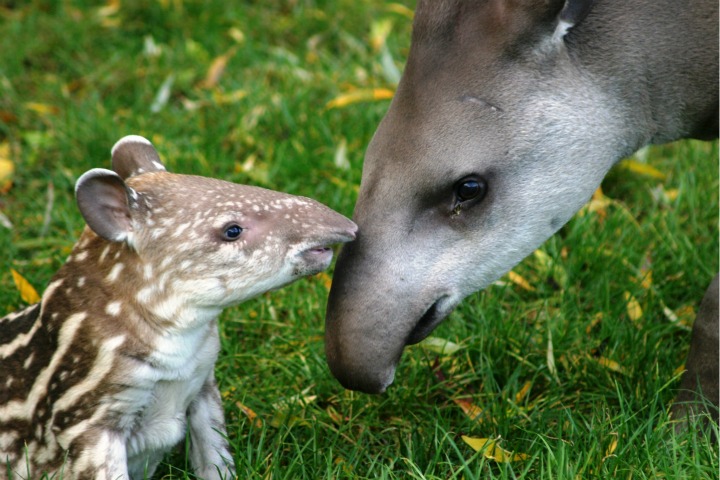
    A Brazilian Tapir baby named Little Ron, at only 9 days old, is now out and about in his paddock at Marwell Wildlife.  Born with a very pretty coat of pale spots and stripes on a reddish brown background, he is delighting visitors with his striking appearance. When he is about a year old he will lose his markings and develop a beautiful light brown color, just like his mom Summer and sister Quito. He's named ‘Little Ron’ in memory of his Dad, Ronaldo, who sadly died at the park last month after an acute illness.

    Section Manager David White said: “Staff miss Ronaldo greatly and he was a popular character amongst visitors to the park- so we thought it would be nice to carry on his memory by calling the baby Little Ron.

    “Summer is coping well and has had some assistance from Quito, her previous offspring. She is very attentive and protective of him, always keeping a look out and calling him when he is out of view, although this all changes when food is about!!”

     “Quito was very interested in the birth and almost acted like a birthing companion for her mom. She has been helping to keep him occupied and is keeping a watchful eye over him.”

    Tapir 4

    Tapir 3
    Photo Credit: Marwell Wildlife

    (more…)

  • ,

    Marwell-Meerkats-2

    Last summer Marwell Wildlife Park in Hampshire, UK, built a new home for its meerkats and this allowed the park to introduce a breeding group. The meerkats are obviously very happy as they have had three meerkats born. The pups made an appearance last week and are delighting visitors with their playfulness!

    Marwell-Meerkats-3

    Marwell-Meerkats

    Marwell-Meerkats-4

  • ,

    Marwell-Park-Coati2

    There's never a dull moment for these cuddling baby Coatis (AKA Brazilian Aardvarks!), photographed earlier this summer at Marwell Wildlife Park by Danielle Connor. A total of 5 baby Coati call Marwell home and as you can see, they spend much of their time wrestling and rough housing in their exhibit. Coatis are members of the Racoon family and although few scientific population studies have been made in recent years, their numbers appear to be in decline due to environmental destruction in their native Central and South America.

    Marwell-Park-Coati

    Marwell-Park-Coati3

    Marwell-Park-Coati6

    Marwell-Park-Coati4

    Marwell-Park-Coati5

  • , ,

    Baby-Gentle-Lemur-(2)

    Marwell Wildlife is celebrating the birth of one of the most endangered species of Lemur in Madagascar. Wild Alaotran Gentle Lemurs (Hapalemur griseus alaotrensis) are only found inhabiting the reed beds around Lake Alaotra in Madagascar. Marwell Wildlife, which is part of the conservation breeding programme, currently has five Alaotran Gentle Lemurs. John Pullen, the charity’s curator of mammals, said: “The youngster seems to be doing very well and Lelafo is a great mum, who is very protective. We are uncertain of its sex at this stage because we keep our distance to make it as natural as possible for them. Once we know the baby’s sex the animal keepers will find it a suitable Madagascan name.”

    Cute-gentle-lemur

    Gentle-Leumr-Marwell-2

    Gentle-Leumr-Marwell
    Photo credits: Marwell Wildlife

    What follows is a video compilation featuring this Gentle Lemur as well as several other species born recetnly at Marwell including a Grevy’s Zebra, Capybaras, Saki Monkeys, Ring-Tailed Coatis, and a Scimitar Horned Oryx.


  • , ,

    Marwell_Oryx_2

    One of Marwell Wildlife’s most majestic animals, the Arabian Oryx, has been ‘brought back from the brink of extinction’ thanks to the work of dedicated conservationists. Successful captive breeding programs and re-introduction efforts mean the species has finally qualified for a move from the Endangered category to Vulnerable on the IUCN Red List. Marwell Wildlife, based in Hampshire, is home to the only breeding group of Arabian Oryx in the UK. Just last month, the park celebrated the birth of a female Arabian Oryx called Akilah.

    Marwell_Oryx

    Oryx-2
    Photo credits: Marwell Wildlife

    (more…)

  • , ,

    Baby Cotton Top Tamarin at the Marwell Zoo 4

    The UK's Marwell Wildlife recently welcomed baby Cottontop Tamarins and photographer Amy Wilton was on the scene to capture one of the little guys first days in the big world. Tamarins are the smallest of all monkeys and Cottontops grow only to about one pound. Unfortunately this tiny species is critically endangered with three quarters of its habitat in Columbia destroyed by logging and development. 

    Baby Cotton Top Tamarin at the Marwell Zoo 1

    Baby Cotton Top Tamarin at the Marwell Zoo 5

    Baby Cotton Top Tamarin at the Marwell Zoo 3Photo credits: Amy Wilton

    (more…)

  • ,

    Marwell Wildlife is celebrating the recent birth of a Brazilian tapir. Born on 2 September to proud mum Summer and dad Ronny, the baby girl has been named ‘Quito’ (pronounced kito) after the capitol city of Ecuador, which lies in the western part of the tapir range. Quito was born with a very pretty coat of pale spots and stripes on a reddish brown background. When she is around a year old she will lose her markings and develop a beautiful light brown colour, just like her big sister Rio.  “Quito is doing really well and is full of confidence, she loves nothing better than exploring her new home. Summer is an excellent mum, whilst her big sister Rio and dad Ronny are never far away in case she runs into trouble. Brazilian tapirs are generally shy animals however, our family are very easy going and Ronny in particular loves a tickle under his chin” said David White, Head keeper for the tapirs. 

    Quito the Baby Brazilian Tapir Calf at Marwell Zoo 1

    Quito the Baby Brazilian Tapir Calf at Marwell Zoo 1

    Quito the Baby Brazilian Tapir Calf at Marwell Zoo 1

    Quito the Baby Brazilian Tapir Calf at Marwell Zoo 1

    Brazilian tapirs live in the Amazon rainforest and spend much of their time foraging near water, which they also use as an escape route from predators such as jaguars. They are able to stay submerged for hours using their long noses to breathe through, just like a snorkel. Tapirs closest living relatives are hoofed animals likes horses and rhinos. Although not as critically endangered as the Malayan tapir, there are still several threats to the survival of the Brazilian tapirs including: illegal hunting, habitat fragmentation which can result in reduced genetic diversity and home range, plus loss of habitat by subsistence farmers and illegal logging.  They are currently listed as Vulnerable on the IUCN Red List.