The Newest, Cutest Baby Animals from the World's Zoos & Aquariums

Category: Mesker Park Zoo

  • ,

    1 takin

    Mesker Park Zoo & Botanic Garden in Indiana has welcomed its first-ever Takin calf, a female named Ching Lan, which means 'beautiful orchid' in Chinese. In the wild, this little calf would be following her mother on steep mountain paths at three days-old. It looks like she's practicing those motor skills by sneaking up on mom!

    Born to first-time parents, the calf is thriving and zoo staff are very pleased with the attention her parents are giving her.

    Zoo Director Amos Morris said, “The Takin are doing exactly what they need to be doing for their offspring and we are all enjoying watching wildlife at its best.”  

    2 takin

    3 takinPhoto credit: Mesker Park Zoo & Botanical Garden

    There are four subspecies of Takin that live throughout the eastern Himalayas, in Tibet, some Chinese provinces, Bhutan, and northeast India. Once thought to be related to muskox, the Takin is now known to be more closely related to sheep.

    In the wild, baby Takin begin to follow their mothers along steep paths when they are just three days old – a crucial survival skill for these leaf-eating animals that travel seasonally to find food. Though heavily-built, Takin are surprisingly agile on the rocky cliffs of their homeland.  Their large hooves have a spur that makes them sure-footed even on steep terrain.  Males can weigh up to 800 pounds. Both males and females have thick upward-turning horns.

    Equipped for life at higher altitudes, they can withstand very cold temperatures. In winter, they grow a secondary coat as protection from freezing temperatures. Long nasal passages warm frigid air before it reaches the lungs. 

    Because Takin live in remote areas, not much is known about their wild populations.  But habitat loss, hunting, and human disturbance have caused Takin to be listed as Vulnerable by the International Union for Conservation of Nature.

  • ,

    Wolf 7 days old FB2

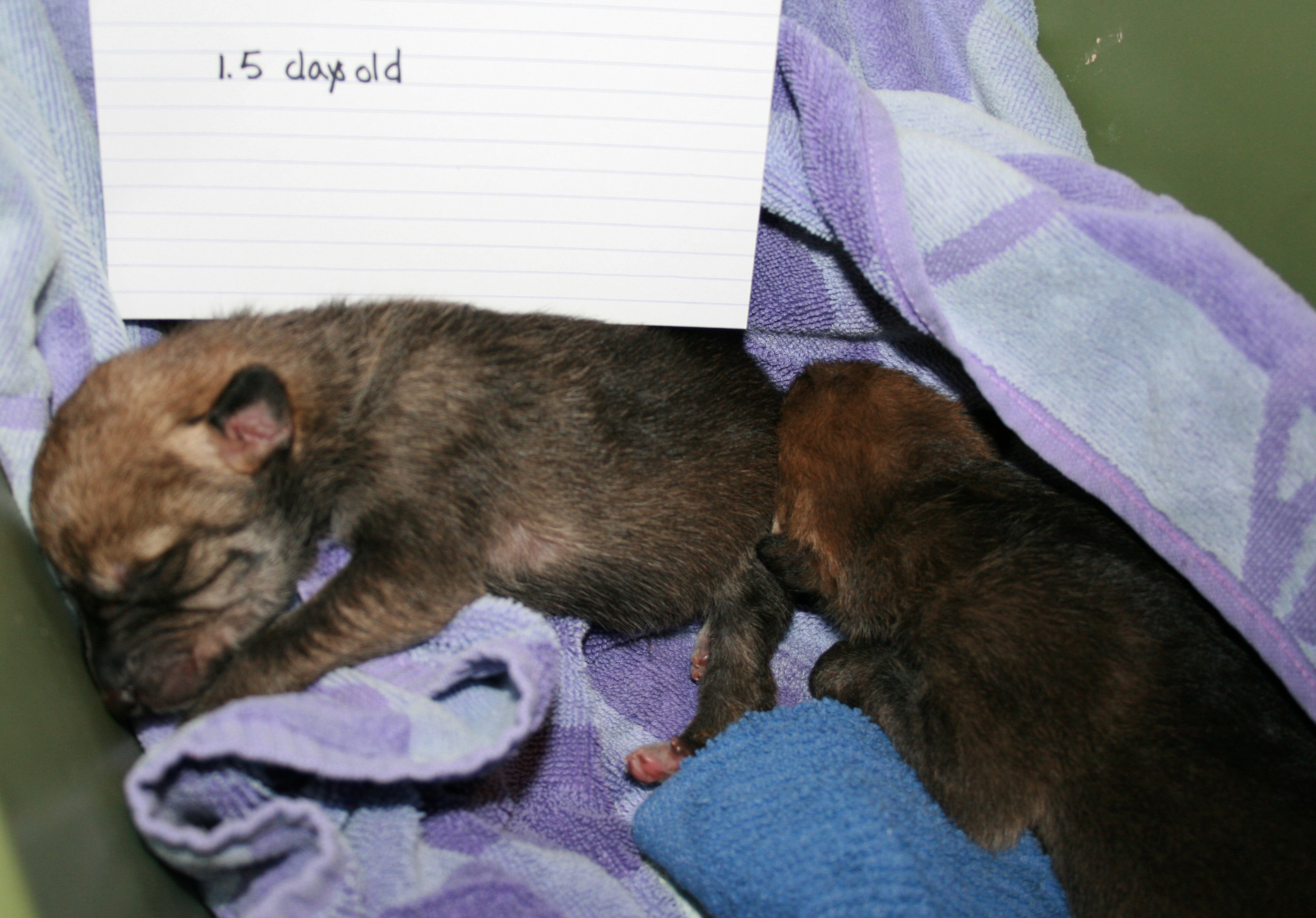
    A litter of Mexican Gray Wolves, the most Endangered wolf species
    in the world, came to the Mesker Park Zoo & Botanic Garden — and not by conventional means. They arrived on a LightHawk* flight at Tri-State Aero, Inc. and
    were immediately given into the care of zoo staff. The pups are doing well.

    Born on May 8 at the Wolf Conservation Center in New York, the pups were pulled within hours of their birth with the goal of being in the care of the Mesker Park Zoo within 24 hours. There they have experienced Wolf parents standing by. The plan is for the pups to be partially hand reared and then, within a few months, be fostered by the resident Wolf parents. This is considered their best chance for surviving and contributing to the genetics of this Endangered species.

    Wolf nurse front crop

    Wolf pup 7 days hold crop
    Photo Credit: Mesker Park Zoo & Botanic Garden

    Although their genetically important birth mother was successful with one litter in her lifetime, her other litters have been totally lost or large portions of her litters lost within the first few weeks of life. The reasons behind these deaths are not known, so the arriving litter is considered fragile by the U.S. Fish and Wildlife Service (USFWS) and Mesker staff. The decision was made to pull any pups she produced this year and foster them via an experienced pair was reached in July by the USFWS and the Mexican Gray Wolf Species Survival Plan in consultation with Dr. Susan Lyndaker Lindsey, Animal Curator at Mesker Park Zoo & Botanic Garden and Behavioral and Husbandry Advisor to the USFWS Mexican Gray Wolf Recovery Program and the Species Survival Plan.

    Read more after the fold:

    Wolf nurse 2

    Wold nurse 3

    Wolf 1.5 days crop

    Dr. Lindsey has previous experience rearing wolf pup
    litters that are not socialized to humans and fostering them to adult wolves to
    form packs.

    Selection of the initial wolf parents for Mesker Park Zoo &
    Botanic Garden was based upon the need for an experienced pair of wolves and
    the unique conservation contribution that Mesker Park Zoo & Botanic Garden could
    offer to the future of this critically Endangered wolf. The male Wolf,
    Nagual, was born on May 4, 2005 at Wild Canid Survival and Research Center in MO. On May 22, 2009, he
    was transferred to a USFWS Sevilleta Wolf
    Management Center, Sevilleta National Wildlife Refuge, NM. Dr. Lindsey fostered two orphan wild
    born pups to this male later that year. The female was born on April 22, 2007
    at the California Wolf Center near Julian, CA. She was transferred to the USFWS Sevilleta Wolf Management
    Center, Sevilleta National Wildlife Refuge, NM on Nov. 23, 2009 and
    later placed with Nagual.

    This
    pair had pups in 2010 and 2011 and raised them all successfully in a large
    pack. They have proven to be
    excellent parents.

    There are only approximately 300 Mexican Gray Wolves in captivity and 60 to 70 in the wild in Arizona and New Mexico. These wolves have also been recently released in Mexico. 

    *LightHawk
    provides donated flights for conservation related organizations and others
    working on natural resource issues. All flights are arranged through the
    generosity of LightHawk volunteer pilots. For more information about this
    nonprofit and unique group of conservationists visit:  http://www.LightHawk.org.

  • ,

    Klipspringer

    Mesker Park Zoo & Botanic Garden is proud to welcome a baby Klipspringer (Oreotragus oreotragus) to the Zoo.  This male calf, born on January 6, 2012, is with his mother and father in an exhibit near the zoo’s Entry Plaza.  The father was born in Detroit in 2001 and has been at Mesker Park Zoo & Botanic Garden since 2003, and the mother, born in Jacksonville in 2007, has been at the zoo since 2009.  There are currently only about 30 Klipspringers in zoos across North America.

    Klipspringer1
    Photo credit: Mesker Park Zoo & Botanic Garden

    The word Klipspringer is Afrikaans for “rock jumper.” Klipspringers are small African hoofed animals that are very sure footed and can easily navigate rocky terrain.  They typically only weigh about forty pounds and stand about twenty-two inches tall at the shoulder.  These animals are strictly monogamous and stay within feet of their mate at all times, taking turns eating and keeping watch for predators.  These delicate animals have large and widely spaced eyes, and the males have four to six inch long horns.

  • , ,

    Longtime ZooBorns readers will know what a bright orange baby monkey means… a newborn Francois' Langur! Mesker Park Zoo is proud to announce the November 26th birth of a little male to mother Liang. The orange bundle of joy is held constantly by either Liang or Sai, another female langur in the collection, even when he clearly wants to go adventuring, as in the video below.

    Baby Francois Langur Mesker Park Zoo 1

    Francois’ Langurs are endangered leaf-eating monkeys found in the forests of Vietnam, Laos, and China. Over the last 20 years the Langur population has decreased by a shocking 85%, primarily due to hunting. Interestingly, these monkeys typically live on limestone cliffs where they prefer to sleep in caves if available. There are only about seventy Francois Langurs in fourteen North American Zoos, seven of them found at Mesker Park Zoo. 

  • , , ,

    Born late last year, this little Colobus monkey got off to a rough start. Health problems resulted in her small size for her age and it appeared that mother, Zoe, might not be producing sufficient milk to nourish her baby. Luckily, veterinary and zookeeper staff at Mesker Park Zoo stepped in, providing supplemental feedings around the clock. Today little Garnet is bright-eyed and bushy-tailed as you can see in the pictures below. Colobus monkeys are born white and turn black as juveniles.

    Baby colobus monkey mesker park zoo 1 rs

    Baby colobus monkey mesker park zoo 2 rs

    Baby colobus monkey mesker park zoo 5

    Baby colobus monkey mesker park zoo 4

    Photo credits: Jessa Franck

    (more…)

  • , ,

    On September 22nd, the Mesker Park Zoo welcomed two beautiful jaguar girls born to first time parents Beliza and Cuxtal. The cubs currently weigh 7 pounds, but are gaining weight quickly so we suggest you get to the zoo as fast as possible. However, if a trip to Indiana isn't in the cards in the near future, you can watch them from anywhere in the world via the zoo's live streaming Jaguar Cam!

    Jaguar cubs mesker zoo 1 rs 

    Jaguar cubs mesker zoo 2 rs 

    Jaguar cubs mesker zoo closeup 3 rs

    And a picture of mom lounging.

    Jaguar mom mesker zoo closeup 4_picnik 

    Photo credits: Brad Fichter / Mesker Park Zoo

  • ,

    In the wee hours of August 20th, the Mesker Park Zoo welcomed a new Grant's Zebra foal to the fold. The smallest of the six subspecies of Plains Zebras, Grant's Zebras are threatened in many African regions by civil war. This baby is the 12th surviving offspring of mother "Press" and weighed a svelte 65 lbs at birth.

    Baby zebra foal mesker park zoo 1

    Baby zebra foal mesker park zoo 2

    Baby zebra foal mesker park zoo 3

  • ,
    Originally ignored by her mother, the Mesker Park Zoo's newest Bactrian camel calf was cared for by keepers for her first week. However, mother camel, Renee, finally came around and is now hopelessly devoted to her little girl, following little Miley everywhere around the exhibit.

    Camel mesker park zoo 3 ab

    Camel mesker park zoo 2
    Above Photo Credit: Bill Palmer

    Camel head mesker park zoo 1 ab

    Learn more about the little camel on the Mesker Park Zoo's blog

    (more…)