The Newest, Cutest Baby Animals from the World's Zoos & Aquariums

Category: Monkey

  • , , ,

    Brookfield-Zoo---White-Cheeked-Gibbon4

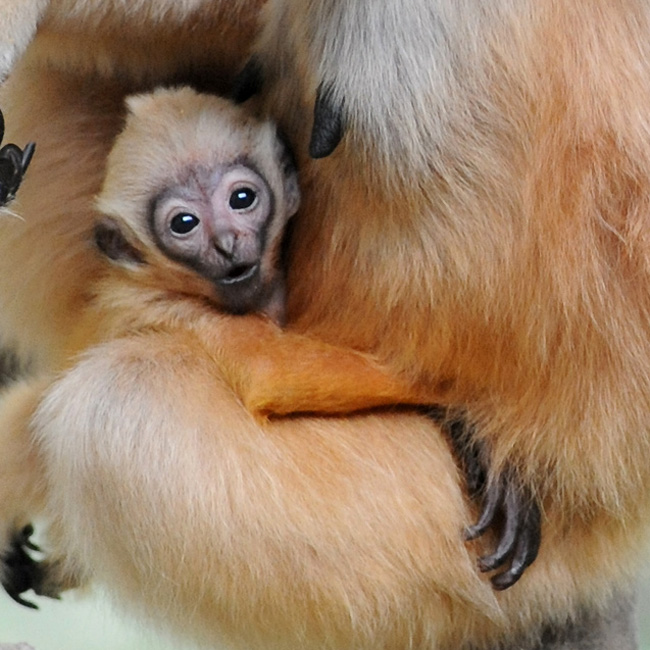
    The Chicago Zoological Society, which manages Brookfield Zoo, is happy to announce the birth of a male White-Cheeked Gibbon on November 15. The 1-month-old infant—along with his mom, Indah; dad, Benny; and 2-year-old brother, Thani—can be seen on exhibit in the zoo’s Tropic World: Asia exhibit daily between 10:00 a.m. and 2:00 p.m.

    Since his birth, the infant has been keeping a close grip on his mom. He will stay in contact and be carried by Indah for a few more months. As he gets older, he will begin to explore the habitat on his own, become more independent, and play with his brother and dad. 

    All White-cheeked Gibbons are born with a blond coat matching their mother’s coat, a form of camouflage. The new male Gibbon will retain this light coloring until it begins to turn dusky when he is half a year old. By the time he reaches his first birthday, the young Gibbon will be sporting a black coat with light cheek patches, like his dad and brother. He will retain this coloration for life. Females turn black and then back to blond again, with a small patch of black on their crown, when they reach sexual maturity at around 6 to 8 years of age.

    Brookfield-Zoo---White-Cheeked-Gibbon5

    Brookfield-Zoo---White-Cheeked-Gibbon3

    Brookfield-Zoo---White-Cheeked-Gibbon

    Brookfield-Zoo---White-Cheeked-Gibbon2

    Brookfield-Zoo---White-Cheeked-Gibbon6

    Indah, 23, and Benny, 26, have been together at Brookfield Zoo since August 1995. Indah was born at Minnesota Zoological Garden, and Benny was born in Leipzig, Germany. They are managed as a breeding pair based on a recommendation by the Gibbon Species Survival Plan (SSP) of the Association of Zoos and Aquariums (AZA). An SSP is a cooperative conservation program for the long-term management of an endangered species’ breeding, health, and welfare in North American zoos. Jay Petersen, curator of mammals for the Chicago Zoological Society, is the Gibbon SSP coordinator. With the assistance of the Gibbon SSP Management Group, he is responsible for management goals for all gibbons in AZA zoos and for breeding recommendations to ensure the sustainability of a healthy, genetically diverse, and demographically varied North American white-cheeked gibbon population. Currently, 83 white-cheeked gibbons live in accredited North American zoos.

    (more…)

  • , , ,

    Little_Rock_Zoo_Geoffroy's_Marmosets

    These twin Geoffroy's Marmosets were born November 21, 2011 on a very stormy night at the Little Rock Zoo. They were born to parents Becky and Santana.  In these photos they are riding on Santana (dad). Their sex remains unknown. Becky was very protective of them and was slow to let Santana carry them, but finally did.  They have an older brother, Carlos who was born in early 2010. He would like to help carry the babies, but so far has not been allowed.  They share and exhibit with a White Faced Saki family and 7 Green Iguanas.

    Little_Rock_Zoo_Geoffroy's_Marmosets_1

    Little_Rock_Zoo_Geoffroy's_Marmosets_2
    Photo credit: Karen Caster, Primate Keeper at the Little Rock Zoo

  • ,

    Emperor Tamarins.

    Drusillas Park in the UK is currently in the midst of a baby boom with a multitude of mini monkeys popping up around the Park!  The monkey madness started when Emperor tamarin, Lucy gave birth to the twins pictured above. This species takes its name from the 19th Century Emperor, Wilhelm II of Germany, whom they are said to resemble on account of their distinctive moustaches. The fan-tash-stic pair are becoming more independent everyday and can now be seen playing with their older siblings. 

    Two silvery marmosets were next to make an appearance (below). The pearl coloured pair were born on August 28 and are thriving under the watchful guidance of proud parents Captain Jack and Hester. Silvery marmosets are native to the forests of Central and South America and usually give birth to twins every five to six months. 

    Marmosets

    More monkey madness below the fold…

    (more…)

  • , ,

    Weeping_Capuchin_6

    After nine years with no babies in the Weeper Capuchin enclosure at Israel's Zoological Center Tel Aviv, Kopatch, a 15 year old female gave birth to a tiny baby. Kopatch's rank in the group is usually very low, but since she gave birth it seems to have risen. The capuchin group arrived at the Safari on May 25th 1987, after being smuggled into Germany and confiscated by the government there. They were kept in the Hannover Zoo until they could find a new home.

    Weeping_Capuchin_5

    Weeping_Capuchin_3
    Photo credits: Tibor Jager


    Capuchins are the smartest monkeys among the "New World monkeys". They are famous for their tool use and nut cracking ability, using two stones- one as an anvil and the other to crack the nut with.

    (more…)

  • , ,

    _Julie-Larsen-Maher-9576-Golden-Lion-Tamarin-and-Baby-PPZ-09-01-11

    Prospect Park Zoo's Golden Lion Tamarin may be small, but the baby monkey is already giving great big grins. The 2-month-old tamarin is also getting brave, going further out on branches away from its first-time parents, Pablo and Teodora.

    _Julie Larsen Maher 9742 Golden Lion Tamarin and Baby PPZ 09 01 11

    _Julie-Larsen-Maher-9554-Golden-Lion-Tamarin-and-Baby-PPZ-09-01-11

    _Julie-Larsen-Maher-9727-Golden-Lion-Tamarin-and-Baby-PPZ-09-01-11
    Photo credits: Julie Larsen Maher © WCS

  • , ,

    Baby-titi-monkey
    A Gray Titi Monkey was born at the Bronx Zoo in April and has just now gone made it's debut on exhibit with mom. In fact, you can hear them sing together early in the morning.

    Gestation for the Bolivian gray titi monkey is about 132 days, a little over 4 months. A single baby is usually born; very rarely, twins are born.  Gray titi monkeys live in family groups, which usually consists of a breeding couple and several offspring. The father will help wtih the baby, carrying it on it's back in the first few days after birth. Older brothers or sisters may also help in this same way.

    The Wildlife Conservation Society, which owns the zoo, works in Bolivia where gray titi monkeys live in the wild. This species is endangered largely due to habitat destruction.

    Titi
    Photo by Julie Larsen Maher/WCS

  • , ,

    Francois_Langur_3

    Taronga’s Primate keepers have been busy with the arrival of another Francois Leaf-monkey infant! He is the second bright orange monkey to be born this year at Taronga and is great news for the zoo's breeding program as the species is on the cusp of extinction. Sadly there may be as few as 1000 left in the wild.

    The male infant, named ‘Tam Dao’ after a National Park located in Vietnam north of Hanoi, was born to mother, ‘Meili’ and father ‘Hanoi’ and found cradled in its mother’s arms in the early morning of Saturday 20 August by zoo keepers who had been monitoring the pregnancy.

    Francois_Langur_1

    Francois_Langur_2

    Francois_Langur_5

    Francois_Langur_4
    Photo credits: Ric Stevens

  • ,

    11 1

    Visitors to the monkey house at Edinburgh Zoo have been meeting the Zoo’s latest arrival, an inquisitive orange-eye baby L’hoest’s monkey. It's birth has special significance, as the baby’s mum, Tumbili, brought new genetics to Edinburgh from North America.

    Animal Team Leader Lorna Hughes said: “Every birth is special, but this one has been really exciting. Tumbili came to Edinburgh from San Diego Zoo about eight months ago, bringing new genetics with her which will strengthen biodiversity here and in zoos throughout Europe.” 

    Born on June 26 to mum Tumbili and dad Kizizi, the new arrival is already developing a big personality. “The baby is quite a confident little one. It comes right up to the window to have a look at visitors," Hughes added. "We’ll check to see if it is a boy or girl when it is about three months old, once the baby has started venturing away from mum a bit more. Once we know, we’ll be able to choose a name.”

      L'hoest 3

    L'hoest Monkey 2
     Photo Credit: Edinburg Zoo

    (more…)

  • ,

    Colobus CU 3818

    On May 20, a male Colobus Monkey was born at the St.Louis Zoo in Missouri. His name is Mosi. This is the first Colobus to be born at the Zoo in 11 years. 

    The Zoo said Tuesday that mom Roberta, 23 years old, has been an attentive mother, holding the baby with one arm when moving around and against her abdomen when at rest in the Zoo's Primate House. Mosi is very active; after only a few days in the world he was seen hopping from mom to the ground and back!

    Colobus Riepl 3807

    B&W Winkelman2011
    Photo credits: Photos 1 & 2 Ethan Riepl, Photo 3 Robin Winkelman

    (more…)

  • , , ,

    Gibbon-PerthZoo17

    A rare baby Gibbon born at Perth Zoo eight weeks ago is thriving thanks to around the clock care by Perth Zoo staff. Weighing just 610 grams (21 oz.) at birth, White-cheeked Gibbon Nakai is being bottle fed and cared for by Zoo staff until he can be reunited with his mother who had difficulties caring for him shortly after the birth. Nakai is being bottle fed baby milk formula nine times a day including night feeds and has almost doubled his birth weight. He now weighs 1050 grams – just over 37 oz.

    Gibbon-PerthZoo8

    Gibbon-PerthZoo14

    Gibbon-PerthZoo16
    Photo and video credits: Perth Zoo

    “The White-cheeked Gibbon is a critically endangered species quite literally on the brink of extinction so Nakai and every single gibbon is precious,” says Holly Thompson, Perth Zoo keeper and one of Nakai’s primary carers. Read below the fold for more pictures.

    Gibbon-PerthZoo7

    Gibbon-PerthZoo1

    Gibbon-PerthZoo3

    Gibbon-PerthZoo15

    “Nakai spent the first few weeks of his life in a humidicrib to maintain his body temperature but now sleeps in a warm room with his teddy bear which is his surrogate mother for now.”

    “We exercise him daily, stretching his arms and swinging him while he hangs on to help strengthen his arms and encourage natural gibbon behaviour. His upper body strength is really developing now and his overall progress has been amazing.

    (more…)