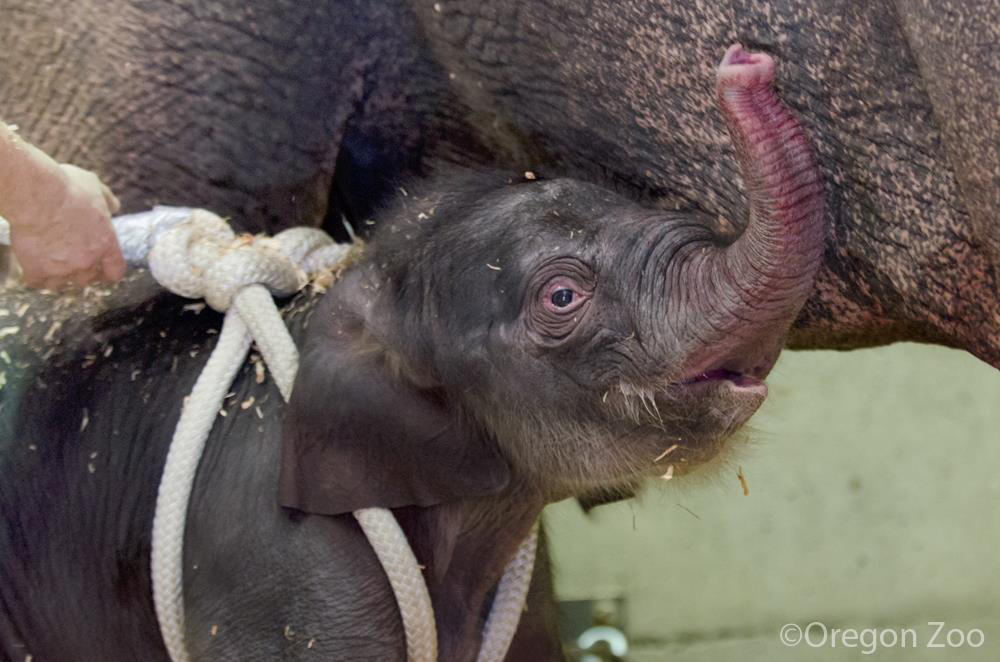
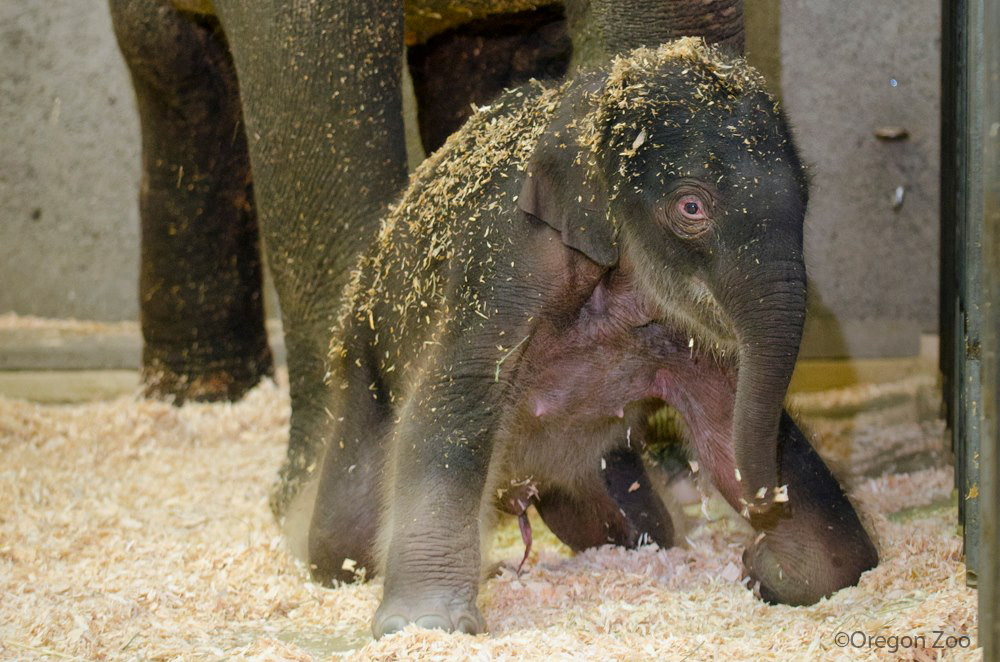
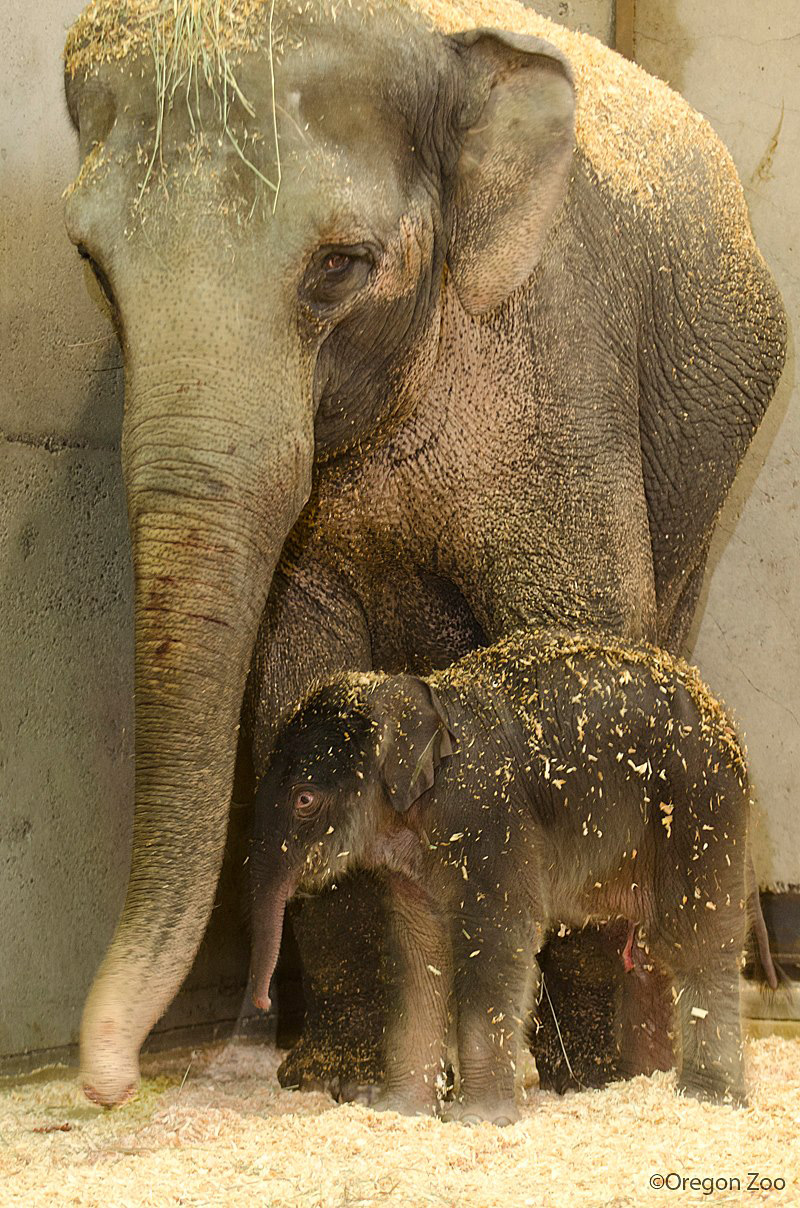
Oregon Zoo's Asian Elephant calf Lily is a little over one month old and has been developing into a joyful, energetic little elephant. You may have read about the baby, born November 30, HERE on ZooBorns. Her public debut was on December 14, when, for limited hours, the public could see her sticking close to Mom Rose-Tu. But even then her personality was evident, earning her the description of a 'spitfire' by her keepers.
Since then, she has grown not only in size but in confidence. She is out for longer hours now with the herd and when not napping, can often be seen skipping, rolling around and playing. She totters in a signature way that has been captured in these stills and on the video below. But she knows she can always return to the safety found under the sturdy legs and bellies of the grown ups!
The long wait is over. Rose-Tu, an 18-year-old Asian Elephant, gave birth to a 300-pound female calf at the Oregon Zoo at 2:17 a.m. on Friday, Nov. 30.
“We’re all delighted at the arrival of Rose-Tu’s new calf,” said Kim Smith, Oregon Zoo director. “The calf is beautiful, healthy, tall and very vigorous. As soon as she hit the ground — before she was even out of the amniotic sac — she was wiggling. And she’s vocalizing loudly. The first time we heard her, the sound was so deep and loud that we thought it was one of the older elephants. She’s definitely got a great set of pipes, and it looks like she’s going to be a real pistol.”
Photo credit: Oregon Zoo
Learn more about this exciting birth below the fold…
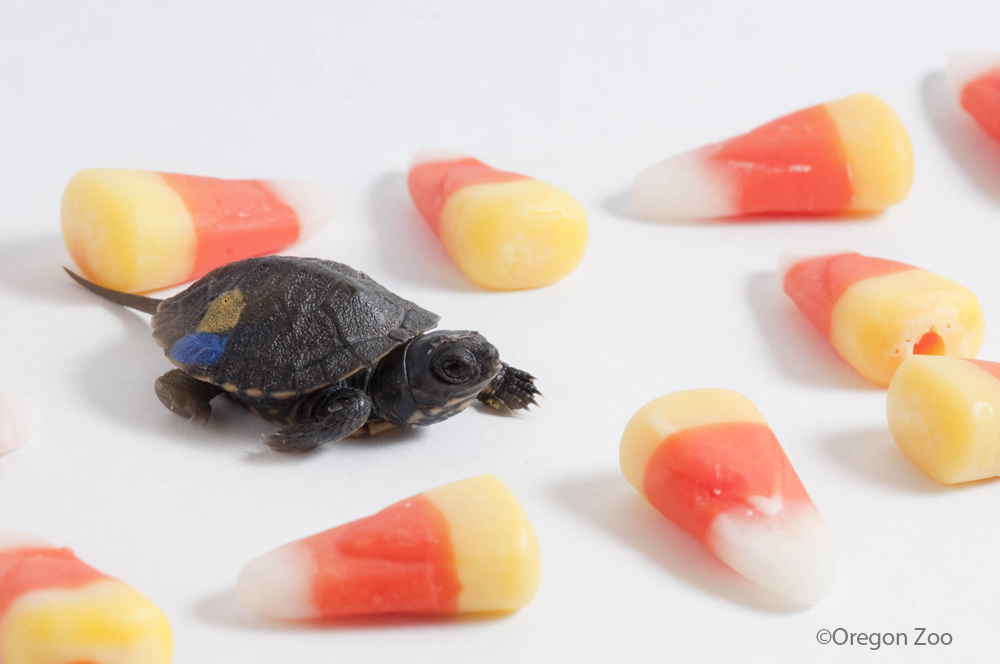
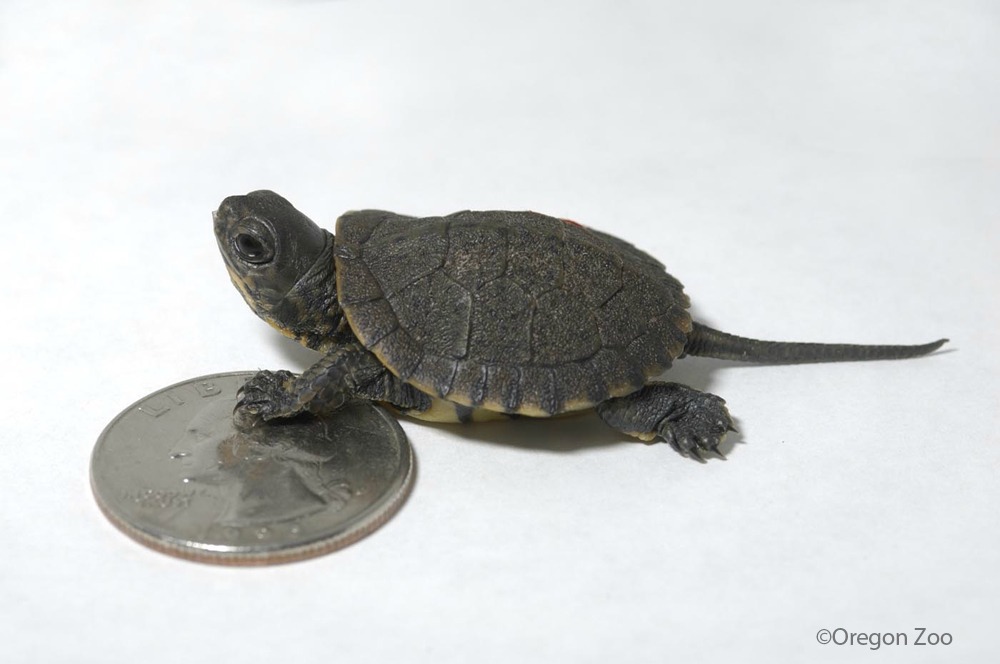
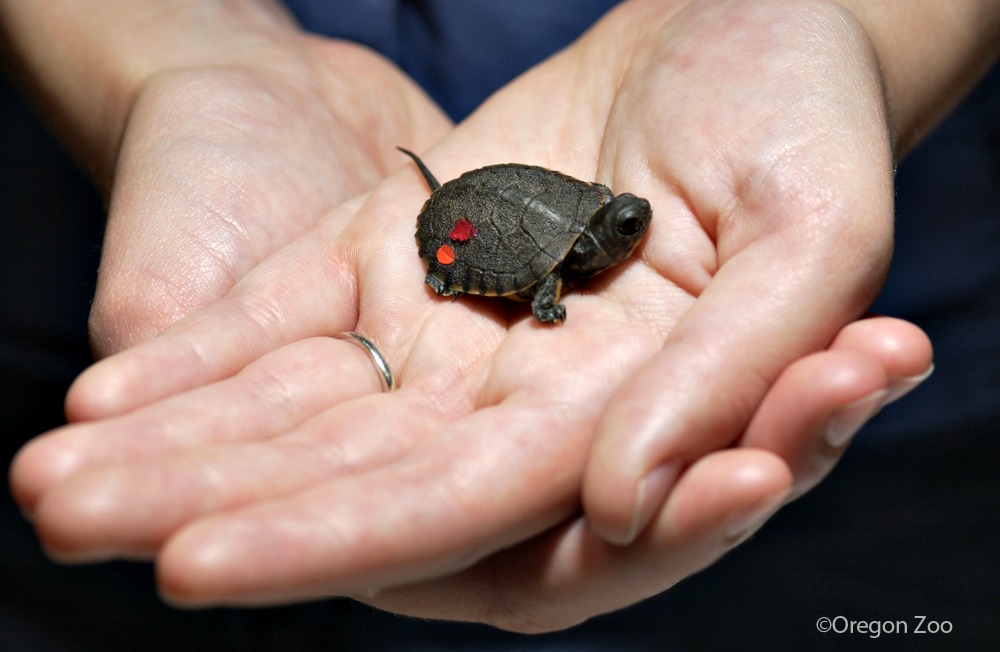
Western Pond Turtles are making
a comeback, and these week-old hatchlings at the Oregon Zoo are destined to aid in the species’
recovery.
For more than two decades the
Oregon Zoo has been working to restore this species to its historic
range, which once extended from Baja California to Puget Sound. As a result, Western Pond Turtle (Actinemys
marmorata) numbers are on the rise. This
species, which can live up to 70 years, has been profoundly affected by the
construction of river dams, invasive plants, predation, and draining of
wetlands.
In 1990, the Western Pond
Turtle “head-starting” project was initiated, which accelerates turtles’
natural growth rates, and thus their ability to withstand predation. The Oregon
Zoo collaborates with Woodland Park Zoo and the Washington Department of Fish
and Wildlife. Other partners include Bonneville Power Administration and the
U.S. Forest Service.
Each spring, scientists count,
trap, mark and fit transmitters on adult females in the wild. In summer, the females are monitored and nest
sites are identified. Hatchlings are
collected in the fall to be cared for at the zoo. Juveniles, some of whom are fitted with
transmitters, are returned to the wild the following spring.
The first turtles released in
1991 in the Columbia River Gorge are reproducing and laying eggs in the wild.
Over the past two decades, approximately 1,500 turtles have been released, and
with good results: the gorge turtle population ranged from a low of 150 in 1990
to approximately 1,500 in 2011. Scientists tracking them estimate that 95
percent of the turtles released to sites in the Columbia River Gorge have
survived.
Photo Credits: Carli Davidson, courtesy of the Oregon Zoo (top photo) and Michael Durham, courtesy of the Oregon Zoo
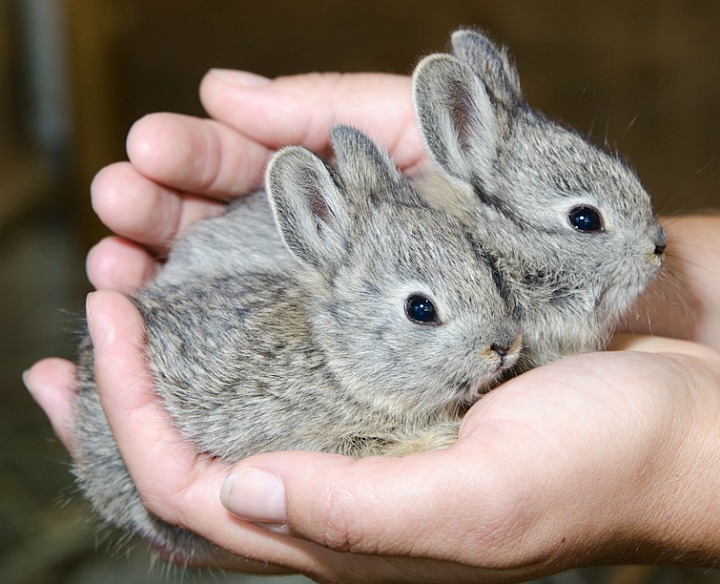
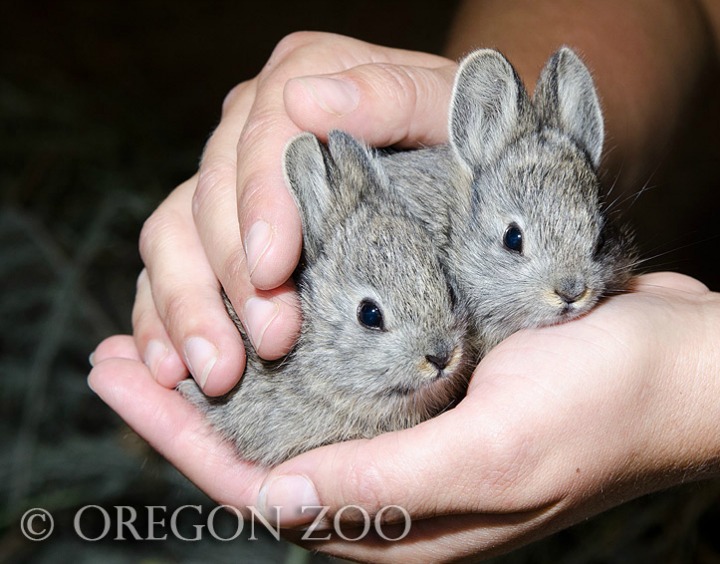
The Oregon Zoo’s 12-year effort to save the endangered Columbia Basin Pygmy Rabbit drew to a close on July 19, when the zoo released its last 14 breeding rabbits and their offspring at the Sagebrush Flat Wildlife Area in eastern Washington. The Pygmy Rabbit is America’s smallest native rabbit, weighing less than one pound when fully grown, and is the country’s only burrow-digging and sagebrush-climbing rabbit. The shy species is dependent on sagebrush, which makes up the majority of its diet and grows in deep, loose soil, where the rabbits dig burrows.
“We’ve helped give these rabbits a chance for survival, and now it’s time to send them off into the world,” said Michael Illig, Oregon Zoo animal curator. “Our hope is that they’ll continue to breed and establish a stable population at Sagebrush Flat. A strong Pygmy Rabbit population there will keep the local community involved and help preserve the habitat.”
The recovery program ends on a high note for these federally endangered bunnies. Nearly 30 kits were born under the Oregon Zoo’s watch this year. The rabbits, currently housed at the zoo’s Jonsson Center for Wildlife Conservation in rural Clackamas County, are headed for a six-acre transitional enclosure at Sagebrush Flat that will acclimate the animals to their surroundings, encourage breeding and protect them from predators. Rabbits recently released from the enclosure have been tracked and are successfully living in the area — a good indication for future population growth, according to Illig.
This post was reprinted in entirety from the Oregon Zoo's outstanding press release
"Michelle, we need your help."
So began a conversation that Michelle Schireman, an Oregon Zoo keeper known for taking in orphaned cougar cubs, realized would upend her life, both professionally and personally, for a while. It was her day off from the zoo, and the Oregon Department of Fish and Wildlife was calling her at home.
As Schireman recounted that surprise phone call to zoo staffers a couple days later, a furry black animal about the size of a Labrador puppy wobbled Bambi-like around her boots, unsure of where to go next. Its tiny size, downy fur, and attachment to a nearby beaver plush toy suggested something harmless. But the sharp teeth and long claws confirmed its true identity: American Black Bear – and, of course, the reason for ODFW's call.
On April 23, state wildlife officials fielded a call from a Medford, Ore., family that had taken a young bear cub from the wild and brought it into their home. With no idea how to care for the helpless yet wild animal, they turned to professionals. Those professionals turned to Schireman.
The animal keeper, who serves as the Association of Zoos and Aquariums' population manager for cougars, has fostered orphaned cougar cubs for several years, having placed nearly 75 during her time with the Oregon Zoo.
"I'm usually the first person fish and wildlife departments call when orphaned cougars are found in the wild," Schireman said. "Young cougars can't survive without their mothers, so I work with accredited zoos to find them new homes." Schireman's big heart and animal-care expertise led wildlife officials to believe she might find a home for this young bear cub too.
She got permission to house the cub temporarily at the zoo's Veterinary Medical Center during her workday, taking him home with her at night since the cub was still of nursing age and required around-the-clock care. At just a couple of months old, the bear weighed 4 pounds – about the same as a half-gallon of milk – which, surprisingly, is normal for an animal that could grow to be 6 feet tall and weigh up to 600 pounds.
Three orphaned cougar cubs with baby-blue eyes, fuzzy spotted coats, and much-too-big feet have briefly taken up residence behind the scenes at the Oregon Zoo until they can be moved to permanent homes in Nashville and Houston next week.
The 10-week-old cubs, all three male, were found in Washington state after their mother was illegally shot by a hunter. When wildlife officials learned the cubs were still alive, they quickly contacted Oregon Zoo keeper Michelle Schireman, who serves as the Association of Zoos and Aquariums’ population manager for cougars.
“I’m usually the first person fish and wildlife departments call when orphaned cubs are found in the wild,” Schireman said. “Young cougars can’t survive without their mothers, so I work with accredited zoos to find them new homes.”
My how you've grown! Oregon Zoo's three Caracal kittens, first introduced HERE, are now 5 weeks old, and their tufted ears – a distinguishing feature of the small African cats – are fully upright. At birth, the kittens’ ears were flat against their heads. The male and two females continue to do well, as does their mother, Peggy.
“The kittens are very healthy and growing quickly,” said senior Africa keeper Asaba Mukobi. “In the past week, the male has put on about half a pound, and his sisters gained almost as much. Peggy is doing a great job of making sure they eat enough.”
The kittens are very active and enjoy playing on a series of climbing logs, which keepers recently placed in the behind-the-scenes area where Peggy and the kittens spend their time. The zoo’s Africa keepers are voting on possible names for the kittens.
The Oregon Zoo's Caracal triplets born June 8th are ready for their close-ups! These photos, taken just yesterday, show the cubs at precisely two weeks of age. Caracals live in the woodlands and savannas of North Africa, Southwest Asia and the Arabian Peninsula. While caracals are listed in the category of “least concern” by the International Union for Conservation of Nature, hunting and habitat loss pose risks to wild populations.
Oregon Zoo Caracal Peggy gave birth to three healthy kittens, two females and one male, on June 8. According to keepers, the first-time mother and her babies are doing well, with all three kittens nursing regularly and starting to move around their behind-the-scenes nesting box.
“We are very proud of Peggy,” said senior Africa keeper Asaba Mukobi. “It’s really amazing to see her do everything she possibly can to care for her kittens. She’s very protective, makes sure everyone is nursing, and sets boundaries for the kittens now that they’re moving around.”
The Oregon Zoo's Cougar cub will be on exhibit starting Thursday, Nov. 11, though visitors will need to keep a sharp eye out to see the youngster. Like all baby Cougars, the female cub is well-camouflaged by the brown spots on her coat. Since her birth Sept. 19, the cub has lived in a maternity den with her mother, Chinook. She and Chinook will have access to the Cougar exhibit in the morning, while the cub's father, Paiute, will be on exhibit in the afternoon. The cub, who keepers describe as "brave and feisty," has ventured into the exhibit several times this past week, first with the exhibit's viewing areas completely closed and then with zoo staff watching from the viewing areas.
"As we expected, the cub quickly adapted to having people around," said Michelle Schireman, Oregon Zoo Cougar keeper. "She's quite the little explorer. Her comfort was the determining factor in our decision to open the exhibit to zoo visitors."