The Newest, Cutest Baby Animals from the World's Zoos & Aquariums

Category: Paignton Zoo

  • ,

    In late October, UK’s Paignton Zoo revealed the exciting news that they had welcomed a male baby orang-utan. Mother and baby have been off-show to visitors whilst they settle in and bond but now they both can be seen by visitors in their Ape House.

    The baby was born to mother Chinta, a 32-year-old Bornean orang-utan, and father Wousan who is 14 years old, on 24 October 2022.

    Baby-orangutan-PZ - credit Georgina Barnes

    (more…)

  • ,

    1_2017 08 PZ toco toucan chicks 5

    Paignton Zoo Environmental Park is the only collection in the UK to have hatched Toco Toucan chicks this year, and the facility is one of only three in all of Europe to have bred this remarkable bird in 2017.

    It’s hard to believe that the two new hatchlings, looking more like comical puppets than growing chicks, will turn into examples of one of the most striking and familiar birds in the world. The Toco is the largest, and probably the best-known, member of the Toucan family.

    2_2017 08 PZ toco toucan chicks 2

    3_2017 08 PZ toco toucan chicks 4

    4_2017 08 PZ toco toucan chicks one month old croppedPhoto Credits: Paignton Zoo Environmental Park 

    The two are being hand-reared by Paignton Zoo bird keeper, Nikki Watt. Although the parents have hatched chicks in the past, they failed to successfully rear their previous offspring. Zoo staff opted to care for the chicks themselves to ensure their survival.

    The chicks are demanding: they are fed first at 7:00am, then every two hours or so until 10:00pm. Each meal of special baby bird formula and fruit has to be prepared and delivered by hand. Nikki records amounts consumed at each sitting.

    Now one month old, the pair is doing well and already starting to look more like the recognizable image of a Toucan.

    The Toco Toucan (Ramphastos toco), also known as the Common Toucan, Giant Toucan or Toucan, is the largest and probably the best-known species in the toucan family. It is native to semi-open habitats throughout a large part of central and eastern South America.

    5_2017 07 PZ toucan chicks 1 one week old

    6_14500577_1228163453871411_1274833214958569407_o

  • ,

    1_2017 03 PZ maned wolf pup 2

    Paignton Zoo’s South American Maned Wolves are rearing a litter of three pups!

    This is the first litter for the pair. The male, Tolock, arrived at Paignton Zoo in September 2016 from Katowice Zoo in Poland, where he was born in 2015. Female Milla was born in December 2012 and arrived in the UK a year later from Nordens Ark Zoo in Sweden.

    It has been seven years since Paignton Zoo has bred Maned Wolves. They are part of the carefully managed European Endangered species Programme.

    Curator of Mammals, Neil Bemment, said, "Judging by the parents’ change in behavior, the pups were born on 23rd February. Being carnivores, we left them undisturbed to get on with it. The pups were not seen by the keepers for four weeks. Our Maned Wolves are quite elusive, but with patience can usually be seen mid-afternoon. There will be a much better chance of seeing one now there are five and especially when the pups become more mobile!”

    2_2017 03 PZ maned wolf pup 3

    3_2017 03 PZ maned wolf pup 1Photo Credits: Paignton Zoo Environmental Park

    The Maned Wolf (Chrysocyon brachyurus) is the largest canid of South America. Adults stand almost 1 meter (3 feet) tall at the shoulder and weigh 20 to 25 kg. (50 to 55 lb).

    They catch small prey such as rodents, hares and birds, but fruit forms a large part of their diet.

    The Maned Wolf is shy and flees when alarmed, and their mane can be raised to display aggression. You are more likely to smell them than see them, as their urine, which they use to communicate, has a very distinctive smell.

    Although often described as "a fox on stilts", due to their coloration, it is not closely related to any other canid and may be a survivor from the Pleistocene fauna of large South American mammals.

    Native to parts of Brazil, Paraguay, and Bolivia, the Maned Wolf is currently classified as “Near Threatened” by the IUCN, thanks largely to the effects of man: habitat loss, poaching, road kill and domestic dogs (which can attack the wolves and spread diseases).

  • ,

    2016 10 PZ pileated gibbon baby by Miriam Haas 2Keepers at the Paignton Zoo are cautiously optimistic that a rare Pileated Gibbon baby will survive despite being born several weeks prematurely.

    Born September 19 to parents Shukdi and Hantu, the baby would be the first of its species to be reared during the zoo’s 15-year breeding program.

    Mom & Baby 2016 10 PZ pileated gibbon baby by Miriam Haas 1
    2016 10 PZ pileated gibbon baby 1Photo Credit:  Miriam Haas


    Like all Gibbons, a Pileated Gibbon baby clings to its mother’s belly for the first several months of life.  Because the baby is so closely held by mom, keepers are often unable to determine the baby's gender until it begins exploring on its own.     

    Male and female Pileated Gibbons display sexual dimorphism – males and females look differently from one another.  Females have light-colored bodies and dark faces, while males have all black fur with white markings. 

    Found in Thailand, Cambodia, and Laos, Pileated Gibbons live in the treetops and feed during the day on fruit, leaves, and small animals.  They are listed as Endangered by the International Union for Conservation of Nature, due to hunting and severe habitat loss and fragmentation. 

    See more photos of the baby Gibbon below.

    (more…)

  • ,

    1_2016 09 PZ adult lemur leaf frog 2

    Paignton Zoo Environmental Park has bred a Critically Endangered frog for the very first time.

    Keepers from the charity’s Lower Vertebrates and Invertebrates Department used artificial rainstorms to help set the mood for the Lemur Leaf Frog, a species found mainly in the rainforests of Costa Rica and Panama.

    Paignton Zoo is one of only four collections in the UK working with this species. Keeper Andy Meek, from the Lower Vertebrates and Invertebrates Department, explained, “We have a total of 18 tadpoles, a number of which have now become full froglets. We also have 10 adults. The species is Critically Endangered. There is a studbook currently being set up to manage this species in Europe. This is a first for Paignton Zoo, so I’m really pleased.”

    The keepers prepared a rain chamber using a water pump and a timer system to make it rain every few hours during the day. The rainfall and the humidity together helped to replicate the sort of conditions the frogs would encounter at the start of the wet season, which is when they breed.

    This is a tiny but welcome success in the face of the huge extinction crisis facing amphibians.

    2_2016 09 PZ Andy Meek with lemur leaf froglet 4

    3_2016 09 PZ adult lemur leaf frog 1Photo Credits: Paignton Zoo

    The Lemur Leaf Frog (Agalychnis lemur) is a slender, lime-green frog with bulging eyes and no webbing on hands and feet. It is a nocturnal tree frog associated with sloping areas in humid lowland and montane primary forest.

    Their eggs are usually deposited on leafs; the larvae wash off or fall into water.

    This endearing little frog also has a trick up its sleeve: it can change color. Light green during the day, and it turns a less obvious reddish-brown at night when it is active.

    It was once considered to be reasonably common in Costa Rica, but most populations have now disappeared. The species is classified as “Critically Endangered” on the IUCN Red List of Threatened Species. The huge declines are probably due to the chytrid* fungus, which is decimating amphibians around the world.

    (*Chytridiomycosis is an infectious disease in amphibians, caused by the chytrid Batrachochytrium dendrobatidis, a nonhyphal zoosporic fungus. Chytridiomycosis has been linked, by experts, to dramatic population declines and extinctions of species in western North America, Central America, South America, eastern Australia, and Dominica and Montserrat in the Caribbean.)

  • ,

    2016 07 PZ Asiatic lion cub portrait large
    A pair of male Asiatic Lions born June 16 at Great Britain’s Paignton Zoo are two of just 15 born in zoos around the world so far this year. 

    2016 07 PZ Asiatic lion cubs 3
    2016 07 PZ Asiatic lion cubs 1
    Photo Credit:  Paignton Zoo
     
    Only about 500 Asiatic Lions are found in the wild today, all living in India’s Gir National Park & Sanctuary.  These cats once lived across southeastern Europe, the Middle East, Pakistan, and India.  The subspecies is listed as Endangered by the International Union for Conservation of Nature.  Hunting and habitat destruction through the centuries have caused the cats’ decline.

    The cubs’ mother, Maliya, has kept the cubs tucked away in the birthing den for several weeks.  The zoo staff is pleased with how Maliya, a first-time mother, has been caring for her babies with the help of her mother, Indu, and the cubs’ father, Lucifer. 

    Asiatic Lions are smaller than Africa Lions and have a distinctive fold of skin on the belly and a smaller, lighter-colored mane on adult males.

  • ,

    1_2016 05 PZ giraffe 5

    A Rothschild’s Giraffe has been born at Paignton Zoo. The male calf was born to mother Janica on the morning of May 19. Sadly, his mother rejected him, so zookeepers have stepped in to bottle feed him.

    Senior Keeper, Craig Gilchrist, said, “He has taken milk from us; he is getting the hang of it. Mammal keepers, Helen Neighbour and Jim Dicks, are doing the feeding. He is separated from the group but can see them all. For the first few days, it is important to keep him separate to allow him to bond with the keepers so he feels comfortable enough to feed from them. As soon as possible, he will be reintroduced to the herd so he doesn’t forget he is a giraffe!”

    Paignton Zoo Curator of Mammals, Neil Bemment, added, “At this stage we don’t know why Janica has rejected him. Giraffe mothers are fickle beasts. Sometimes they will rear their calves, sometimes they won’t. For example, Janica reared her first, Tonda, who is now the breeding bull at Chessington Zoo, Surrey, but declined to rear her second Valentino, who was successfully hand reared by the keepers, reintroduced to the family group, and is now in Port Lympne Zoo, Kent.”

    Paignton Zoo is going to get through a lot of milk over the next few months. Craig added, “At the moment we need about 4 to 6 litres of gold top milk each day. He will take in around 10% of his body weight in milk each day and gain weight just as quickly. As he grows, so will his milk requirements.”

    2_2016 05 PZ giraffe 1

    3_2016 05 PZ giraffe 4

    4_2016 05 PZ giraffe 3Photo Credits: Paignton Zoo

    Hand rearing a giraffe is a lot of extra work and commitment for the keepers. “He is fed 4 times a day and could need milk for up to 9 months. We will start weaning him when he is around 5 to 6 months, depending on how he gets on.”

    The calf stands at nearly six feet tall at birth. The gestation period for a giraffe is between 400 and 460 days. The mother gives birth standing up, and the fall breaks the umbilical cord. The calf can stand and run within a few hours.

    Father, Yoda, came from Givskud Zoo, Denmark, where he was born on 14th November 2004. He arrived at Devon in September 2006. Janica came to Paignton Zoo from Duvr Kralove Zoo in the Czech Republic.

    The Zoo’s other adult female is Sangha, who came from Liberec Zoo, also in the Czech Republic. The other youngsters at the Zoo are Otilie, who was born in September 2012, and Joanna, born in January 2014 (both to mother Sangha) and Eliska, born in January last year to Janica.

    All the giraffes at Paignton Zoo Environmental Park (a registered charity in the UK) are Rothschild’s Giraffes.

    (more…)

  • ,

    1_2016 03 PZ joey 6 by Miriam Haas

    A Western Grey Kangaroo joey emerged into the sunshine recently at Paignton Zoo Environmental Park in Devon, UK.

    The rather ungainly exit from its mother’s pouch was probably the youngster’s first attempt. Born in May or June last year, it’s been developing in its mother’s pouch for months.

    Paignton Zoo Curator of Mammals, Neil Bemment, said, “It’s been peeking out for a while, but the weather was just too chilly and wet for it to want to come out completely…and who can blame it!”

    Photographer, and regular Paignton Zoo visitor, Miriam Haas, who took the photos, said, “It [the joey] spent a good 10 minutes or more enjoying the sunshine before returning to the safety of the pouch.”

    2_2016 03 PZ joey 1 by Miriam Haas

    3_2016 03 PZ joey 2 by Miriam Haas

    4_2016 03 PZ joey 3 by Miriam HaasPhoto Credits: Miriam Haas

    The Western Grey Kangaroo Macropus fuliginosus (also referred to as a Black-faced Kangaroo, Mallee Kangaroo, and Sooty Kangaroo) is a large and very common kangaroo found across almost the entire southern part of Australia.

    The Western Grey Kangaroo is one of the largest macropods in Australia. An adult can weigh 28–54 kg (62–120 lb) and have a length of 0.84–1.1 m (2 ft 9 in–3 ft 7 in), and a 0.80–1.0 m (2 ft 7 in–3 ft 3 in) tail. They stand approximately 1.3 m (4 ft 3 in) tall.

    (more…)
  • , , , , ,

    12027303_10153722450829254_7587102204204898737_o

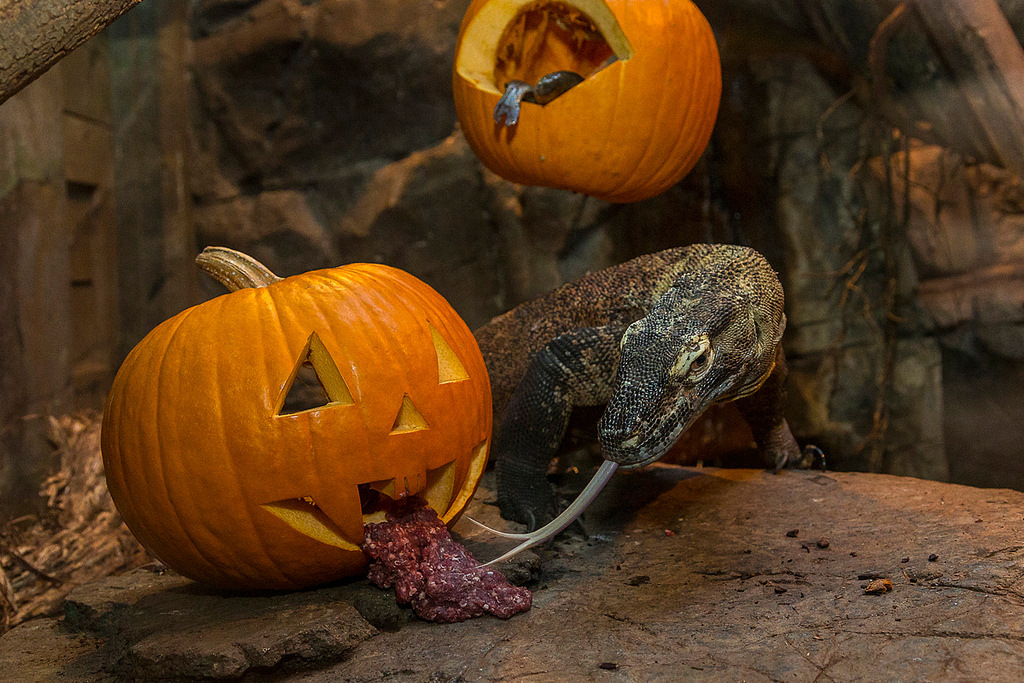
    It's Halloween, and that means zoo animals around the world are enjoying encounters with pumpkins and gourds of all shapes and sizes.  Animals' reactions to pumpkins vary, but critters may sniff, munch on, or completely destroy their pumpkin treats.

    The pumpkins are more than a seasonal celebration – they serve as enrichment for zoo residents. Enrichment provides physical, mental, or sensory stimulation and encourages natural behaviors in animals.  Happy Halloween from ZooBorns!

    22367994008_334ae5ee11_k
    22509311582_c68cbe932a_b
    12022500_10153722450759254_5938967778058632815_o
    12189140_1022059024481856_5382870302403062225_n
    Elephant oregon1
    12113458_10153722450824254_432652503730689610_o
    Lion Cubs 9982 - Grahm S. Jones, Columbus Zoo and Aquarium
    12028749_10153722450804254_2589276873012121375_o
    11219085_1022327344455024_3996086366465239910_n
    Gecko dallas
    Photo Credits (top to bottom)
    Ring-tailed Lemur:  Fort Wayne Children's Zoo
    Galapagos Tortoise:  San Diego Zoo
    Komodo Dragon:  San Diego Zoo
    North American River Otter:  San Diego Zoo
    Gorilla:  Paignton Zoo
    Asian Elephant:  Oregon Zoo/Shervin Hess
    Sumatran Tiger:  Fort Wayne Children's Zoo
    African Lion:  Columbus Zoo & Aquarium/Grahm S. Jones
    Red Panda:  Fort Wayne Children's Zoo
    Spider Monkey:  Paignton Zoo
    Satanic Leaf-tailed Gecko:  Dallas Zoo

  • ,

    IMG_0268 copy
    A Rothschild’s Giraffe born at the United Kingdom’s Paignton Zoo on January 11 is thriving under the care of zoo keepers after her mother rejected her.

    2015 01 PZ Helen Neighbour and giraffe baby 2
    2015 02 PZ Riverford 1
    2015 01 PZ giraffe 2Photo Credit:  Miriam Haas/Paignton Zoo  

    Keepers are not sure why the mother, Janica, refused to care for her female calf, which has been named Eliska, but they have wholeheartedly taken on the daunting task of caring for a six-foot-tall baby who drinks up to two gallons of milk a day.

    Senior head keeper of mammals Matthew Webb, who has been helping to feed Eliska, said, “She will take in around 10% of her body weight in milk each day and gain weight just as quickly. She was 63 kilos (139 pounds) at birth, but as she grows, so will her milk requirements.”

    Luckily, a local organic dairy farm has offered to supply the zoo with milk as long as Eliska needs it.  Eliska is fed four times a day and could need milk for up to nine months.  She will begin weaning at around five to six months of age. 

    As soon as possible, keepers plan to introduce Eliska to the rest of the herd.  This is an important step and will ensure that Eliska knows that she is a Giraffe, not a human.  Paignton Zoo has successfully hand-reared one other Giraffe calf.

    Rothschild's Giraffes, also known as Baringo Giraffes, are classified as Endangered by the International Union for Conservation of Nature.  Those living in European zoos are managed by the European Endangered Species Program.

    See more photos of the Giraffe calf below.

    (more…)