The Newest, Cutest Baby Animals from the World's Zoos & Aquariums

Category: SeaWorld San Diego

  • ,

    SW1_0492B

    Twelve Caribbean Flamingo chicks have hatched at SeaWorld San
    Diego
    in the past three weeks!  The
    chicks are being hand-raised by aviculturists in SeaWorld’s Avian Center.

    SW1_0463B

    SW1_0491B

    SW1_0493B
    Photo Credit:  SeaWorld San Diego

    Flamingos lay a single egg on a muddy mound, and both
    parents care for the chick for up to six years, when the young reach maturity.  Though adult Flamingos are pink, the chicks
    have downy white feathers.  The birds’ pink
    coloration comes from pigments in the aquatic organisms that they eat. 

    Caribbean Flamingos are also known as American
    Flamingos.  They are native to some Caribbean
    Islands, coastal Mexico, Venezuela, and Colombia, as well as the Galapagos Islands.

    Related articles

    Sea Lion Pup Welcomed at Seneca Park Zoo
    Trio of Endangered Penguins at the Audubon Aquarium
  • ,

    Whale baby solo

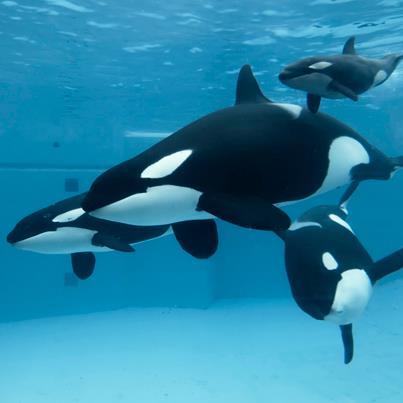
    SeaWorld San Diego's Killer Whale mom Kasatka, estimated to be 37 years old, gave birth on Valentines Day to a healthy calf at Shamu Stadium under the watchful eyes of SeaWorld’s zoological team members. The birth marked the sixth successful killer whale to be born at SeaWorld San Diego. Kasatka and her new baby were swimming together in the show pool that very day. And DNA testing recently revealed that it's a boy! That makes SeaWorld’s Killer Whales to ten — five males and five females.

    Killer whale gestation is between 17 and 18 months long, and Kasatka’s took the full 18 months. Calves typically weigh between 300 and 350 pounds and measure between 6 and 7 feet at birth. The park’s zoological team members report that mother and baby continue to do well, with the calf nursing regularly from the start. Trainers and veterinarians continue a 24-hour watch on the whales to assure their health and well being. 

    In the mean time, he’s not only spending time with his brother and sister (Kalia and Nakai), but he's also swimming with Corky, Shouka and Orkid. And he’s already learned to swim upside down, proving himself to be a bit of a show-boat!!! The plan is to introduce him to the others – Ulises, Keet and Ike — in the near future. 

    Whale w fam

    Whale baby swims w mom

    Whale baby and mom

    Photo Credit: All photos: SeaWorld San Diego, Photo 1, 2: Mike Aguilera

    See more pictures of the baby Killer Whale swimming with Mom and the rest of the whale family after the fold.

    (more…)

  • ,

    Seal 1

    In early March, SeaWorld San Diego rescued a young Pacific Harbor Seal, estimated to be only days old, from a local beach. The animal, which appeared to be separated from its mother, is now being bottle-fed and cared for behind the scenes by SeaWorld's rescue team. SeaWorld experts expect the seal to make a full recovery and be returned to the wild. 

    So far this year, SeaWorld San Diego has rescued more than 100 marine mammals.

    Seal 2

    SW6_6854

    856479_10151450434341855_991347148_o
    Photo credits: SeaWorld San Diego
    Pacific Harbor Seals are born in February through April, and are weaned at four weeks old. A pup can swim at birth, but will ride on its mother's back when tired. Weighing just twenty to twenty-four pounds at birth, Pacific Harbor Seals grow to an adult size of up to 300 pounds.  
  • ,

    Dolphin3

    An Atlantic Bottlenose Dolphin calf is making waves at SeaWorld San Diego
    After a 12-month gestation period, the calf was born to a 29-year-old Dolphin named Cascade on November 5 in a behind-the-scenes
    pool at the marine-life park.  Trainers
    and veterinarians at SeaWorld report that the mother and baby are in good health
    and are swimming together and bonding. This birth marks Cascade’s fifth calf born at SeaWorld
    San Diego. 

    Dolphin1

    Dolphin4

    Dolphin2

    Trainers
    monitor the mother and baby round-the-clock documenting respirations and
    nursing frequency.  The
    gender of the calf will be determined in the coming weeks.  The calf is estimated to weigh approximately
    30 pounds.

    Bottlenose Dolphins are mammals, so they give birth to live young. Mother Dolphins nurse their young with milk.  Dolphin populations are widespread, occuring throughout most of the world's temperate and tropical oceans.  At this time, most populations are stable, so Dolphins are not endangered.

    Photo Credits:  SeaWorld San Diego

  • , , , ,

    Alaska SeaLife Center Bottlefeeding 2b

    Four accredited U.S. aquariums have come together in an effort to save a newborn Beluga whale calf which was found stranded in South Naknek, Alaska last week - this is the first time in history that a live calf has been found and rescued in U.S. waters. Marine mammal experts with a combined 125 years of experience from Shedd Aquarium, SeaWorld and Georgia Aquarium immediately answered the Alaska SeaLife Center’s call for assistance to provide around-the-clock care for the calf during this rehabilitation period. The male, 112-pound calf is touch-and-go at this point and considered in critical condition – especially due to his immature immune system, and remains under 24-hour observation.

    This is a great example of how the aquarium community comes together to work collaboratively in order do what’s best for an animal in need.

    Alaska SeaLife Center Baby Beluga 1

    DSCN0923Photo credits 1 and 2 and video: Alaska SeaLife Center. Photo 3: Provided by Shedd Aquarium featuring SeaWorld's Bill Winhall and Shedd Aquarium's Lisa Takaki

  • , ,

    On July 1st the Monterey Bay Aquarium placed five lively juvenile green sea turtles on exhibit as part of its “Hot Pink Flamingos: Stories of Hope in a Changing Sea” special exhibition. The young sea turtles are just under 9 months old and each is about the size of a dinner plate. The sea turtles are featured in a gallery that shows how rising temperatures could alter the gender of an incubating clutch of sea turtle eggs, or how rising sea levels threaten sea turtles’ nesting beaches.

    Green sea turtle monterey bay aquarium 1 rs

    Green sea turtle monterey bay aquarium 2 rsPhoto credits: ©Monterey Bay Aquarium / Randy Wilder 

    Senior Aquarist Veronica Franklin brought 10 young sea turtles to the aquarium on June 24 from SeaWorld San Diego, where they were among 82 hatchlings born October 5 to resident sea turtles in the park’s “Shipwreck Beach.” The sea turtles’ gender will remain a mystery until they mature a little more. 

    The young sea turtles at the aquarium will rotate between the exhibit and behind-the-scenes holding pools. The two larger turtles they replaced, as well as some of the smaller turtles, will be part of the aquarium’s remodeled “Open Sea” galleries that open in July 2011.

    There’s more information online about their background, and how Franklin and her staff care for the turtles, at www.montereybayaquarium.org/exhibitupdates.

  • ,

    Early this month, Sea World San Diego announced the hatching of 82 Baby Sea Turtles on the park's Shipwreck Beach. The hatchlings, born without human aid or incubation, are developing well and park officials are pleased with the progress. The babies eat a varied diet of squid, krill, shrimp, and special pellets. Adult Sea Turtles live to be well over 100 years old!

    Slide_3483_49330_large

    Slide_3483_49326_large

    Slide_3483_49329_large

  • ,
    An Atlantic bottlenose dolphin calf, born at SeaWorld San Diego on June 10, 2009, swims alongside her 11-year-old mother, Malibu. SeaWorld used sex-selection techniques to determine the sex of the calf prior to birth, which enables them to optimally balance their ratio of males and females. 

    Dolphin calf sea world ab

    Dolphin calf sea world 2 ab

    Dolphin calf sea world closeup
    Photos: Mike Aguilera/SeaWorld San Diego 
  • , ,
    Eventually growing to a height of narly 3 ½ feet feet, this newborn Malayan Great Argus pheasant chick is only a couple of inches tall at the moment. Hatched May 13 at SeaWorld San Diego, a breeding pair of Great Argus pheasants can be seen by guests on behind-the-scenes tours at the marine-life park.

    Pheasant chick at SeaWorld 1

    Ready for take-off!

    Pheasant chick at SeaWorld 2

    Little feathers close-up

    Pheasant Feathers Closeup

    Although not currently endangered, the bird is considered threatened due to declining numbers in the wild.  The chick weighed only two ounces when it hatched.

  • ,
    Everyone say hello to SeaWorld San Diego's newest harbor seal pup, born just last week on April 8th. The 29 lb. male will nurse from mom for four to six weeks then begin a diet of squid, mackerel and sardines.

    Harbor seal pup 1 abc

    Harbor seal pup 2 abc

    The pup's mom, Annie, was rescued by SeaWorld nearly thirty years ago as part of the park’s rescue and rehabilitation program. Once the pup and mom go back on exhibit, visitors can feed them small trays of fish at the Pacific Point exhibit.