The Newest, Cutest Baby Animals from the World's Zoos & Aquariums

Category: Tamarin

  • ,

    1_cotton-top-babies-gallery-5

    Auckland Zoo recently welcomed two critically endangered Cotton-top Tamarin babies to the world.

    The pair was born on the evening of June 11. It has been 16 years since the Zoo has bred Cotton-top Tamarins.

    Primates team leader, Amy Robbins, says that both babies and parents are doing well, so far. “We’re all buzzing about the new arrivals. It’s exciting to have our Cotton-top parents starting to build their troop, and being a critically endangered species makes the babies arrival even more special. They’re showing signs of being great parents, with Mum feeding and Dad carrying them.”

    Keepers won’t know the sex of the pair for some time, but the Zoo will be providing updates on their progress.

    The new troop are still adjusting to the world, but Amy says they’re becoming more and more confident, so visitors may get a glimpse of the two new babies during their next visit.

    2_cotton-top-babies-gallery-1

    3_cotton-top-babies-gallery-2

    4_cotton-top-babies-gallery-8Photo Credits: Auckland Zoo

    The Zoo’s Cotton-top parents, “Mr. and Mrs. Nuri” (male from Germany and a female from Italy), have settled in well since their arrival in December and share their Rainforest home with three female Agouti’s.

    Cotton-top Tamarins are critically endangered in the lowland forests of South America having lost 80% of their original habitat over the last 40 years to deforestation for agriculture, paper and timber supplies.

    For this reason, Auckland Zoo’s Cotton-tops have an important advocacy role to help visitors connect with the species and be a voice for their wild cousins. Consumers can help the cause by buying only rainforest friendly paper products to help protect our forests for future generations.

    The Cotton-top Tamarin (Saguinus oedipus) is a small New World monkey weighing less than 0.5 kg. They are arboreal (tree dwelling) in wet tropical forests or dry thorn forests in northern Colombia. They live in the mid to lower levels of the forest and have an important role as a seed disperser within their ecosystem.

    These primates live in family groups of about 15 animals. Tamarins are monogamous animals (mate for life). Females dominate Tamarin society and only one female has babies at a time in each group. Males care for the babies and even assist at the birth and look after them throughout the early stages.

    The specie is currently classified as “Critically Endangered” by the IUCN due to large-scale deforestation and habitat destruction, as the Columbian northwestern lowland forests have been reduced to 5% of their previous area. It is estimated that there are only 6,000 individuals left in the wild.

    5_cotton-top-babies-gallery-6

    6_cotton-top-babies-gallery-3

    7_cotton-top-tamarin-hero

    8_cotton-top-babies-gallery-4

  • ,

    1_28423404_1915710588453878_5136941138720865066_o

    Zoo de Beauval is incredibly proud of two little Golden Lion Tamarins that were born on February 3rd. The infants are under the care of experienced mother, Maya, and their father, Maceio.

    Dad, Maceio, is a survivor of an incredible incident that occurred at the French zoo in 2015. Organized thieves evaded security cameras and stole seven Golden Lion Tamarins and ten Slivery Marmosets. Unfortunately, the endangered animals were never recovered. According to Zoo de Beauval, Maya was introduced to Maceio after the 2015 incident and the two have parented several offspring.

    2_28337125_1915710615120542_2102159958318042145_o

    3_28516708_1915710658453871_1027206022165039016_o

    4_28336959_1915710771787193_6076582640766452426_oPhoto Credits: Zoo de Beauval

    The Golden Lion Tamarin (Leontopithecus rosalia), also known as the Golden Marmoset, is a small New World monkey of the family Callitrichidae. The species is native to the Atlantic coastal forests of Brazil. It is currently classified as “Endangered” by the IUCN, as there are only around 1,000 left in the whole world.

    The Golden Lion Tamarin has an omnivorous diet consisting of fruits, flowers, nectar, bird eggs, insects and small vertebrates. The monkey uses fingers to extract prey from crevices, under leaves, and in dense growth; a behavior known as micromanipulation, which is made possible by elongated hands and fingers.

    The Golden Lion Tamarin is largely monogamous. In the wild, reproduction is seasonal and depends on rainfall. Mating is at its highest at the end of the rainy season between late March to mid-June. Tamarins have a four-month gestation period. Groups exhibit cooperative rearing of the infants, due to the fact that tamarins commonly give birth to twins and, to a lesser extent, triplets and quadruplets. In their first four weeks, the infants are completely dependent on their mother for nursing and carrying. By week five, the infants spend less time on their mother’s back and begin to explore their surroundings. Young reach their juvenile stage at 17 weeks and will socialize other group members. A tamarin first displays adult behaviors at 14 months of age.

    Threats to the Golden Lion Tamarin population in the wild include: illegal logging, poaching, mining, urbanization and infrastructure development and the introduction of alien species. In captivity, the greatest threat to the species is organized crime. According to some experts, a breeding pair can fetch more than $30,000 on the “black market”.

    The species was first listed as “Endangered” by the IUCN in 1982. By 1984, the National Zoological Park in Washington, D.C. and the World Wide Fund for Nature, through the Golden Lion Tamarin Association, began a reintroduction programme from 140 zoos worldwide. Despite the success of the project, the IUCN classification was changed to “Critically Endangered” in 1996. By 2003 the successful establishment of a new population at União Biological Reserve enabled the classification of the species, once again, to “Endangered”. The IUCN warns that extreme habitat fragmentation from deforestation means the wild population has little potential for any further expansion.

    5_28336090_1915710691787201_3577137612246343599_o

  • ,

    1_Tamarin Baby 1_Photo by Paul Fahy

    Taronga Zoo is celebrating the birth of a tiny, boiled egg-loving Cotton-top Tamarin.

    The baby was born on December 10, but has just started to explore on its own and sample solid foods, to the delight of keepers and keen-eyed visitors.

    “We’re beginning to see the baby climbing off mum or dad’s back to explore. It’s started to run along tree branches and it’s grabbing food out of mum’s hands. It really seems to enjoy eggs, along with little pieces of carrot and sweet potato,” said Primate Keeper, Alex Wright.

    Keepers are yet to name or determine the sex of the baby, which is the first Cotton-top Tamarin born at Taronga in 10 years. The baby is also the first for mum and dad, Esmeralda and Diego, who are proving to be particularly attentive parents.

    “Diego is playing a very active role in caring for the baby. We usually see the baby on his back during the day, so mum must be doing the night shift,” said Alex.

    Native to the forests of northwest Colombia, Cotton-top Tamarins usually weigh less than 500 grams as adults and are sometimes likened to tiny punks due to their distinctive crest of white hair.

    “The baby does have an impressive mohawk, but it’s quite flat at this early stage. Once it gets a bit older we’d expect that little mo’ to really grow,” said Alex.

    2_Tamarin Baby 2_Photo by Paul Fahy

    3_Tamarin Baby 5_Photo by Paul Fahy

    4_Tamarin Baby 10_Photo by Paul FahyPhoto Credits: Taronga Zoo & Paul Fahy (Images 1-8) / Renae Robinson (Images 9-10)

    Classed as “Critically Endangered” by the IUCN, with less than 6,000 remaining in the wild, Cotton-top Tamarins (Saguinus oedipus) have lost more than 75% of their original habitat in northwestern Colombia to deforestation. They are also threatened by capture for the illegal pet trade.

    (more…)

  • ,

    1_Critically Endangered Cotton-top Tamarin baby

    Cotswold Wildlife Park recently celebrated the birth of twin Cotton-top Tamarins. The striking infants are the second set of twins for parents Johnny and Louise. Twins Lilley and Lana were born last year, and the newborns share their enclosure with these older siblings.

    New father Johnny is an important individual for the European Endangered Species Programme (EEP) as he has an impressively pure bloodline. These new births are considered significant additions to the EEP, helping to ensure the genetic diversity of the species.

    Each member of the family plays a specific role when it comes to rearing the young. The dominant male spends the most time carrying his infants; the mother carries them for the first week of life, and then holds them only to suckle.

    Primate keeper, Natalie Horner, commented: “Male Tamarins take an active role in rearing their young by carrying and caring for the infants the majority of the time. The babies only return to their mother to feed…[The dads] even teach the older youngsters how to care for their younger siblings, which is an important part of their development.”

    2_Baby Cotton-top Tamarins 2Photo Credits: Cotswold Wildlife Park


    (more…)

  • , ,

    _MG_8856

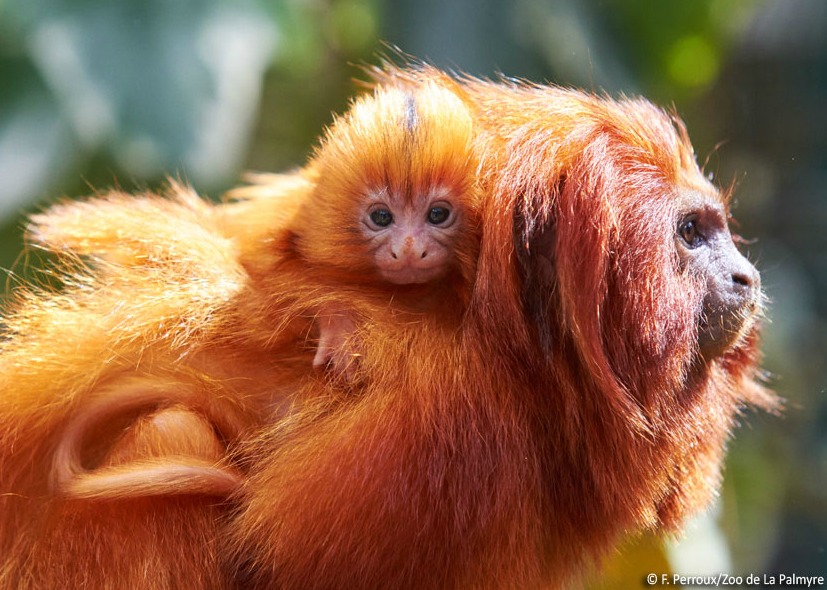
    Two Golden Lion Tamarins born March 13 at France’s La Palmyre Zoo are part of a worldwide program aimed at boosting the wild population.

    Golden Lion Tamarins were on the brink of extinction in their native Brazilian rain forest in the 1980s.  Between 1984 and 2001, a worldwide consortium of 43 zoos, including La Palmyre Zoo, translocated 146 individuals to Brazil to bolster the wild population.  Thanks to this program, there are now more than 3,000 Golden Lion Tamarins in the wild, with about 1,000 of these being descendants of the zoo-born translocated animals. 

    _MG_8887
    _MG_8917
    _MG_8873
    _MG_8947Photo Credit:  F. Perroux/La Palmyre Zoo

    Zoo-born Tamarins are still translocated occasionally to reinforce some wild populations.  The program also includes protection of the forest corridor that the Tamarins rely on for survival.

    Without the translocation of zoo-born Tamarins, Golden Lion Tamarins might be extinct in the wild today.

    These tiny Monkeys travel through the forests in small family groups, feeding on fruit, nectar, tree gum, and small animals. 

    Golden Lion Tamarins weigh only one to two pounds as adults.  At birth, babies weight about 8-10% of their mothers’ body weight.   They are listed as Endangered by the International Union for Conservation of Nature.


  • ,

    1_ComoZooTamarinTwins

    Meet Luke and Leia…the Como Park Zoo’s version of ‘Minnesota twins’!

    The Emperor Tamarin twins were born at the Zoo on January 27, and they are the 2nd and 3rd babies born to parents Lara and Roger. Visitors to the Como Zoo’s Primate Building will often see them clinging to big brother Franklin.

    2_ComoZooTamarinTwins

    3_ComoZooTamarinTwins

    4_ComoZooTamarinTwinsPhoto Credits: Como Park Zoo & Conservatory


    The Emperor Tamarin is a species allegedly named for its mustached resemblance to the German Emperor Wilhelm II. Both male and female Emperor Tamarins are known to sport the distinctive facial hair.

    This species of tamarin is native to the southwest Amazon Basin, eastern Peru, northern Bolivia, and the western Brazilian states of Acre and Amazonas. They prefer Amazonian lowland and lower montane rain forests, as well as remnant, primary, and secondary forests.

    They consume a wide range of specimens in their daily dietary routine, including: fruits, flowers, exude of plants (gums and saps), insects, frogs, and other animal prey.

    The age of first reproduction in Emperor Tamarins is around 16 to 20 months old, with a gestation period of up to 6 months. Tamarins are seasonal breeders, and breeding is based around food availability, with most births occurring during the wet season when food resources are in abundance.

    Tamarin species were once thought to be monogamous, but observations of Emperor Tamarins in the wild shot they often have a polyandrous mating system, with one dominant female mating with multiple males.

    Due to the high rate of twins or multiples at birth, Emperor Tamarins rely on parental and paternal care to ensure infant survival. Helpers are either older female offspring of the dominant female that have remained a part of the group, or they are males that have frequent interaction with the dominant female. Infant carrying has a high energetic cost due to the relatively large fetal weight of infants to the weight of adults. Helpers provide the extra support needed for caring of multiple infants. Male Emperor Tamarins have been observed to spend the most time with infants, often carrying several while the mother forages for food. The males have also been observed to be more protective of the young and are known to react faster to distress calls.

    (more…)

  • ,

    IMG_0588
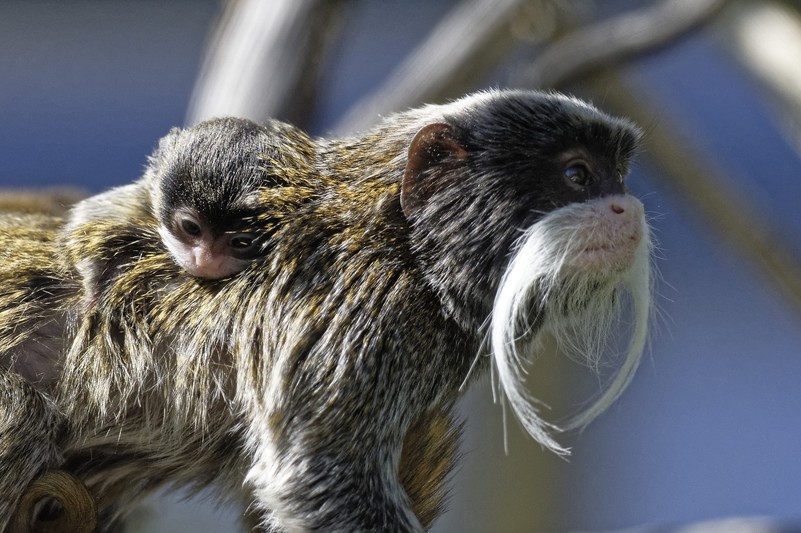
    A baby Emperor Tamarin born on November 3 at Great Britain’s Blackpool Zoo is too young to sport an impressive moustache like her parents, but if you look closely at the photo, you’ll see that she already has a little “stubble” on each side of her nose!

    Why do Emperor Tamarins have moustaches? No one knows for certain, but the bright white facial hair may aid communication among groups of these tiny monkeys. 

    Tamarins are among the smallest of all monkeys – they’re about the size of squirrels and weigh only about one pound. Emperor Tamarins are native to the rain forests of western Brazil, eastern Peru, and northern Bolivia in the Amazon Basin.  At this time, the species is plentiful in the wild.

    Photo Credit:  Jay Mayne


  • ,

    1_Cotton-top with parent looking at camera

    It has been fourteen years since Cotton-top Tamarins produced young at Cotswold Wildlife Park, so keepers were thrilled when their newest female gave birth to twins. The striking infants were born to first-time parents and have been named Tilly and Tammy. 

    2.2_Cotton top Tamarin baby close up

    2_Cottons head tilt

    3_Cotton twins on parentPhoto Credits: Cotswold Wildlife Park

    Cotton-top Tamarins (Saguinus oedipus) are considered to be one of the world’s 25 most endangered primates and are classified as “Critically Endangered” by the International Union for Conservation of Nature (IUCN), making them one of South America’s rarest monkeys. Rampant deforestation and gold mining have destroyed an estimated 95% of their natural habitat. In the wild, these exceptionally rare creatures are restricted to a tiny corner of north-west Colombia. Approximately 6,000 individuals remain in the wild, which is a devastatingly low figure, considering their numbers once ranged between 20,000 to 30,000 in the 1960s and 1970s.

    The twin’s new father Johnny (named for punk star Johnny Rotten) is an important individual for the European Endangered Species Programme (EEP). He has an impressively pure bloodline, so these new births are considered significant additions to the EEP, helping to ensure the genetic diversity of this rare and wonderful species.

    Curator of Cotswold Wildlife Park, Jamie Craig, said, “This is the first time we have bred this species for many years, and the keepers are delighted at the progress of the youngsters so far!”

    Each member of the family plays a specific role when it comes to rearing the young. The dominant male spends the most time carrying the infants. The mother carries them for the first week of life, and then holds them only to suckle. Females are pregnant for six months and the babies weigh about 15 per cent of their mother’s body weight, which is equivalent to a nine-stone woman giving birth to two ten-pound babies.

    Cotton-top Tamarins boast a fantastic crest of long white hair, like a mane of white cotton. The white fur can be raised and lowered, creating a punk-like fan display. Cotton-top Tamarins also have more than 40 vocalizations used to communicate everything from the discovery of food to the approach of predators. 

    More incredible pics, below the fold!

    (more…)

  • ,

    1_pa_baertigeraffennachwuchs1_animal_detail_801

    Schönbrunn Zoo’s mustache collection increased by one this spring. A new Emperor Tamarin was born April 26, at the Vienna Zoo.

    The infant is frequently seen, riding piggyback, on the father or older brother. “The male Emperor Tamarins take on the care and rearing of the young. If the baby gets hungry, however, it is returned quickly to mother,” said Zoo Director, Dagmar Schratter.

    2_pa_baertigeraffennachwuchs2_animal_detail_801

    3_pa_baertigeraffennachwuchs4_animal_detail_801

    4_pa_baertigeraffennachwuchs3_animal_detail_801Photo Credits: Georg Blaha (Image 1), Franz Wunsch (Image 2,4), Norbert Potensky (Image 3)

    The Emperor Tamarin is a species allegedly named for its mustached resemblance to the German Emperor Wilhelm II.  Both male and female Emperor Tamarins are known to sport the distinctive facial hair.

    This species of tamarin is native to the southwest Amazon Basin, eastern Peru, northern Bolivia, and the western Brazilian states of Acre and Amazonas.  They prefer Amazonian lowland and lower montane rain forests, as well as remnant, primary, and secondary forests.

    They consume a wide range of specimens in their daily dietary routine, including: fruits, flowers, exude of plants (gums and saps), insects, frogs, and other animal prey.

    The age of first reproduction in Emperor Tamarins is around 16 to 20 months old, with a gestation period of up to 6 months. Tamarins are seasonal breeders, and breeding is based around food availability, with most births occurring during the wet season when food resources are in abundance.

    Tamarin species were once thought to be monogamous, but observations of Emperor Tamarins in the wild shot they often have a polyandrous mating system, with one dominant female mating with multiple males.

    Due to the high rate of twins or multiples at birth, Emperor Tamarins rely on parental and paternal care to ensure infant survival. Helpers are either older female offspring of the dominant female that have remained a part of the group, or they are males that have frequent interaction with the dominant female. Infant carrying has a high energetic cost due to the relatively large fetal weight of infants to the weight of adults. Helpers provide the extra support needed for caring of multiple infants. Male Emperor Tamarins have been observed to spend the most time with infants, often carrying several while the mother forages for food. The males have also been observed to be more protective of the young and are known to react faster to distress calls.

    Emperor Tamarins are currently listed as “Least Concern” on the IUCN Red List of Threatened Species. There are currently no conservation efforts aimed directly toward this species of primates. However, their populations have been in decline due to threats of deforestation and human encroachment.   


  • ,

    (1)  Movember is in full swing at Belfast Zoo with the arrival of an emperor tamarin!

    The Emperor Tamarins, at Belfast Zoo, are up and ready for “Movember”!  The newest moustached member of the zoo, ‘Lucky’, was born on September 28th to mother, ‘Bella’ and father, ‘Alfie’.

    (2)  The moustached little monkey, who has been named Lucky, was born on 28 September 2014 to mother, Bella and father, Alfie.

    (3)  These primates live in family groups and, while the mother nurses her offspring, it is the father who carries and cares for them.

    (4)  Alfie certainly has his hands full with the new arrival but luckily the pair’s other offspring, Dot, Ethel, Ping and Pong help out with the childcare!Photo Credits: Belfast Zoo

    “Movember” is an international campaign, held every November. Men across the globe are encouraged to grow moustaches as a means to promote and raise awareness for men’s health issues, such as prostate cancer.

    Zoo manager, Mark Challis, said, “Emperor Tamarins are named after the German Emperor, Wilhelm II, because of their long white moustaches. It is fantastic that at less than two months old, little Lucky has a ‘Movember’ moustache to rival anyone’s!  Lucky is the third Emperor Tamarin to be born at the zoo in 2014, and we are delighted to welcome him to the Belfast Zoo family!”

    Emperor Tamarins are found in the tropical rainforests along the Amazon River in Peru, Brazil and Bolivia.  These primates live in family groups, and, while the mother nurses her offspring, it is the father who carries and cares for them. Little Lucky’s father, ‘Alfie’, certainly has his hands full with the new arrival, but luckily the parent’s other offspring, ‘Dot’, ‘Ethel’, ‘Ping’ and ‘Pong’, help out with the childcare!

    More pics below the fold!

    (more…)