Big day for the little snow leopards at Zoo Zürich: They recently had their first visit from the vet. The program included the first health check. In addition, the two cubs, around six weeks old at the time of the check-up, received their chip and the first vaccination.
BROTHER AND SISTER
We also know since the first vet check that the two little ones are a male and a female. Officials will determine their names in a competition on zoo.ch at a later date. So check back soon.
WHAT HAPPENED UNTIL NOW
The two young snow leopards were born on May 6th and 7th, 2022. They are Saida and Shahrukh's first cubs.
Credit for the den cam footage: Zoo Zürich, Nicole Schnyder
Credit for vet check footage: Zoo Zürich, Sandro Schoenbaechler and Nicole Schnyder
Over the last few days, Zoo Zurich has reported the emergence of a Koala Joey. While it’s showing a keen interest in snacking on Eucalyptus, it still needs its mother’s milk to survive. Believe it or not, the joey is already 7 months old! Mother Pippa clearly trusts her joey has a firm grip as she clings from branch to branch. The pair get quite a workout and after so much movement so they do take extended rests. The joey was born on April 13, but its sex remains unknown.
Black-Necked Swan cygnets have hatched at Zoo Zurich. The grey offspring can be seen following their graceful parents in the water or riding, stylishly, on their backs.
Photo Credits: Peter Bolliger / Zoo Zurich
The Black-Necked Swan is native to South America. They are found in freshwater marshes, lagoons, and lake shores in southern South America. They breed in the Chilean Southern Zone, Patagonia, Tierra del Fuego, and on the Falkland Islands. In the austral winter, they migrate northwards to Paraguay and southern Brazil.
Adults average 40 to 49 inches (102 to 124 cm) and weight 7.7 to 14.8 lbs (3.5 to 6.7 kg). The wingspan ranges from 53 to 70 inches (135 to 177 cm). The body plumage is white with a black neck and head, and the bill is grey. The Black-Necked Swan has a red knob near the base of the bill and a white stripe behind the eye. The sexes are similar, with the female being slightly smaller. The cygnets are covered in light grey plumage, and they have a black bill and feet. They will develop the characteristic black neck in their second year.
The Black-Necked Swan is the smallest member of the genus: Cygnus. Its nearest relatives are the Black and Mute Swan, and like their relations, they are mostly silent.
Swans reach sexual maturity between 4 and 7 years of age. However, they can form socially monogamous pair bonds from as early as 20 months of age. These bonds last for many years, and in some cases, they can last for life. The female lays four to six eggs in a mounded nest of vegetation. Both Black-Necked parents regularly carry their cygnets on their backs. Their diet consists of vegetation, insects, and fish spawn.
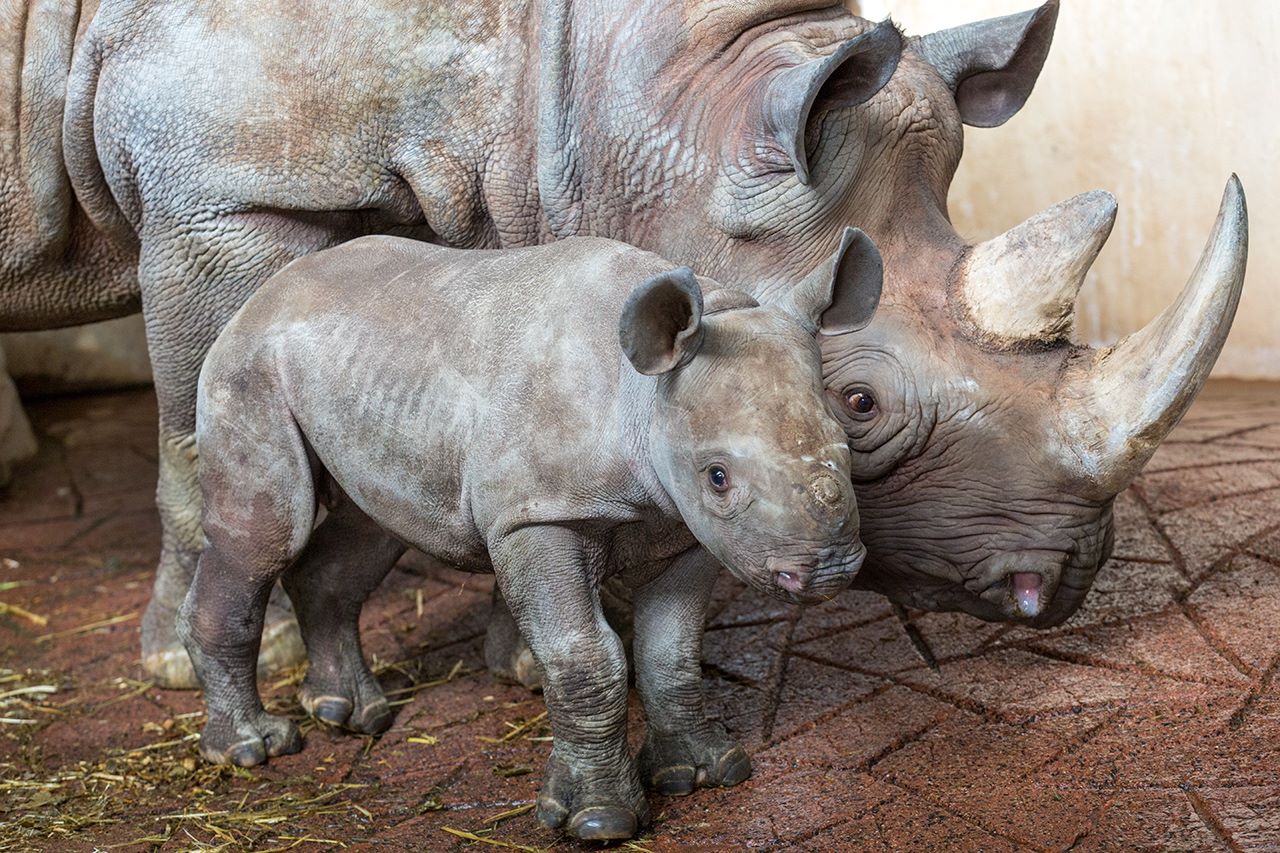
An Eastern Black Rhinoceros calf born on December 28 at Switzerland’s Zoo Zurich is out to prove that she’s growing up. Not only is this little female calf, named Olmoti, starting to grow her horn, she’s also practicing her charging skills, as seen in the video below.
In the video, Olmoti charges at her mother in little bursts, a skill all Rhinos use as a defense against unfamiliar things. Rhinos have relatively poor eyesight, so when taken by surprise, they may rush at people, vehicles, stationary objects, or other Rhinos to frighten them off.
Unfortunately for Rhinos, their horns led to a 96% loss in population from the 1970s to the 1990s, putting these unique animals on the brink of extinction. Demand for Rhino horn, which is made of keratin like your hair and fingernails, has exploded in the last 40 years. Sold on illegal markets, Rhino horn is used in traditional Asian medicine and for traditional dagger handles in Yemen.
Thanks to enhanced protection and Yemen signing the Convention on International trade in Endangered Species (CITES), Black Rhino populations are slowly increasing. However, these animals are still Critically Endangered, according to the International Union for Conservation of Nature.
Zoo Zurich has eagerly waited 18 years to be able to announce the birth of a new East African Black Rhino. After years of failed breeding attempts, the zoo has been closely monitoring the recent pregnancy of one of their females. Finally, on December 28th, 14-year-old mother, ‘Samira’, and 15-year-old father, ‘Jeremy’, welcomed a healthy, feisty rhino girl, named ‘Olmoti’!
When fully grown, Olmoti could grow to 12 feet long and five feet high at the shoulder, and she could weigh up to 3,000 pounds.
Eastern Black Rhinos, in the wild, inhabit transitional zones between grasslands and forests, generally in thick thorn bush or acacia scrub. However, they may also be found in more open country.
As a herbivorous browser, the Black Rhino eats leafy plants as well as branches, shoots, thorny wood bushes and fruit. Rhino skin harbors many external parasites, which are eaten by tickbirds and egrets that live with the rhino. In the wild, young are preyed upon by hyenas. These solitary animals are more nocturnal than diurnal. Females are not territorial; their ranges vary according to food supply. Males are more aggressive in defending turf, but will tolerate properly submissive male intruders.
Mating is non-seasonal, but births peak toward the end of the rainy season in drier habitats. Gestation is 15-16 months, after which single young are born weighing about 85 pounds. These calves are active soon after birth and can follow mother after about three days. Eastern Black Rhinos mature at five years.
In late December, Zoo Zurich welcomed the arrival of a newborn male Guanaco, named ‘Omar’.
Photo Credits: Zoo Zurich/Enzo Franchini
Wild relatives of the Llama, Guanacos are hump-less members of the Camelidae family that inhabit the arid and semi-arid habitats of South America, as well as the Andean forests of Tierra del Fuego. They range from southern Chile to southern Peru, up to elevations of 14,500 feet. Their last remaining stronghold is the Patagonian steppe, a vast, windswept expanse of Argentina and southernmost Chile. To survive in harsh, dry climates, Guanacos have a remarkable ability to conserve water and, like other camels, can obtain moisture from the plants they eat.
Most Guanacos live in herds composed of family groups or “bachelor” males and females, but some males are solitary. They graze on grasses, leaves and buds, and, as the largest native herbivore in Patagonia, played a key role in structuring native vegetation communities. Their quivery, sensitive lips help them select tender food among thorny and woody vegetation, and their softly padded feet do not damage the soil and vegetation as do the hard hooves of livestock.
Guanacos have been reduced by nearly 95 percent of their original number, which may have been as much as 50 million. Early explorers described long-distance migrations by huge herds, but now Guanacos are mostly sedentary, confined by fences, livestock, and hunting.
The sisters are also quite skillful at testing the patience and fortitude of 14-year-old mom, ‘Dshamilja’, and 11-year-old father, ‘Villy’.
The Snow Leopard is native to the mountain ranges of Central and South Asia. It is currently listed as “Endangered” on the IUCN Red List of Threatened Species. As of 2003, there were only estimated to be a global population of 4,080 to 6,590 adults, of which fewer than 2,500 may reproduce in the wild. There are approximately 600 Snow Leopards in zoos around the world.
A Mongolian wolf pup was born April 25th, 2013, at Zoo Zurich in Switzerland. Zoo keepers had prepared a den (with a hidden camera) for the first time wolf mother, but she used it for only several days. She soon took her pup to different dens the wolves had burrowed themselves. According to keepers, the small female pup has an independent streak, preferring at times to wander around alone. As she grows older, she'll learn to adjust to life within the pack.
The mating season for wolves is approximately from December to January, starting when wolves reach maturity at two years of age. Gestation takes about 65 days and often produces 4-7 offspring in a litter. Wolves can live up to 20 years.
The Grey Wolf and its subspecies, such as this pup, once ranged over most of North America, Europe, and Asia, but have been pushed to the northern boundaries of most of these continents by habitat destruction and eradication efforts. These wolves share a common ancestry with domestic dogs and live in packs. Group life requires a versatile and precise language. Members of a Wolf pack communicate with visible signals such as ear position, baring teeth, fur bristling, and tail position. But there are also olfactory signals, such as urine or feces; audible signals, such as growling, whining, and howling; and tactile signals like snout poking.
Photo and VIdeo Credit: Peter Bolliger/Zoo Zürich
Watch this video of the pup at play.
<br /></p>
<p>See more pictures, after the fold:</p>
<p>
<img src="http://static.typepad.com/.shared:v14c8b45:typepad:en_us/tiny_mce/3.3.9.4/plugins/pagebreak/img/trans.gif" _mce_src="http://static.typepad.com/.shared:v14c8b45:typepad:en_us/tiny_mce/3.3.9.4/plugins/pagebreak/img/trans.gif" class="mcePageBreak mceItemNoResize" />
</p>
Standing up can be a big challenge when you've got extra-long legs and haven't had much practice. But Nara, a female Bactrian Camel born on April 24 at Zoo Zurich, finally got the hang of it.
Photo Credit: Zoo Zürich, Peter Bolliger
Bactrian Camels have been domesticated for use as pack animals in central Asia for centuries. Their exceptional tolerance of extreme heat and freezing temperatures and their ability to go for several months without water makes them ideal for travelling across the remote steppes of central Asia. More than two million domesticated Bactrian camels exist, but they are critically endangered, possibly extinct, in the wild.
Last week, Zoo Zurich welcomed one of the world's smallest hoofed animals into the world. Mouse Deer, also known as Chevrotains, are neither mouse nor deer. Nine of the 10 extant Mouse Deer species are found in South and Southeast Asia, with one other species inhabiting Central and West Africa. The French word Chevrotain can be translated as "little goat".