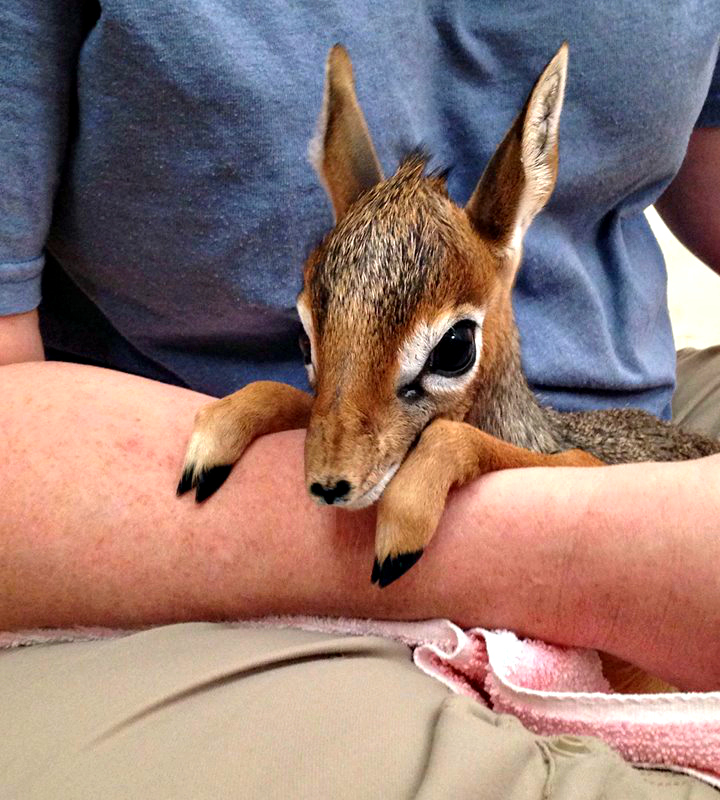
A basic translation of the original press release follows:
“It is the second offspring of this species, the result of the efforts of the Valencian park in the international program for its conservation. The skin of a single Kirk dik-dik is needed to make a single glove, which is why it is hunted and placed on the Red List of Endangered Species.
Valencia, September 30, 2022.- The wonderful biodiversity of our planet never ceases to amaze us, on this occasion, with species that seem to come out of a fairy tale, such as the dik-dik. BIOPARC's objective is to ensure the preservation of nature and to this end it participates in nearly 50 international programs for the reproduction of endangered species. As a result of one of these conservation actions, the second calf of Kirk's Dik-dik (Madoqua kirkii) was born in the Valencian park. The newborn remains these days in the interior enclosure under the care of his devoted parents and the supervision of the BIOPARC technical team, to guarantee his maximum well-being.
A female Kirk's dikdik has been born at Beekse Bergen. This antelope native to East and Southwest Africa is the smallest of its kind.
The Kirk's dik-dik lives in the drier regions of East and Southwest Africa. It prefers dry areas with dense undergrowth, where the dik-dik can hide in case of danger.
Memphis Zoo proudly announced the first two zoo babies of the new year- a Dik-Dik and a Bongo! Shortly before ringing in the new year, a Dik-Dik was born and has been staying warm inside with mom. She was named Hinata (pronounced Hee-nuh-tuh) which means “sunny place”. Zookeepers lovingly refer to Hinata as Hina for short. Hina was born to first time mom, Willow, who is two years old, and dad, Mike, who is 10 years old. Memphis Zoo's Dik-Dik can be found in the Zambezi Hippo River Camp where they share an exhibit with an okapi and a Helmeted Guinefowl. Since the Dik-Dik population in North American Zoos is quite small, Hina’s birth will help continue the persistence of the population. The Memphis Zoo has volunteered to be a breeding partner to help improve the population size for this species, so hopefully this is the first of many Dik-Dik births moving forward! Hinata and her mom will not be on exhibit until we begin experiencing warmer weather in Memphis.
The first animal born in 2022 was Zito, a baby male bongo. “Zito” means clumsy- which he very much is- or big- which once you see his ears, you’ll understand! He was born to mom, Marley, and dad, Franklin. Due to difficulties immediately following birth, Zito was bottle fed by his keepers for the first week to ensure his survival. After gaining strength and based on his mother’s behavior, he has been reintroduced to his mom and while he is nursing from her, staff will continue to supplement him as necessary. Since these animals are critically endangered, Zito’s birth will help ensure genetic diversity within the zoo population of bongos. He will be an ambassador for his species to educate the public about his wild cousins who need our help. Mom and baby will be on exhibit with the rest of the herd in the next few weeks, weather dependent.
About Dik-Dik
Dik-Dik are a very small antelope native to southern Africa. This shy and elusive animal spends most of its day concealed in a brush. Their name comes from the alarm sound they make when startled as they run in a zig-zag pattern.
About Bongo
Also known as forest antelope, Bongo are native to the forests of Africa. These animals are strictly herbivores feeding primarily grasses, leaves, bushes, and fruits. They are a critically endangered species with wild populations continuing to decline primarily due to hunting and habitat loss.
Brookfield, Ill. — A Kirk’s dik-dik, one of the world’s smallest antelopes, was born at Brookfield Zoo on October 13. At birth, the not-yet-named male calf weighed just over 1½ pounds. He is currently behind the scenes with his mother. To not disturb the bonding process between Buttons, the 2-year-old mom, and her offspring, animal care staff set up a GoPro camera to get video of the newest addition to share with the public. It can be viewed on the zoo’s social media channels.
Behind the scenes, there is a nest site, which is where a newborn dik-dik remains hidden for 10 to 20 days. It will nurse for about three to four months. Weaning is attained when the calf reaches a weight of about 4 pounds. Once full grown, the male can weigh up to 14 pounds and measure 14 to 16 inches tall at the shoulder.
This small antelope, native to Africa’s Kenya, Somalia, Tanzania, Angola, and Namibia, got its name from the sound it makes when threatened as well as after Sir John Kirk, a 19th century Scottish naturalist. Its coat varies in color from a yellowish-gray to reddish-brown. The species can be identified best by its large, striking, dark eyes that are each surrounded by a white ring. Only the males grow short corrugated horns. The elongated snout allows a dik-dik to help keep cool by rapidly panting to cool the air, and therefore its body. This system also helps minimize its need for water.
The calf at Brookfield Zoo will not be making his public debut until spring 2022, but guests can see an adult pair in their outdoor habitat during regular zoo hours, weather permitting. Currently, there are 25 Kirk’s dik-diks at 11 accredited North American zoos, including five at Brookfield Zoo.
The months of February and March are traditionally the time of the year when Zoo Wroclaw welcomes new Dik-dik offspring. True to fashion, new mom, Lenonka, welcomed a female calf on February 26.
According to the Zoo’s tradition, newborns are given a music related name.
Because of their shared characteristic of blonde hair, the new Dik-dik is being called “Lady G” (a nod to Lady Gaga).
Zoo management has allowed the keepers a bit of creativity with the selection of names for the new births. As a result, Zoo Wroclaw is proud to relate that they are home to Elvis, Eminem, Lennon, Limahl, Loreen, and now Lady G!
Photo Credits: Zoo Wroclaw / Image 4: new parents, Federiko and Lenonka / Image 5: new mom, Lenonka / Image 6: dad, Federiko
Kirk’s Dik-diks have made their home at Zoo Wroclaw since 2014. The Zoo’s most known member of the herd is Lady G’s father, Federiko. Keepers state he is almost always in a location within the exhibit that is visible to the public, as if he is guarding the rest of the herd.
Kirk's Dik-dik (Madoqua kirkii) is a small antelope native to Eastern Africa and one of four species of Dik-dik antelope. Dik-diks are herbivores and are typically of a fawn color that aids in camouflaging in savannah habitats.
The unique name is derived from its call. When threatened, Dik-diks lay low. If discovered, they run in a swift zigzag until finding another safe hiding spot. During this time, they are known to emit a call that sounds like “zik-zik” and is intended to raise an alarm.
The lifespan of Kirk's Dik-dik in the wild is typically 5 to 10 years. In captivity, males have been known to live up to 16 to 18 years.
The species is currently classified as “Least Concern” on the IUCN Red List. They have many natural enemies in the wild: leopards, cheetahs, jackals, baboons, eagles, and pythons.
However, the biggest threat awaits them from the human side. Not only are they hunted for use of their meat and bone, but they are also hunted for the production of leather. It has been said that at least two individual Dik-diks must be slaughtered to produce as little as one pair of leather gloves.
A tiny Dik-dik is making a big impression at Chester Zoo. The little Antelope is being cared for by zoo staff after its mother passed away soon after giving birth.
Standing only about 8 inches tall at the shoulders, the tiny Kirk’s Dik-dik is being bottle fed by staff five times a day. He will continue to receive a helping hand until he is old enough to eat by himself.
Photo Credit: Chester Zoo
Assistant team manager Kim Wood and keeper Barbara Dreyer have both been caring for the new arrival, who is currently so light he doesn’t register a weight on the zoo’s set of antelope scales.
Kim said, “The youngster is beginning to find his feet now and is really starting to hold his own. We’re hopeful that, in a few months’ time, we’ll be able to introduce him to some of the other members of our group of Dik-diks. He may be tiny but he is certainly making a big impression on everyone at the zoo.”
Kirk’s Dik-diks grow to a maximum size of just 16 inches tall at the shoulders, making them one of the smallest species of Antelope in the world.
The species takes its name from Sir John Kirk, a 19th century Scottish naturalist, as well as the alarm calls made by female Dik-diks.
Kirk’s Dik-diks are native to northeastern Africa and conservationists say they mark their territory with fluid from glands between their toes and just under their eyes, not dissimilar to tears. Populations in the wild are stable.
When a Kirk’s Dik Dik was born in mid-October at thePueblo Zoo, keepers were thrilled. But when his mother did not feed the male calf, keepers stepped in to provide daily care.
Photo Credit: Pueblo Zoo
Though they look like miniature deer, Dik Diks are small antelope that stand just over a foot high at the shoulder. Found on eastern Africa’s savannahs, Dik Diks may appear small and vulnerable. But their excellent eyesight and ability to run up to 26 miles per hour enable them to escape predatory lions, hyenas, and wild dogs.
In addition, Dik Diks run in zig-zags as they escape, further confounding their pursuers. As they flee, females emit an alarm call that sounds like “dik dik,” hence their name.
Dik Diks are widespread in Kenya and Tanzania, and populations are considered stable.
A tiny Kirk’s Dik-dik antelope, which was hand-reared by keepers after being rejected by her mom, has stepped in to help her much-smaller sibling. Eight-month-old Aluna is now playing the big sister to new arrival Neo at Chester Zoo in England, and the two have struck up a charming bond.
Keeper Claire McPhee says, "Dik-dik mothers do not always take to their young, and unfortunately Neo and his mum didn’t quite hit it off. But happily, his not-so-big sister Aluna - who herself didn’t manage to bond with her mum – is drawing on her own experiences and is being a real calming influence on him. They spend lots and lots of time in each other’s company and she’s really helping with his development in his crucial early days.
“Little Neo is only 20 centimeters (8 inches) tall and a little bit shy, nervous and jumpy around other Dik-diks. But Aluna is dishing out lots of special care and attention and it’s helping him integrate into the wider family group. She’s helping him to settle in nicely and it’s lovely to see.”
Photo credits: Chester Zoo
The Kirk's Dik-dik is native to Kenya, Tanzania and Namibia and is named after the sound it makes when fleeing danger. They can live for up to 10 years and reach a maximum size of about 16 inches (40 cm) tall, making them one of the smallest antelope species in the world.
The tiny new arrival, born October 10, now weighs little more than a bag of sugar at 2.8 pounds (1.3 kg). Keepers chose the name Neo as it means ‘gift’ in Swahili. Aluna, born in February, was previously featured on ZooBorns. Aluna means 'come here' in Swahili.
The last photo is a throwback: a younger Aluna visits with Curator of Mammals Tim Rowlands, who bottle-fed her five times a day.
She stands just a few
centimetres tall but this tiny new arrival at Chester Zoo is making a big
impression. Aluna, the tiny Kirk’s
Dik-dik Antelope, is not much taller than a TV remote.
For now, she is being
bottle-fed milk five times a day by the zoo’s dedicated curator of mammals
after she failed to bond with her mother. She will be given a helping hand until she is old enough to tuck into a
diet of buds, shoots and fruit on her own.
Photo credits: Chester Zoo
He said: “Our little one is growing stronger and
stronger by the day and, all being well, it shouldn’t be too long until she‘ll
be able to really hold her own. For the time being though her feed times are
staggered through the day and she has her first bottle in my living room at
home at around 7am. I then pop her into the car and bring her to work where she
has another three feeds in my office. Finally, her last one is at 10pm back at
my house.
“She’s already pretty quick on her feet and gives us quite the run
around in the office. That’s why we’ve called here Aluna which means ‘come here’ in Swahili. It’s rather apt!”
Rejected by its mother, this tiny Kirk's Dik-Dik is being hand raised by keepers at England's Chester Zoo. Standing just 10 inches tall, the baby is bottle fed five times a day and appears to be doing well. These small antelope are native to Eastern and Southwestern Africa.