The Newest, Cutest Baby Animals from the World's Zoos & Aquariums

Category: Lemur

  • ,

    2 Gertrude

    Two female Sifaka lemurs, Gertrude and Eleanor, were born on January 5 at the Duke Lemur Center. Gertrude weighed .23 pounds (105 g) at birth and Eleanor—a big girl!— weighed .25 pounds (117 g).  

    Gertrude is the daughter of mom Pia and dad Jovian – Jovian being the famous lemur that played Zoboomafoo in the popular kids show by that name on public television. Eleanor is daughter to Rodelinda and Marcus. Both infants are in the process of being introduced to their fathers and siblings, and all is going well.

    1 Eleanor

    3 Eleanor

    5 lemur moms and babies

    Photo credits: Duke Lemur Center / David Haring (2-6)

    These infants add to a total of only 60 Coquerel’s Sifaka in captivity, an Endangered species in Madagascar due to deforestation and hunting pressure. All Coquerel’s Sifaka in captivity live in the US and are managed by the Duke Lemur Center. 

    Twenty-nine live at the Lemur Center and the remainder are on loan to nine other facilities for Species Survival Plan breeding recommendations. The Coquerel’s Sifaka at Duke Lemur Center are the only members of this particular lemur family, the Indriidae, in captivity in the US for research and conservation. 

    See more photos after the fold.

    (more…)

  • _DSC4639-2 7160m

    What has four eyes, two tails and the tiniest fingers you've ever seen? A pair of Grey Mouse Lemurs! The Duke Lemur Center welcomed twins, a male named
    Filbert and a female named Scuppernong, on June 18th. At birth, they were no longer than an inch from nose to the base of the tail and weighed about
    .2 ounces (5 grams). They two have grown quickly! At just 3 weeks old, Scuppernong and Filbert weight about an ounce each (28 grams and 32 grams, respectively).
    Filbert is adventurous, exploring outside the nest box and showing interest in the fruit his mother eats. Scuppernong is more timid than her brother,
    preferring the nest box. At 2 months old, the twins are health and continuing to grow. Scuppernong is 1.5 ounces (44 grams) and Filbert is 1.6 ounces (46 grams).

    _ mm 7159f 7160m_DSC4637ED

    These primates belong to the group that includes the world's smallest primates, though the species is the largest of the Mouse Lemurs. Adults weigh about
    3 ounces (90 grams) and stand no more than 3 inches tall. At the Duke Lemur Center, they live socially the same way they do in their native habitat of Madagascar—females live in groups and males live solitary lives.

    _ mm 7160m_DSC4645-2

    The Duke Lemur Center houses the only breeding colony of Grey Mouse Lemurs in North America. The program has been very successful, boasting a 100% success
    rate with infant Grey Mouse Lemurs. Scientists at Duke and all over the world are excited about the new advances in Mouse Lemur research. Genome sequencing
    and advances in noninvasive imaging technology allow scientists to peek inside a mouse lemur's brain to study the aging process.

    Lemur1

    _ mm 7159f_DSC5428
    Photo Credit: Duke Lemur Center

    Related articles

    Baby Lemur Makes a Friend at Drusillas Park
    Rockhopper Penguin Chick Hatches at Shedd Aquarium
    UPDATE: Baby Gibbon Reaches 2-Month Milestone
  • ,

    Lead image

    A three-month-old Black
    Lemur born at the United Kingdom’s Drusillas Park has made an unlikely
    friend: a Ring-Tailed Lemur named
    William.

    Baby Black Lemur at Drusillas Park

    Baby black lemur with mum Clementine at Drusillas Park

    Black Lemur 18.05.13 26
    Photo Credit:  Drusillas Park

    The baby and his adopted “Uncle
    William” have a unique relationship, with William being very protective of the
    little Lemur.  As the baby becomes more
    independent, he spends less time with his mother and more time playing with
    William.

    Zoo keepers recently
    confirmed that the baby, born in April, is a male. Now that they know the baby’s
    gender, keepers will soon give him a name.

    The gender of a Black Lemur
    becomes evident over time due to the strong sexual dimorphism in this species.
    Males are all black with striking orange eyes, and females are brown with long
    whitish ear tufts. After weeks of speculation, there is now no doubt that the
    baby is a boy.

    In the wild, Black Lemurs
    are native to the Island of Madagascar, where they live in the forest regions of
    the north. Although they are primates, they are not considered monkeys or apes;
    instead they are prosimians, which means ‘before the monkey’.

    The population of Black
    Lemurs is declining in the wild due to habitat destruction and hunting. They
    are listed as Vulnerable by the International Union for Conservation of Nature.

    See more photos below the fold.

    (more…)

  • ,

    14 days old - Christa Klein

    The Sacramento Zoo welcomed four Black-and-white Ruffed
    Lemur babies on May 17. The babies have been growing fast in an off-exhibit area with
    mom.

    8 days old - Christa Klein

    12 days old - Christa Klein

    4 days old - Christa Klein

    BWRuffed Lemurs 06102013 (10)
    Photo Credits:  Christa Klein (1,2,3,4); Sacramento Zoo (5)


    Ruffed Lemurs are the only primates that keep their young in nests instead of
    carrying them. In the wilds of their native Madagascar, these Lemurs nest in
    tree cavities. At the zoo, keepers
    provide tubs and crates as nesting sites. Just as she would in the wild, the mother Lemur moves her babies from
    nest to nest in her enclosure.

    At a few weeks of age, the baby Lemurs began following mom around and
    practicing their climbing skills. For now, the babies’ father and older brother
    live separately from mom and her young, but they can all see and smell each
    other through a mesh door. This will
    make the introduction process, when the family is completely reunited in a few
    months, go much smoother.

    Infant Lemurs are pint-sized versions of adults, with the same black-and-white
    coat colors. Each individual has a slightly
    different coat pattern with varying amounts of white, black, and even some
    shades of brown. Eye color often starts out as blue and then changes (often multiple
    times in the same individual) to yellow, gold, or green.

    In Madagascar, Black-and-white Ruffed Lemurs are listed as
    Critically Endangered by the International Union for Conservation of
    Nature. Because they are large, these
    Lemurs are hunted for their meat. As rain
    forests are cut to make way for agriculture, the Lemurs’ habitat is
    destroyed. They now live in only a few
    isolated forest pockets on the island. 

  • ,

    Blue-Eyed Lemur 1

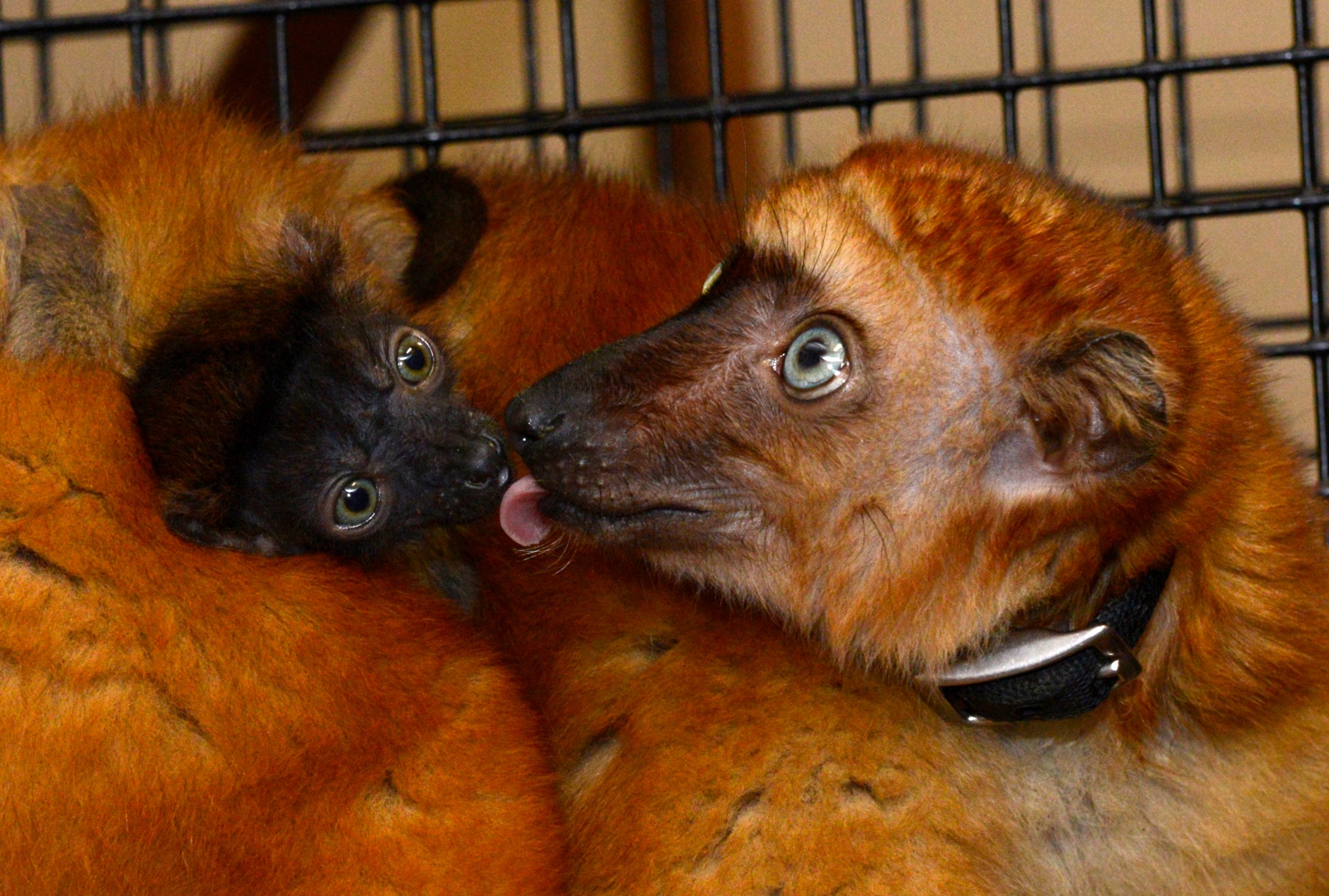
    A baby Blue-Eyed Lemur has been receiving very special care at its home at the La Palmyre Zoo. When the youngster appeared weak and was having trouble clinging to its mother's fur following its birth on April 9th, keepers sprang into action to hand raise the baby, providing 24-hour care.

    The little girl, the first of this species born at the zoo since they began caring for its kind eleven years ago, has been making great progress and is growing at a steady rate. After removing it for care, keepers brought its entire family to the nursery to make sure that the parents stayed in visual contact with the newborn. Now, at two months of age, the baby is healthy and reportedly very active.

    Blue-Eyed Lemur 2

    Blue-Eyed Lemur 3
    Photo Credit: F. Perroux / La Palmyre Zoo

    Last week, both the newborn and its family were returned to their normal enclosure, however, for now the baby is remaining in its own cage within the enclosure as a precautionary measure due to its small size. When it is big enough, the baby will be slowly and carefully reintroduced to its entire family.

    See and learn more after the fold!

    (more…)

  • ,

    1.2 Credit Phillipa Dobson 2 low res

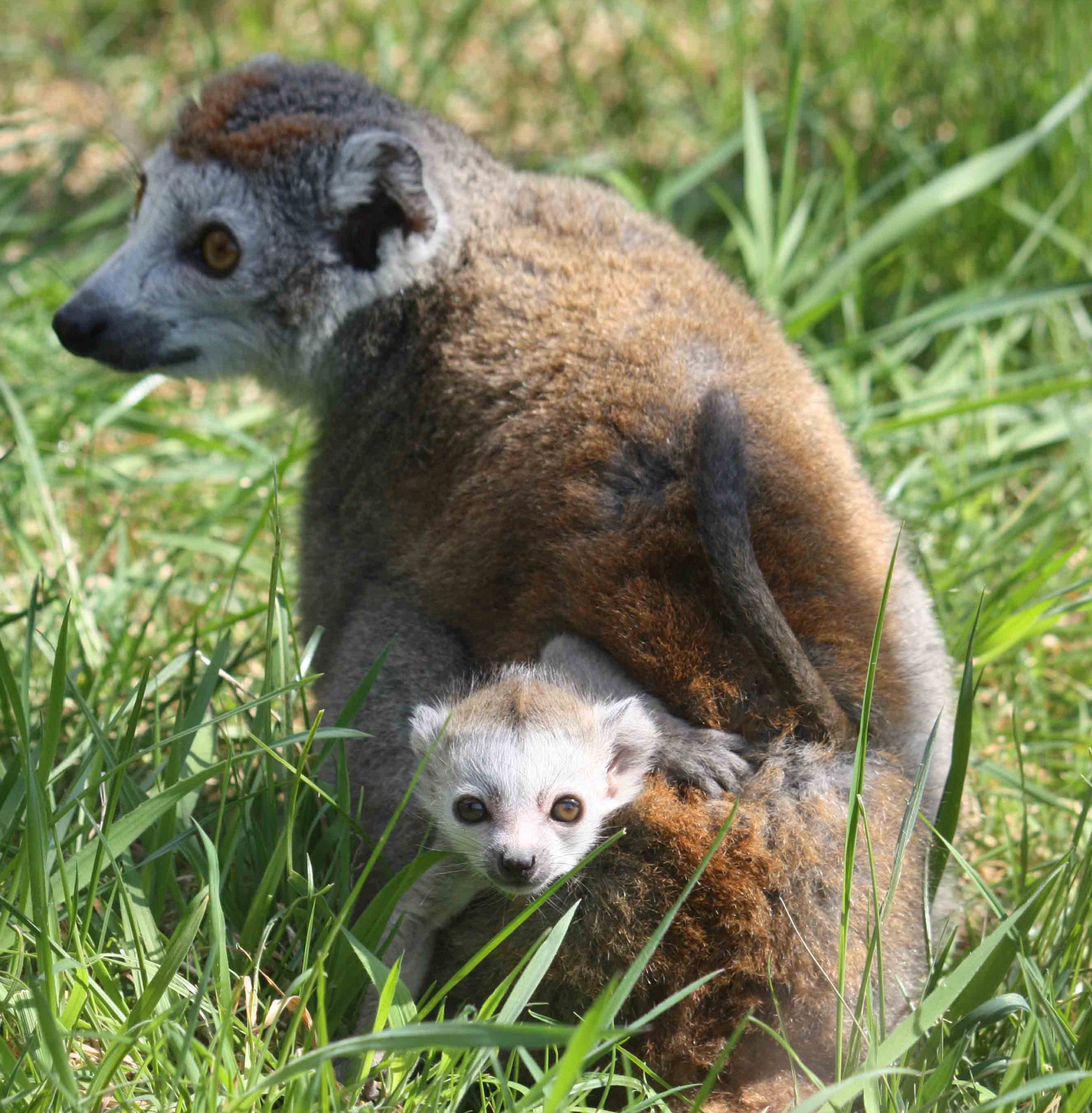
    Keepers at Twycross Zoo are celebrating the arrival of a baby Crowned Lemur, born on April 11. Experienced mom Rose is doing a superb job. Infants are initially carried on the mother’s front but as they grow heavier they are moved onto her back. The father takes and active role in parenting as well. Tony Dobbs, Section Head of Primates, said: “The baby arrived a few days earlier than we had expected but both mum and baby are doing very well. While Rose is looking after the newborn, the father, Rik, has taken on the role of the proud, protective father.”

    In the wild the Crowned Lemur is confined to a small patch of forest in Madagascar and listed on the IUCN Red List  as Vulnerable. There their population is decreasing because their habitat is in rapid decline principally due to heavy mining, illegal logging and hunting for food.

     3.3

    2.2

    Photo Credit: Phillipa Dobson

    Zoological Director, Sharon Redrobe, added: “The Crowned Lemur, like all the lemur species, is under threat in the wild and therefore the role of the captive population is becoming more and more important. A successful birth such as this is a huge boost to the conservation of this species.”

    You can get a glimpse to the baby tucked into mom's hip on this video:

    Read more about the baby's family at the zoo and find Crowned Lemur facts, after the fold:

    (more…)

  • ,

    Poots.jpg

    The Duke Lemur Center is proud to announce the births of two Blue-eyed Black Lemurs, one male – Hiddleston – and one female – Poots. Like many species in this genus, these lemurs are sexually dichromatic, meaning the the males and females are different colors (black and reddish brown respectively).

    Named for actor Tom Hiddleston, Hiddleston was born to mother West and father Hopkins on March 24, 2013. He weighed a healthy 82 grams at birth. Poots, named for Imogen Poots, was born on March 27, 2013, to parents Margaret and Tarantino. Poots weighed 92 grams at birth.
    West and Margaret are first-time mothers, and both are doing a fantastic job with their new little ones.

    Blue eyed black Duke Lemur Center 2.jpg

    Blue eyed black Duke Lemur Center 3.jpg

    Blue eyed black Duke Lemur Center 2a.jpg

    The successful births of Hiddleston and Poots contribute a great deal to the conservation of this species. The Duke Lemur Center currently houses North America’s only breeding females of Blue-eyed Black lemurs: West, Margaret and Foster. These females hold the key to the conservation of this species of lemur because of dramatic habitat loss in the wild and the limited breeding population in captivity.
    With expert care (and some very handsome Blue-eyed Black Lemur males), DLC is hoping for many more babies in the future to continue to preserve these rare, beautiful lemurs.

    Poots with mom.jpg
    Photos of Hiddleston (the reddish little guy) by David Haring. Photos of Poots (the lighter little guy in the first and last photos) Fallon Owens

  • ,

    2013_062_076

    The Zoological and Botanical Park of Mulhouse is pleased to announce the birth of 'Dimbi' on the 8th of March. The male Blue-eyed Black Lemur baby is an ambassador for his critically endangered species. For the last 25 years, the park has worked to prevent the final extinction of this species. Less than 2000 individuals remain in the Madagascan wild. Special thanks to Life on White for these outstanding images.

    2013_062_027

    2013_062_036

    2013_062_039
    Photo credits: LifeOnWhite.com

    See many more pictures below the fold…

    (more…)

  • , ,

    Beatrice1

    Meet Beatrice of Swabia, the newest addition to a noble line
    of Coquerel’s Sifakas at Duke Lemur Center. She has a close-knit family:
    a five-year-old mother, Rodelinda, an eight-year-old father, Marcus, and an
    older sister, 23 month-old Bertha of Sulzbach. (Duke Lemur Center is
    certainly proud of their Sifakas: the whole family is named after Roman
    Emperors.)

    Beatrice4
    Photo credits: David Haring / Duke Lemur Center

    Beatrice of Swbabia—Beatrice for short—is a healthy little
    heir. She weighed a respectable 107 grams at her birth on December 19th,
    and has since been growing in leaps and bounds.  She clings tightly to her mother, another sign of good
    health, but also spends some time with her father and sister who hold and groom
    the new baby.

    Sifakas are named for their distinctive “shif-auk!” call.  They are known for their graceful sideways
    leaping across the ground, a dance that they share with ten other diurnal
    members of the lemur family Indriidae.


    “Sifakas are really one of the Lemur Center’s flagship
    species,” says Andrea Katz, the Duke Lemur Center animal curator. The Duke
    Lemur Center was the first to ever successfully breed Sifakas. Only 56
    Coquerel’s sifakas live in captivity. The Lemur Center owns every single one
    and manages them either on-site or through cooperative breeding loans with 9
    other institutions across the United States. 

    “We’ve learned
    a lot over the years about sifaka behavior, breeding behavior, mother-infant
    behavior… I think it’s fair to say that the Lemur Center is really viewed as the
    expert on Sifaka breeding management.”

    Take a leap across the fold!

    (more…)

  • ,

    Lemur1

    Found only on the island of Madagascar, Black-and-White
    Ruffed Lemurs are critically endangered. 
    But twins born at the Mogo Zoo on October 6 offer a glimmer of hope for
    the species.

    The yet-to-be-named and sexed twins are being expertly cared
    for by their parents.  According to
    Animal Operations Manager Paul Whitehorn, “Tame’ and Itasi are being great
    parents, and the youngsters are becoming so active and a delight to watch.”  Though the twins are still nursing, they are
    already enjoying healthy fruits and veggies as part of their daily diet.

    Lemur2

    Lemur5

    Lemur3

    Lemur6

    Unfortunately, the future for wild Black-and-White Ruffed Lemurs is bleak.  Classified as
    Critically Endangered, these primates are threatened by habitat loss due to
    slash-and-burn agriculture, logging, and mining.  Additionally, they are hunted by poachers for
    their meat. 

    Black-and-White Ruffed Lemurs are the only diurnal primates
    to build nests.  Australia’s Mogo Zoo
    participates in the Species Management Program to ensure the genetic diversity
    of the captive population.

    Photo Credit:  Mogo Zoo