The Newest, Cutest Baby Animals from the World's Zoos & Aquariums

Category: Lemur

  • ,

    Face 1

    On March 29, Harriet, one of the White Collared Lemurs at Linton Zoological Gardens, gave birth to a beautiful baby boy named Jako, one of the Malagasy words for monkey. Every lemur has its own distinct personality, and with Jako being such an energetic, playful, comical little bundle of fun, they thought ‘monkey’ was a very apt name.

    There are only 13 White Collared Lemurs in captivity in Europe, nine of which are at Linton. This mischievous new baby lives with his Dad Jeepster, mom Harriet and sister Mirana, born last year. This species has been listed as one of the top 25 rarest primates in the world; every captive birth will help to ensure it does not become completely extinct!

    The White Collared Lemur (Eulemur cinereiceps), also known as the Grey Headed Lemur, is from the South West of Madagascar, and highly threatened in the wild. Despite being protected, it is still hunted for food and continued habitat destruction and alteration is a major problem. It has a total remaining habitat area of less than 270 square miles (700 km²), which is very fragmented and partly shared with the Red Fronted Lemur. This has resulted in hybridization between the two species therefore lowering the genetic diversity of the wild population.

    W mom

    Mom

    Face 2
    Photo Credits: Linton Zoological Gardens

  • , ,

    Baby Mouse Lemur Duke Lemur Center

    Back in July we brought you Duke Lemur Center's first batch of wriggling baby Mouse Lemurs! Today we officially bring the season to a close and what a successful one it's been! A total of twenty infants, ten males and ten females, have been born this summer with the last birth on August 10th. The oldest mouse moms were four year olds Oleander and Calendula and the youngest was 10 month old Nettle. 

    _3DH2762_mm 7113 4114 _ b 13 July 12

    As an added bonus, Duke Lemur Center has also shared photos of their tiny Fat-tailed Dwarf Lemur babies, marking the first successful birth of this species since 1987! This unique animal is the only tropical mammal as well as only primate anywhere known to hibernate. Unlike cold weather hibernators, the Fat-tailed Dwarf Lemur appears to enter periods of dormancy during drought. While hibernating, this lemur lives off of stores of fat in its tail. Despite having a name that's a mouthful, this species is one of the smallest of all primates.

    _3DH3108_cm7123 7124 7125ED

    _3DH3109_cm7123 7124 7125EDjpg

    _3DH3115_cm7123 7124 7125EDPhoto credits: David Haring / Duke Lemur Center

  • ,

    Baby Mouse Lemurs Duke Lemur Center 1

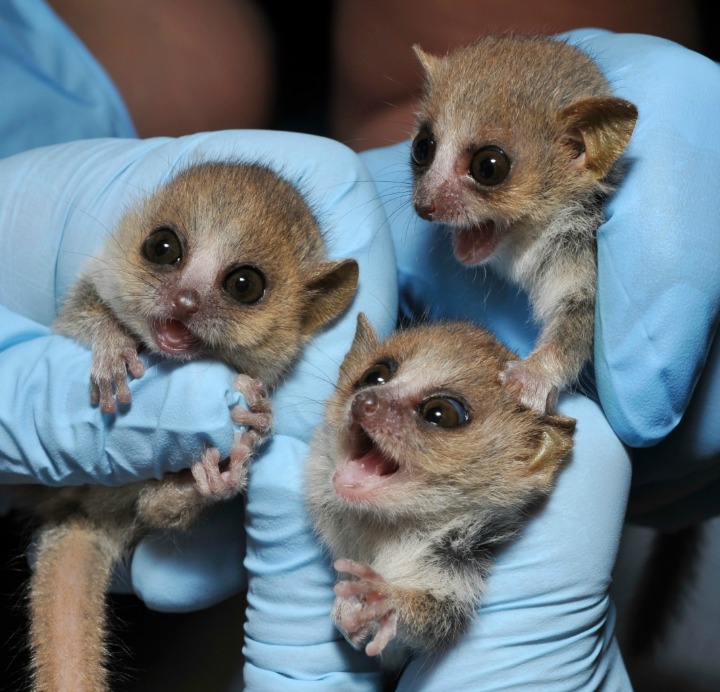
    The Duke Lemur Center is smack-dab in the middle of baby Mouse Lemur season with seven little ones, born to four mothers, in the month of June alone. Four more Mouse Lemur females are pregnant so there are more of these feisty little guys on the way. The first photo shows a set of frantic Mouse Lemur triplets who arrived on June 5th. The second photo and video show a much calmer singleton. These four are named Bluebell, Blackberry, Pipkin and Dogbane.

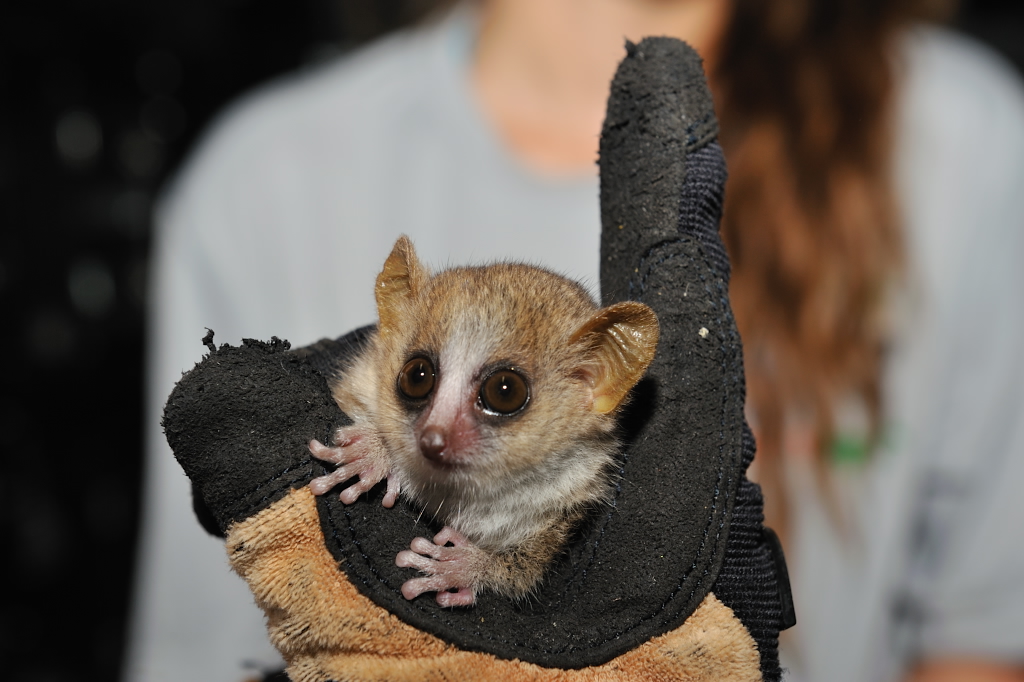
    Gray Mouse Lemurs are among the world's smallest primates, weighing only about 1/8th of a pound as adults At night this species hunts alone, leaping between thin branches in the treetops. By day they curl up in tree holes with up to fifteen other Mouse Lemurs to sleep in a furry heap. There are seventeen different species of Mouse Lemur, but they all look nearly the same, making research challenging. Only through genetic testing can scientists be sure of what species they are observing. 

    Baby Mouse Lemur Duke Lemur Center 2Photo credits: Duke LemurCenter / David Haring

  • ,

    Trio

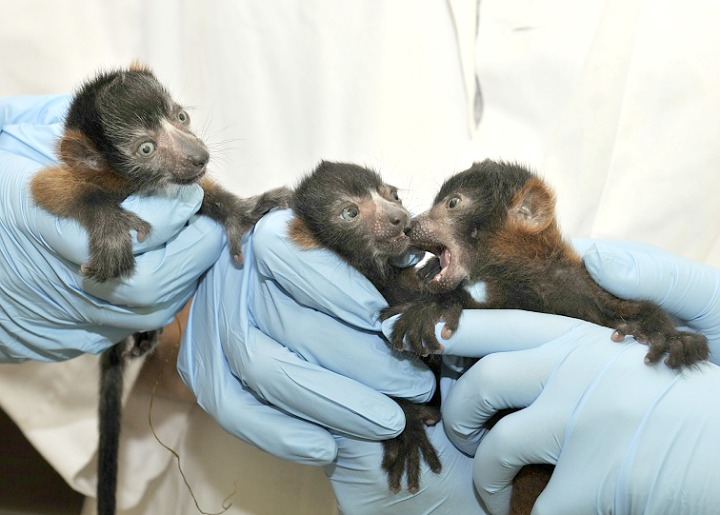
    Red Ruffed Lemur triplets were born May 10 to mom, Pyxis, and dad, Hunter, at the Duke Lemur Center at Duke University in North Carolina. There are two males and one female and they are all healthy and well.  Whereas last week Pyxis was still carrying them in her mouth, and on nice days might take them to a high shelf on her outdoor habitat,  they are now at the stage where they are making their first independent, albeit clumsy, forays away from their mom and the laundry basket that has served as their nest.

    Hunter has been locked inside from free-ranging and is living in an adjacent area. He has been introduced to Pyxsis and their offspring. While he doesn’t interact with them much, he does appear to stand guard over them on the rare occasions when Pyxis leaves to eat. Male guarding behavior in Ruffed Lemurs is fairly common.

    Nurse 2

    Blanket

    Shelf
    Photo Credit: Duke Lemur Center

  • ,

    Baby Ruffed Lemur Binder Park Zoo 1

    It’s triplets at Binder Park Zoo! Phin and John, the Zoo’s pair of Black and White Ruffed Lemurs, have their hands full. On Sunday April 29th, Phin, a 7 year old female, gave birth to three healthy Black and White Ruffed Lemur babies.This is a significant birth for this endangered species and is only the second time in 35 years that Binder Park has welcomed baby Ruffed Lemurs. Black and White Ruffed Lemurs have a gestation of around 3 months and usually have twins but can have up to six babies at once.

    Ruffed Lemurs are from Eastern Madagascar and live in evergreen rainforests. In the wild, female lemurs usually build a nest 60 to 80 feet high in trees. Phin was given the choice of several man-made nest boxes in her indoor holding area. She routinely moves the babies from nest to nest, as she would in the wild. The babies are fully mobile and do not cling to their mother as many other lemur infants do. The babies will stay in the nest for several weeks but mature rapidly so they can travel with their mother in search for food. 

    Baby Ruffed Lemur Binder Park Zoo 2

    Ruffed Lemurs eat lots of fruit, but will also eat leaves, nectar, flowers, fungi and even dirt! Fathers take no part in child care, but the triplets are old enough to be introduced back to their father, John, and they should be a compatible social group.

  • , ,

    _Julie Larsen Maher 6551 Coquerel's Sifaka and Baby MAD BZ 04 25 12

    The Wildlife Conservation Society's Bronx Zoo recently welcomed two baby lemurs, a Conquerel's Sifaka and a Collared Lemur. 

    Both babies will spend their next few weeks clinging firmly to mom's back. Coquerel’s Sifakas spend most of their time in trees and leap effortlessly, launching themselves vertically with their strong legs. Like most species of lemurs, the females are dominant, claiming the choicest food and the best sleeping and sunning spots.

    Collared lemurs use their long tails to balance when leaping through the forest canopy. Collared Lemurs live in groups of males and females but are not matriarchal like the Sifaka and many other lemurs.

    _Julie Larsen Maher 6830 Collared Lemur and Baby MAD BA 04 27 12

    Photo Credits: Julie Larsen Maher © WCS

    Video Credits: Luke Groskin © WCS

  • , , ,

    BG-Mongoose-Lemur-5

    Earlier this month, Busch Gardens witnessed an uncommon event: the birth of Mongoose Lemur twins. On Friday, April 6, the two babies were born to 17-year-old mother Rosalita and 18-year-old father Guillermo. Rosalita’s first baby – a male named Duggan – was also born at Busch Gardens and moved to another zoo for breeding. Mongoose Lemurs are classified as a “vulnerable” species, and Busch Gardens takes part in Species Survival Plans (SSP) initiated by the Association of Zoos and Aquariums (AZA) to cooperatively manage breeding programs for threatened or endangered species in accredited institutions. 

    Busch Gardens zoo staff aren’t yet sure if the new babies are male or female. All baby Mongoose Lemurs look the same at birth, but around 6-8 months of age, males start to change color and develop their red “beard” and cheeks. Females have a darker face and white beard. 

    Look closely in the pictures below to spot the babies tucked under mom's leg!

    BG-Mongoose-Lemur-3

    BG-Mongoose-Lemur-2

    BG-Mongoose-Lemur-4
    Photo credit: Matt Marriott / Busch Gardens Tampa Bay

    The Mongoose Lemur, like all Lemurs, is indigenous to the island of Madagascar in the Indian Ocean, but they are one of only two species of Lemur to also live in an area outside the island: Mongoose Lemurs can be found on the Comoros Islands between Madagascar and Africa.

  • ,

    RRCU

    Something was afoot at Mississippi's Jackson Zoo… the pitter patter of 16 little feet! Four little Red Ruffed Lemur babies were born on March 31. The litter was discovered on the morning of April first, after their birth the night before. Timmy, the father, is 27 years old, and the mother, named Moon, is 14. She and all her pups are doing very well. The genders of the babies are still unknown.

    Like all lemurs, the Red Ruffed lemur is native to Madagascar. Newborns have fur and are born with eyes open. In the wild they stay in the nest as mom forages until they are about seven weeks old, when they begin to follow their parents through the treetops. These little ones at the zoo have just started to explore the outside area of their exhibit habitat. They usually become fully weaned after about four months.

    Lemur babies 2012 009

    3
    Photo Credits: Jackson Zoo

  • , ,

    Mongoose-Leumr-Sacramento-Zoo

    Is it a boy or a girl? Only time will tell. All baby Mongoose Lemurs are born looking like females. However, at around 6-8 months, males begin to change color and develop their trademark black masks. These pictures were taken yesterday at Sacramento Zoo, when the little Lemur was just ten days old. 

    Infant Mongoose Lemurs cling tightly to mom’s waist (like in the picture below) and are weaned between five and seven months. Mongoose Lemurs tend to live in small groups of three to four consisting of a mature pair and their immature offspring. The Ankarafantsika Reserve is the only protected area in Madagascar for the Mongoose Lemur. It is under heavy pressure due to forest clearance for pasture, charcoal production and croplands.

    Mongoose Leumr Sacramento Zoo 2
    Photo credit: Sacramento Zoo

    Can you spot the baby in the photo above?

  • , ,

    CU

    What’s new at the Toronto Zoo? A baby Ring-tailed Lemur. Mom, Lily, gave birth to the little one on March 5… although the baby’s father is a mystery, keepers believe it was most likely Lionel or Larry.

    The gender of the baby will remain undetermined until the baby leaves the comfort of mom’s furry chest. It’s a natural instinct to separate and start exploring at about one month old.

    Ring-tailed lemurs are only found on the island of Madagascar, and like all lemurs, are at risk from habitat destruction as jungle is converted to farmland. Sociable vegetarians, Ring-tails are currently listed as ‘Threatened’ by the International Union for Conservation of Nature. 

    Mom
    Photo Credit: Toronto Zoo