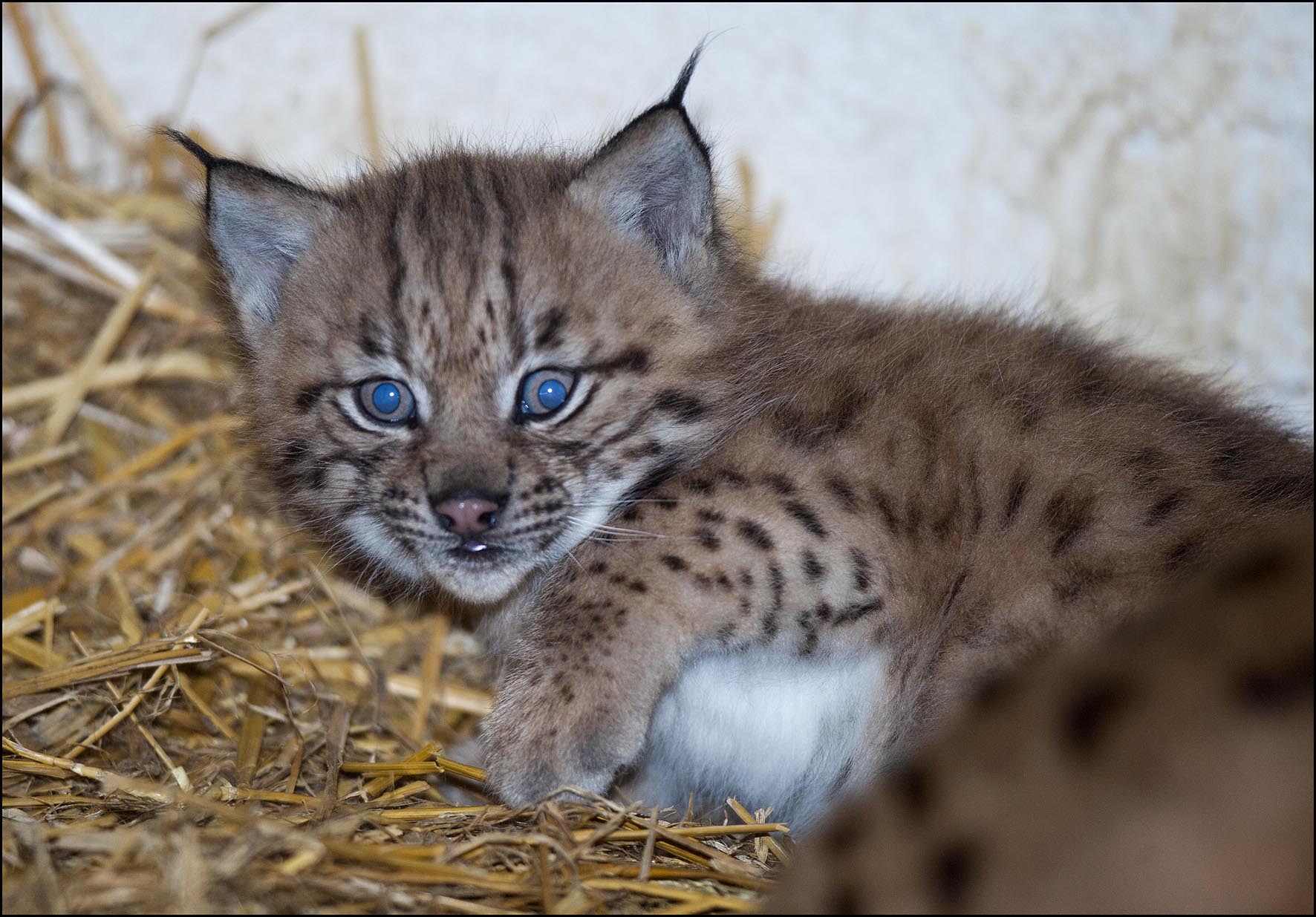
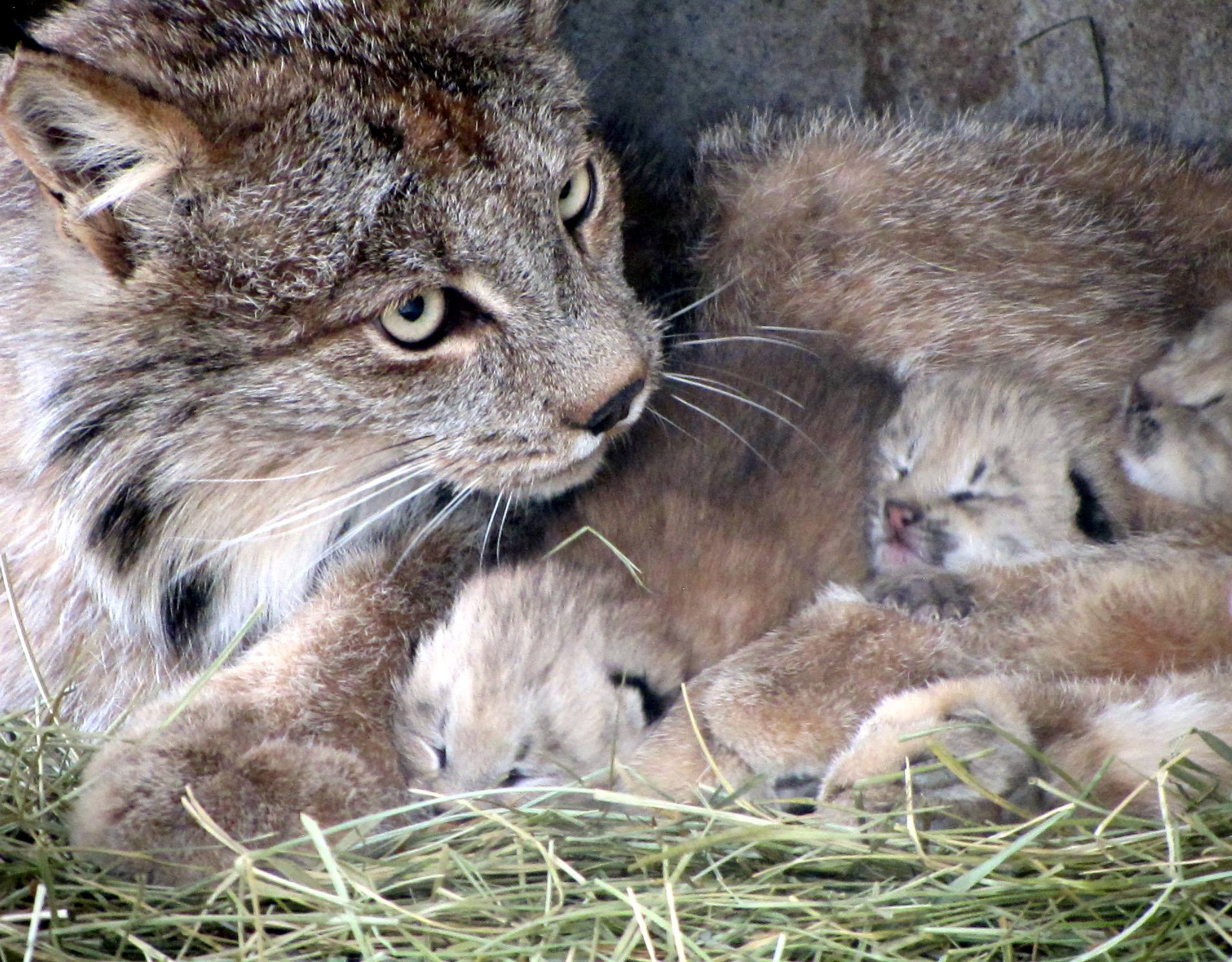
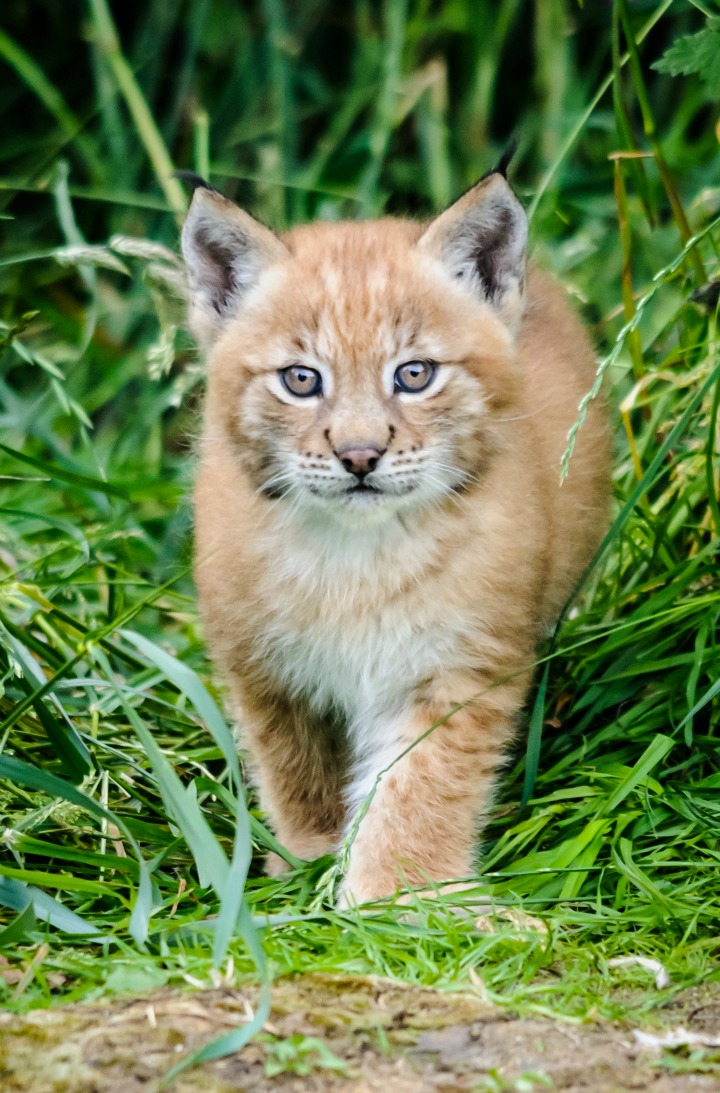
Meet Point Defiance Zoo's 9-week-old Canada Lynx kitten. Jasper is part of the Species Survival Plan® for Canada Lynx, which are listed as endangered in Washington state. He now weighs about 4 pounds and is being hand-reared by Point Defiance Zoo staff. Jasper will make periodic appearances around the zoo this summer as he grows into his role as an ambassador for his species.
There’s much excitement at the United Kingdom’s Dudley Zoo! Three Carpathian Lynx cubs – the first ever born at the zoo – arrived on May 23.
Photo Credit: Dudley Zoological Gardens
The triplets have been tucked in their den with mother Daisy since birth, but they started to explore the great outdoors this week.
Assistant Curator Richard Brown said of first-time mother Daisy, “We’re all absolutely delighted with the cubs’ progress. We've got a few more weeks to wait until we find out what sex they are, when we'll also be giving them their first vaccinations."
Dad is three-year-old Dave, who remains in the enclosure with Daisy and their offspring.
Carpathian Lynx are a subspecies of Eurasian Lynx found in the Carpathian mountains of Romania. Scientists believe that about 2,500 Lynx live in these forests, the densest population in all of Europe.
Lynx are secretive cats, and are most active early in the morning and late at night. They feed on hares, birds, and other small prey.
In some parts of Europe, these cats are locally extinct due to loss of habitat.
Cheyenne Mountain Zoo’s three curious, climbing Lynx kittens have been spotted exploring their public exhibit. Born on May 8, 2013, the two males and one female have been in an off-exhibit outdoor habitat until they were big enough to maneuver the larger public exhibit space. The zoo invites guests to view the growing kittens and their parents – mother, Magina (mah-jee’-nah), and father, Kajika (kah-jee’-kah).
The three Lynx kittens are the first Canada Lynx born at Cheyenne Mountain Zoo. Often mistaken for Bobcats, Lynx are classified by Colorado Parks and Wildlife as federally threatened and a Colorado state special concern. The zoo’s Lynx were paired together following a breeding recommendation from the Association of Zoos and Aquariums (AZA) Species Survival Plan. The birth of the three Lynx is truly exciting. Yet, the story of the parents living together is extremely rare and unique.
In the wild, Canada Lynx live as solitary cats. They don’t live in pairs, don’t hunt together, nor do they raise their young in family groups. In fact, other than breeding, males and females typically want nothing to do with each other and males want even less to do with their kittens. Cheyenne Mountain Zoo strives to mimic wild-living arrangements in a captive setting, but in the case of Cheyenne's Canada Lynx, they didn’t appear to want to live like their wild counterparts.
On June 4, the Espace Pour La Vie (Space for Life) Biodôme in Montréal welcomed
three Lynx kittens into the world. The kittens are developing normally
with their mother’s attentive care. She diligently nurtures her little ones,
nursing them, cleaning them and keeping them warm. Their first medical exam
found that they are one male and two females, all growing healthy and fast. Ten
weeks after the birth, the kittens and their mother transitioned to a new home:
a Laurentian maple forest exhibit viewable by the public. Their arrival in the
habitat signals a new phase in their development, during which they will hone
their reflexes with their mother’s help. Visitors can see the Lynx kittens
playing together, interacting with their mother and exploring their environment
freely. The father will be kept separately in the nighttime quarters, as the
female could perceive him as a threat to her offspring.
Both adult Lynx are seven years old, and this
is the third time the pair have reproduced at the Biodôme—a clear sign that they are healthy
and happy in their habitat. In the summer of 2012, the female gave to litter of
three, but only one kitten survived to adulthood. Caretakers at the Biodôme
decided to supplement that kitten’s diet with bottle-feeding while allowing it
to continue nursing from its mother. In January of 2013, the healthy adult
offspring moved to another institution to be paired with another lynx for
breeding. This year’s litter is growing even more quickly under the care of the
more-experienced mother; this time, caretakers did not need to intervene with
extra feedings. As the captive Lynx population’s growth rate is very low, the birth of new kittens increases its genetic diversity. This year's litter may eventually be moved to other institutions to form new breeding pairs.
With their pointy ears peeking out from the long grass, this trio of Lynx kittens played hide and seek as they recently made their public debut at ZSL Whipsnade Zoo. The eight-week-old triplets named Ruby, Amber, and Opal, spent their first few weeks snuggled up inside with their mother, Maja, before taking their first tiny, tentative steps outside this week. And now they are big enough to venture out on their own! The playful kittens are getting bolder by the day and are often spotted perched on tree trunks from which to pounce, play fighting in the grass, and snoozing on logs.
Zookeeper Cliff Tack said: “All three kittens are doing fantastically well. Mum kept them well hidden in their den to begin with, but they’re now growing in confidence and becoming a lot more adventurous, especially with the warm weather encouraging them to come out to play.”
Photo Credit: ZSL Whipsnade Zoo
Known as a crepuscular species, European Lynx are most active at dawn and dusk, and the kittens are already showing signs of this behavior – with keepers spotting the cheeky trio at their most playful at the beginning and end of the day. The all-girl trio, who are parents Maja and Timo’s third litter, are a welcome addition to the European StudBook Breeding Program for Lynx. They are already showing off their distinctive pointed ears, and are just beginning to develop spotted markings on their coats which will continue to appear as they get older.
Read some Fun facts and see more pictures, after the jump:
In late May, Kristiansand Zoo in Norway welcomed two Eurasian Lynx cubs. One of them, shown in the photographs on a July 4th checkup, is a little male weighing about three and a half pounds (1.54 kg). The other cub, whose sex isn't yet known, was hiding at the time and didn't want to come out for a checkup. These little additions bring the zoo's Lynx count up to six.
According to the International Union for Conservation of Nature, the Eurasian Lynx is considered a species of Least Concern on the Red List of Threatened Species. However, though this cat ranges widely throughout the Eurasian continent, some populations of the Eurasian Lynx are endangered or critically endangered, often due to illegal hunting. It is classified as an endangered species in Norway, where Kristiansand Zoo is located.
A litter of Canadian Lynx triplets born in May at the Czech
Republic’s Zoo Brno had a health
checkup last week. The three kittens –
one male and two female – were proclaimed healthy by the zoo staff.
Photo Credit: Zoo Brno
Zoo staff gave the trio their vaccinations and implanted an
identifying microchip in each youngster.
Catching the elusive kittens was a challenge, because they are so
active!
Canadian Lynx live in forested areas across all of Canada
and Alaska. Their large furry feet act
like snowshoes to help them travel through deep drifts. They feed primarily on Snowshoe Hares. Though they are legally trapped for their
fur, Canadian Lynx are listed as a species of Least Concern by the
International Union for Conservation of Nature. Canadian Lynx are listed as
Threatened by the U.S. Fish and Wildlife Service because they have been
extirpated in many parts of their original Rocky Mountain range.
See more photos of the triplets' exam below the fold.
Nashville Zoo is pleased to announce the birth of a Eurasian Lynx.
The female cub was born to the Zoo’s on-exhibit pair on Saturday, May 4.
“We suspected
that our Lynx might be pregnant due to a slight weight gain but never had
confirmation,” said Connie Philipp, mammal curator. “The cub arrived on its
estimated due date based on the data the keepers collected, and she’s now being
hand-raised by our animal care staff. She will eventually join an educational
outreach program at another zoo.”
Photo credits: Amiee Stubbs Photography
Nashville
Zoo is home to three Eurasian Lynx, a male and female on exhibit, and a male,
known as Blitz, that is a part of our “Wildlife on Wheels” program. The
Eurasian Lynx exhibit was generously sponsored by David and Kathryn Brown.
Eurasian Lynx are the largest of the lynx species and are
native to Central Asian, European and Siberian forests. While not listed as
endangered, Eurasian Lynx are rarely seen in some parts of its home range.
Last week, a 10-week
old Lynx cub made his debut at the Montréal
Biodôme. Visitors will now get to see the cub play hide and seek, learn to climb trees, and leap from
rock to rock … all under the watchful eye of his mother.
In May, the animal keepers at the Biodôme suspected that the
six-year-old female Lynx was pregnant, judging by her weight gain and her behavior. Since
she was looking for a dark, safe place to give birth, a wooden shelter was built over
her rest area. The Lynx cub was born during the night of May 26-27, in good health, while two
other cubs died within just a few days. The surviving cub has done very well since then.
He is still nursing, but has recently been developing a taste for small game. On July 26,
during his general check-up, he received his first vaccination without any complaints. He
weighs just over 5 pounds (2.3 kg).
Over the next few months, the young Lynx will be alone with his
mother in the Laurentian Maple Forest habitat. During this time the six-year-old father
will be kept in night quarters. Just as in the wild, the female raises her cub
alone, since males can be a threat to their offspring.
Lynx have a low success rate when it comes to breeding in
captivity. From 1999 to 2009, the average North American birth rate for Canada Lynx was 1.45
cubs per year. The Biodôme,a member of the Association of Zoos and Aquariums (AZA) and the
Canadian Association of Zoos and Aquariums (CAZA), is very proud of this important birth.
One proud set of parents at ZSL Whipsnade Zoo have three reasons to celebrate this summer: the birth of European Lynx kitten triplets. The all-female trio, born in June to parents Maja and Timo, have spent their first weeks of life tucked up in their den but have just now begun to explore outside. This is the second litter of Whipsnade’s rare European Lynx, one of Europe’s largest predators. They were born blind and helpless, weighing between 8.5 -15oz and will reach adult-size at around two-years-old.
Now that they are big enough to venture out on their own, the playful kittens can be spotted perched on logs and playing hide and seek with each other in the long grass while mom keeps a close watch. Senior keeper Carole Day said: “Mum’s doing a sterling job of looking after all three kittens. They are starting to become more adventurous and independent and are having lots of fun exploring their paddock.”
Known to be a crepuscular species, European Lynx are most active at dawn and dusk and the kittens are no exception. Keepers at ZSL Whipsnade Zoo see the cheeky three playing most often at the beginning and end of the day. Whipsnade’s kittens are already showing off their distinctive pointed ears and large padded paws but won’t develop their spotted markings for another few months yet.