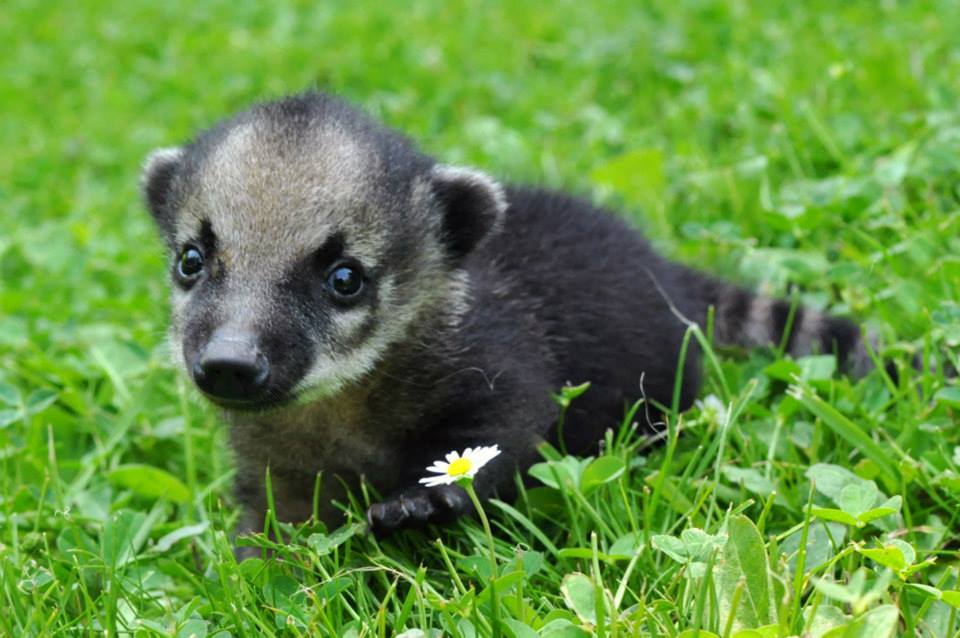
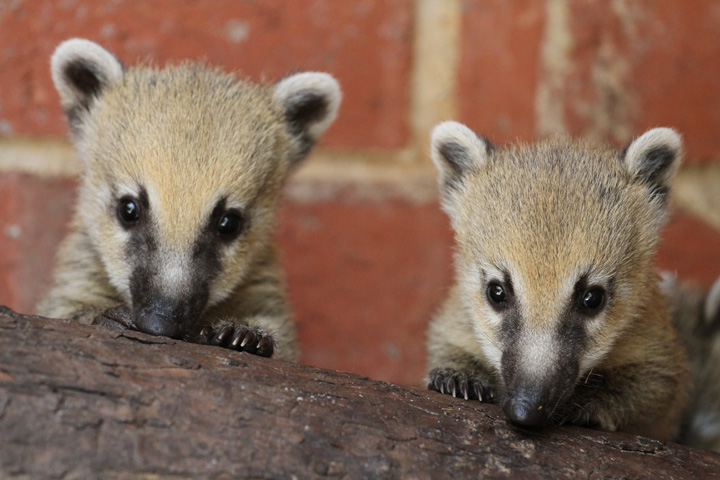
The Newest, Cutest Baby Animals from the World's Zoos & Aquariums

Category: Coati Mundi

  • ,

    Two coatis came to the Fort Worth Zoo (TX) at the beginning of July named Ringo and Camilo (born in May). They are not brothers but have been together for almost their entire lives. 

    They are part of the outreach program/ambassador animals which means they interact with guests in different parts of the Zoo. Because of this, they are trained to present certain behaviors to ease their daily care and transportation throughout the Zoo. They are trained to voluntarily get in their crates and walk on a leash with a harness. They are also trained to “come” and to follow a target.

    0O4A8913

    (more…)

  • , , ,

    For the third time in a row, Schönbrunn Zoo can look forward to two offspring of white-nosed coatis this year. In mid-May, the two cubs were born blind and deaf and were nursed and cared for by their mother in the nest for the first few weeks. “Meanwhile, the approximately six-week-old twins, a male and a female, have left their safe nest and are out and about throughout the indoor facility. The two currently spend most of the day sleeping snuggled up to their mother," reports animal keeper Michaela Hoffmann.

    Fb_nasenbär_07072022_tgs_zupanc_04

    (more…)

  • ,

    1010746_10151538433980896_1023347071_n

    An elderly South American Coati unexpectedly gave birth to two healthy pups at Zoo Budapest. In the wild, Coatis rarely live longer than seven to eight years, but they have been known to live up to 17 years in captivity. The mother of these two pups, Juliet, is 15 years old. The Zoo's press release notes that "it is almost a matter of biological peculiarity" that she has successfully given birth to two healthy pups at her advanced age. At four years old, the pups' sire has only been sexually mature for about half a year, making the parents quite the unlikely pair!

    Zoo staff were concerned that the elderly mother would not be able to raise both pups on her own, so one pup is staying with mom while the other is being hand-raised by human caregivers. As an adult, the hand-raised pup will be used for educational programs at the zoo. The pups are now about three weeks old.


    1016516_10151538433925896_252683372_n

    Coati

    1005859_10151538434030896_363840898_n
    Photo credits: Zoo Budapest

    See and learn more after the fold!


    (more…)

  • ,

    971561_567509413293876_996985939_n

    Five lively South American Coati babies are keeping their mother busy at the Taipei Zoo.  Born on March 23, the babies progressed in their development quickly, opening their eyes at five days and standing at 12 days. 

    Coati

    _____

    _______
    Photo Credit:  Taipei Zoo

    The babies now follow their mother everywhere in the exhibit, stopping to explore and investigate along the way.  They’ve recently learned to jump, and will use their mother’s back as a springboard to reach tree trunks. 

    Coatis are expert climbers and diggers.  They rummage for food in the leaf litter of the tropical forests of South America.  Fruits, insects, and lizards are preferred food items, but as omnivores, Coatis will eat a wide variety of foods. 

    Not enough is known about the wild population of Coatis to understand their conservation status.  Like many mammals, they face pressures from unregulated hunting and habitat loss.


    Related articles

    It's a Girl! Brevard Zoo Welcomes an Endangered Baird's Tapir
    Baby Sloth Clings to Mom at Zoo Vienna
    Baby Orangutan Thriving at Taipei Zoo at One Year Old
    Trio of Big-Eyed Baby Maras Born at Artis Zoo
  • , ,

    Coati1

    Two baby Coatis are charming visitors at the U.K.’s Exmoor
    Zoo
    . The pair was born earlier this month. 
    Native to Central and South America, Coatis use their long, flexible
    snout to search for insects, spiders, fruit, and small animals. 

    Coati2

    Coati3

    Coati4

    As close relatives of raccoons, Coatis exhibit agility,
    intelligence, and adaptability.  They can
    be found in a variety of habitats, from tropical rain forests to high mountain
    slopes. Coatis commonly forage on the forest floor, using their pig-like snout
    to push aside leaf litter as they look for food.  They are easily identified by their long,
    striped tail.  Coatis may travel in loose
    groups of up to 25 individuals.

    While not listed as threatened, Coatis face pressures from
    habitat destruction and unregulated hunting.

    Photo Credit:  Exmoor
    Zoo

  • ,

    Coati2

    A pair of coatis debuted at Germany’s Tiergarten Delitzsch this week, providing plenty of entertainment for zoo visitors.  After spending the first few months of life secluded in their barn, the baby coatis are just beginning to explore their enclosure.

    Zoo keepers have not yet determined the gender of the babies, which are the first to be born at the zoo since the mid-1990s.  This is the first litter for the zoo’s coati pair.

    Coatis are native to Central and South America, where they live in a wide range of habitats, from arid grasslands to cold mountainous areas.  Closely related to raccoons, coatis feed on invertebrates, fruit, lizards, and bird eggs.  The long, flexible snout, which can be rotated in any direction, provides impressive sniffing power as coatis forage for food among the leaf litter.

    Coati6

    Coati1

    Coati8

    Photo Credits:  Tiergarten Delitzsch

    (more…)

  • ,

    Coati Zoo Brno 4

    On Monday, Zoo Brno in the Czech Republic gave its 6 young Red Coati cubs a routine vet check. The cubs received vaccinations and tiny microchips to identify them. The litter of young Coatis includes 4 males and 2 females. These South American members of the Raccoon family, known also as Brazilian Aardvarks, are active both day and night and prefer to sleep in elevated treetop nests.

    Coati Zoo Brno 3

    Coati Zoo Brno 6

    Coati Zoo Brno 1
    Photo credit: Zoo Brno

    More images beneath the fold…

    (more…)

  • ,

    Coati-002

    A recently-arrived group of Coatis has settled into Melbourne Zoo so well that they have produced three litters, with a total of 22 kittens. The kittens have been secluded in nest boxes for the first weeks of their lives. Now they are starting to eat solid food, and it’s time for a large-scale session with the Zoo’s Veterinarians, who need to protect the kittens against three potential diseases with the F3 vaccination.

    There are four adult females and one male in the group, selected by the international breeding program to create a genetically diverse breeding group. Coatis belong to the larger Raccoon family, which includes 17 species, all native to the Americas.  This species is native to Arizona, Mexico, Central America, Colombia, and Ecuador.

    Coati-005

    Coati-001

    Coati-003

    Coati-004
    Photo credit: Meagan Thomas, Melbourne Zoo

    They are very skilled climbers, known for descending trees head first.  Their long tails are used as balancing rods to assist when they’re climbing. Coatis are omnivores, eating insects, fruits, other vegetation, and meat. In the wild, a new mother will typically keep her kittens isolated in her nest for 6 to 10 weeks before rejoining the band.

    (more…)

  • ,

    Marwell-Park-Coati2

    There's never a dull moment for these cuddling baby Coatis (AKA Brazilian Aardvarks!), photographed earlier this summer at Marwell Wildlife Park by Danielle Connor. A total of 5 baby Coati call Marwell home and as you can see, they spend much of their time wrestling and rough housing in their exhibit. Coatis are members of the Racoon family and although few scientific population studies have been made in recent years, their numbers appear to be in decline due to environmental destruction in their native Central and South America.

    Marwell-Park-Coati

    Marwell-Park-Coati3

    Marwell-Park-Coati6

    Marwell-Park-Coati4

    Marwell-Park-Coati5

  • ,

    Closely related to racoons, the Coati Mundi is a curious, clever, and affectionate critter. These photos were taken last week at Germany's Darmstadt Zoo. Coatis use special postures to communicate like hiding their long nose between the front paws as a sign of submission or lowering the head, baring their teeth and hopping about to signal aggresion. Coincidentally, that's also how I start a fight.


    3773622523_81ea93383f

    3774430232_994e865415

    3774430826_38b5283b9e

    3773622245_0ef1d44050

    3773623121_56b87308ae
    Photo credits: Joachim Mueller